
Coaches: 34–36 inch Chests Show When to Pick Youth vs Adult Sizes
Youth and adult sizing are two separate systems with different proportions. They overlap slightly around youth XL and adult small, where chest widths are similar but youth body length remains shorter. Pick youth sizes for shorter, stockier kids and switch to adult once height or torso length outgrows the youth block. For team orders, go by chest and height measurements, never age labels.
TL;DR:
- Youth XL and adult small share similar chest measurements but differ significantly in body length, with adult small being roughly 2 to 3 inches longer.
- Youth medium can be 4 to 6 inches narrower in chest and about 6 inches shorter in length than adult small, making them unsuitable as direct replacements once outgrown.
- Shirt fit depends more on body length and shoulder width than chest width alone, with youth cuts featuring straighter profiles and adult cuts offering tapering and longer sleeves.
- Always measure chest, height, shoulder width, and sleeve length to determine proper size rather than relying on age labels or perceived fit.
- For team orders, collect measurements from every player, prioritize length if needed, and always test a sample garment before committing to full production.
Table of Contents
- Youth vs Adult Sizes: How the Measurements Actually Compare
- What Changes Besides Chest Size?
- When Should You Choose Youth vs Adult Sizes?
- How to Measure and Convert Between Youth and Adult Sizes
- Ordering Tips for Mixed Youth and Adult Team Orders
- How Capra Sports Helps Teams Get Sizing Right
- A Coach’s Take on Youth vs Adult Sizing
- Get Sizing Right Before You Order a Full Team Kit
- Sources
- FAQ
Youth vs Adult Sizes: How the Measurements Actually Compare
Chest width is where most people start comparing sizes, but it is the least reliable number on its own. Two shirts can share an identical chest measurement and still fit completely differently once you factor in body length and shoulder width.
Youth sizing typically runs like this, based on standard youth size chart data:
- Youth XS: chest 22–24 inches, body length 18–19 inches
- Youth S: chest 26–28 inches, body length 19–20 inches
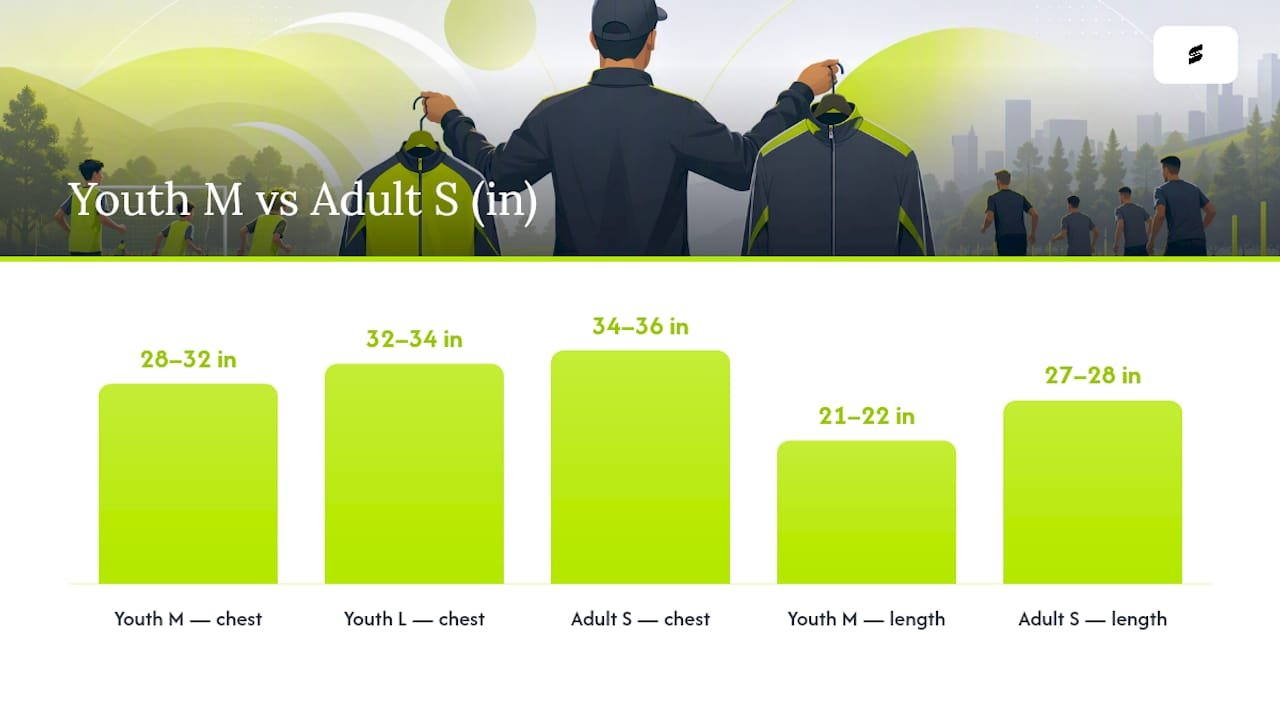
- Youth M: chest 28–32 inches, body length 21–22 inches
- Youth L: chest 32–34 inches, body length 23–24 inches
- Youth XL: chest 34–36 inches, body length 25 inches
Adult sizing picks up around where youth L ends, but the length jumps faster than the chest does:
- Adult XS: chest 32–34 inches, body length 26–27 inches
- Adult S: chest 34–36 inches, body length 27–28 inches
- Adult M: chest 38–40 inches, body length 28–29 inches
- Adult L: chest 42–44 inches, body length 29–30 inches
Look closely at youth XL and adult small. Both list a 34 to 36 inch chest, but adult small runs 2 to 3 inches longer in the body, according to a youth vs adult sizing comparison. That gap is the entire story of youth vs adult sizing in one line: same width, different length.
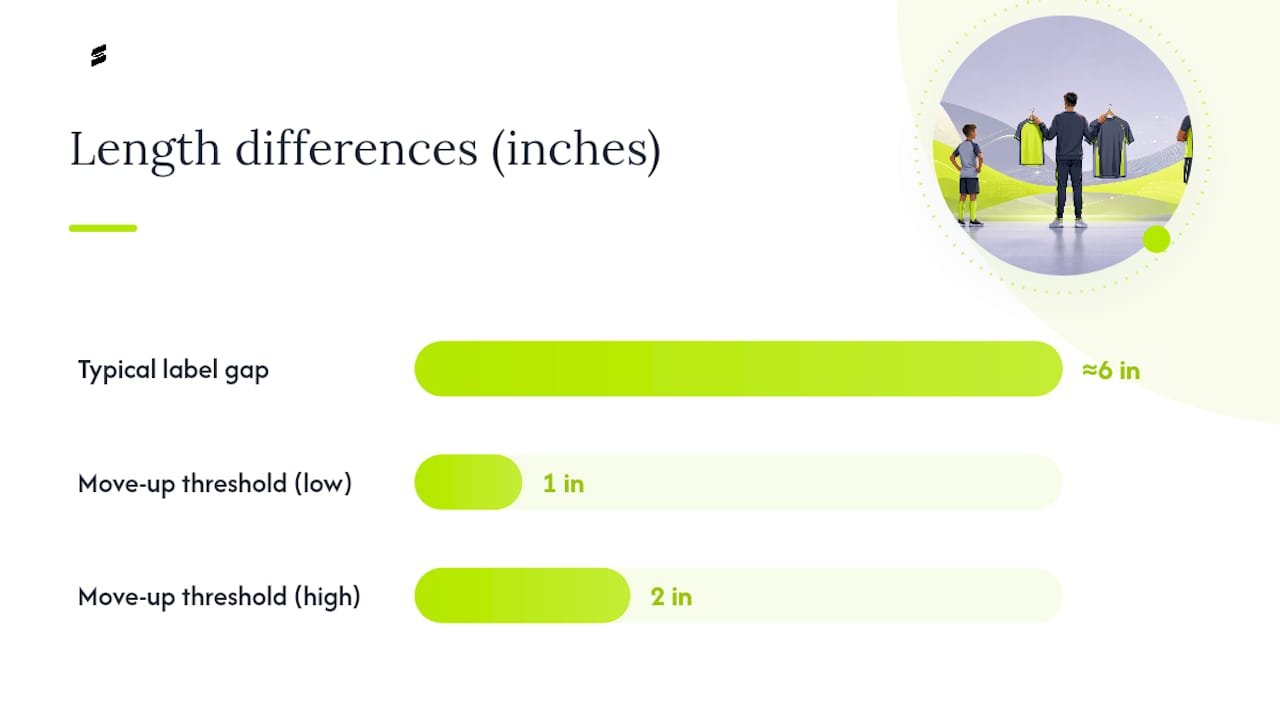
Youth medium sits even further from adult small. A youth medium vs adult small breakdown across Gildan, Bella+Canvas, and Hanes shows youth medium running 4 to 6 inches narrower in chest and about 6 inches shorter in length than adult small. That is not a close call. It means a kid who has outgrown youth medium is nowhere near ready for adult small either; there is usually a youth large step in between.
Every number above shifts depending on the brand and the cut. Unisex blocks, women’s cuts, and athletic tapers all grade differently even at the same labeled size, which is why the actual garment measurements matter more than the size label printed on the tag.
What Changes Besides Chest Size?
Chest width gets all the attention, but it is not what makes a shirt feel right or wrong on a body. Youth blocks are cut straighter, almost like a cylinder, with a shorter torso and narrower shoulders. Adult blocks add a slight taper at the waist, wider shoulder seams, longer sleeves, and a deeper neckline drop.
That difference shows up fast once a shirt is actually worn:
- A youth XL on a tall, lean teenager rides up at the waist even if the chest fits fine.
- An adult small on a shorter or younger athlete hangs loose through the shoulders and sleeves.
- Sleeve length differences change how a compression sleeve or undershirt layers underneath.
- Print placement shifts because a shorter youth body leaves less vertical space for a full front logo.
Pro Tip: If a shirt fits at the chest but bunches or rides up at the hips, that is almost always a youth-length problem, not a sizing mistake. Move up to adult small before you move up an entire youth size.
When Should You Choose Youth vs Adult Sizes?
Skip the age chart on the bag and go straight to the tape measure. Here is the order to work through:
- Measure chest first. Anything under 34 inches almost always stays in youth sizing regardless of age.
- Check height next. Most kids cross into adult sizing somewhere between age 14 and 16, according to size transition guidance, but a tall 12-year-old can outgrow youth length years earlier.
- Factor in use case. A player who needs freedom of movement and a snug, non-riding fit for contact sports often does better in adult small once chest hits the 34 to 36 inch range, even if youth XL “technically” fits.
- Default to length when in doubt. If chest measurements tie between youth XL and adult small, let torso length break the tie.
Casual wear tolerates a looser fit than game-day uniforms do, so a kid heading to practice can usually stretch a size longer in youth than a kid who needs a jersey that will not shift mid-play.
How to Measure and Convert Between Youth and Adult Sizes
A tape measure and five minutes solve most sizing disputes before they start. Here is the process:
- Chest: Wrap the tape around the fullest part of the chest, under the arms, keeping it level front to back.
- Height: Measure standing, without shoes, from the floor to the top of the head.
- Shoulder width: Measure across the back from one shoulder seam edge to the other on a well-fitting shirt.
- Sleeve length: Measure from the shoulder seam to the end of the sleeve.
- Body length: Measure from the highest point of the shoulder straight down to the hem.
Compare those body numbers to a garment laid flat, measured pit to pit and doubled for chest, then top to hem for length. That pit-to-pit reading is more reliable than the size printed on the label, since a youth medium to adult small comparison shows nearly a 6 inch length gap between labels that sound only one step apart.
The conversion rule that solves most cases: if chest matches across youth XL and adult small but the body length measurement is short by more than an inch or two, move up to adult small. If the chest does not match, stay in youth.
Ordering Tips for Mixed Youth and Adult Team Orders
Team orders break down fastest when everyone assumes their normal retail size applies. Collect individual chest and height measurements from every player before you order anything, and request a physical sample or size set to check fit against real bodies rather than a chart on a screen.
- Decide upfront whether you are prioritizing chest fit or length consistency across the roster; you often cannot get both once players span youth XL and adult small.
- If more than a couple of players sit right on that youth XL to adult small line, order samples in both blocks rather than guessing.
- Ask for mockups on both the youth and adult block before production. Logo scale and placement that look right on an adult torso can crowd or overflow a shorter youth body.
- Standardize which block handles the print file master, then scale down or up from there instead of designing twice.
Coaches and equipment managers who skip the sample step tend to be the ones reordering three weeks before opening day.
How Capra Sports Helps Teams Get Sizing Right
Capra Sports maintains detailed team uniform sizing guides built specifically for coaches sorting through youth and adult rosters in one order. Each order includes one sizing sample to check a real garment against players before committing to full production. Collaboration with a designer helps ensure logo placement is checked on both youth and adult blocks, rather than guessed from a flat template.
A Coach’s Take on Youth vs Adult Sizing
Age on a birth certificate tells you almost nothing useful about how a shirt will fit. Chest and height measurements tell you everything. Run the tape, compare it to the actual garment measurements, and when a kid sits right on the youth XL to adult small line, favor adult small if length matters and youth XL if a shorter, snugger cut matters more. Order the sample before you order the season.
— Agha
Get Sizing Right Before You Order a Full Team Kit
Guessing on 20 rosters at once is how teams end up with a box of shirts nobody wants to wear. Orders are built around a 10 set team minimum with one sizing sample included to confirm fit on an actual garment before committing to the full run. Designer collaboration includes mockup revisions on both youth and adult blocks, with mockups delivered in 24 hours, so logo placement fits appropriately across sizes.
Check the Capra Sports size guide to compare your roster’s measurements against real garment blocks, or head to the pricing page to see current per-piece costs across basketball, baseball, soccer, football, and volleyball uniforms. If you’re building out a full roster, the basketball team package page shows how a mixed youth and adult order comes together from sample to final print. Request your sizing sample today and get the fit locked in before the season schedule does.
Sources
This guide draws on the youth size chart, the youth vs adult t-shirt sizing comparison, and a group-order conversion guide from Shay’s Print Shop.
FAQ
What Size Is a Youth XL in Adult Sizing?
Youth XL usually matches adult small in chest width, both landing around 34 to 36 inches. Body length is the exception: adult small runs 2 to 3 inches longer than youth XL, so a taller wearer will feel the shirt ride short in youth XL even when the chest fits fine.
Is Youth 14 to 16 the Same as Adult Small?
Youth sizes labeled 14 to 16 generally correspond to youth XL, which lines up with adult small in chest measurement but not in body length. Most kids in that age range are also right at the typical transition point between youth and adult sizing, so checking actual chest and height numbers matters more than the age label on the tag.
Can a Youth XL Fit an Adult?
A youth XL can fit a smaller adult through the chest, but the shorter body length, narrower shoulders, and shorter sleeves usually make it feel tight and cropped compared to an adult small. It works better as a snug, athletic-fit alternative than as a standard adult shirt.
Is Youth XL a Size 14?
Youth XL commonly corresponds to the 14 to 16 age and size range depending on the brand, though exact labeling varies across manufacturers. Checking the chest and length measurements on a youth size chart against the actual wearer is more reliable than matching the number alone.