
Woven Patch vs Embroidery: Which One Fits Your Design?
Pick woven for fine detail, small text, and gradients on lightweight or stretchy fabric; see exact sizes and specs for logo placement on shirts to ensure the patch fits perfectly. Pick embroidered for bold, simple logos that need a raised, textured look on structured blanks like caps and jackets. The exception: if your art has both fine text and heavy color blocks, run a sample of each before committing to a bulk order.
TL;DR:
- Woven patches are ideal for fine detail, small text, and smooth color gradients, making them suitable for soft, lightweight fabrics like beanies and performance gear.
- Embroidered patches produce a raised, textured look suited for bold logos, uniforms, and structured items such as caps and jackets, but are less effective for intricate detail.
- Woven patches generally run more cost-effective for detailed designs, while embroidery costs increase with stitch density and coverage.
- For thin, stretchy, or knit fabrics, woven patches are less likely to pucker or distort compared to embroidered patches.
- Testing a small batch before bulk orders and confirming design detail and fabric support ensures the patch type aligns with intended use and durability needs.
Table of Contents
- Woven Patch vs Embroidery: What’s Actually Different?
- Embroidered Patches: Construction, Look, and Ideal Uses
- Woven vs Embroidered: A Side-by-Side Comparison
- How to Choose Between Woven and Embroidered
- Caring for Woven and Embroidered Patches Over Time
- Environmental Impact of Woven vs Embroidered Patches
- Customization and Design Revision Flexibility
- Where Each Patch Type Dominates by Industry
- Capra Sports’ Take: Matching Patches to the Product
- A Different Route: Let Capra Sports Handle the Whole Uniform
- Sources
- FAQ
Woven Patch vs Embroidery: What’s Actually Different?
The core difference between woven and embroidered patches comes down to how the design gets built. Woven patches are made on a loom using ultra-fine threads that weave directly into the fabric, creating a flat, high-resolution surface. Embroidered patches are stitched with thicker thread onto a twill backing, which stacks the design on top of the base fabric and creates a raised, tactile finish you can feel with your fingers.
That construction difference decides almost everything else about patch quality and what each type can reproduce. Because woven threads are so fine, woven patches can reproduce small text down to roughly a few millimeters, some suppliers even claim readable text as small as 4pt. Embroidery simply can’t hit that resolution. Thread width and stitch density put a floor on how small your lettering or line work can go before it turns into a blurry blob.
Woven patches also handle color gradients the way a woven clothing label does, blending shades smoothly instead of stepping between solid thread colors. That makes woven the better call for heritage logos or vintage branding where color fidelity matters.
Where woven earns its keep:
- Small text, fine line art, or multicolor gradients
- Soft-knit beanies, backpacks, and performance fabrics that shouldn’t feel stiff
- Iron-on applications, since the thin profile lets heat reach the adhesive faster
- Sew-on or Velcro backing when you want a low-profile finish that lies flat under a jacket collar
Embroidered Patches: Construction, Look, and Ideal Uses
Embroidery builds the design in stitches on top of a twill or felt base, and that extra layer of thread is exactly why embroidered patches feel substantial in your hand. The raised surface reads well from a distance, which is why it remains the default for varsity jackets, military patches, and team uniforms that need to look official on a shelf or under stadium lights.
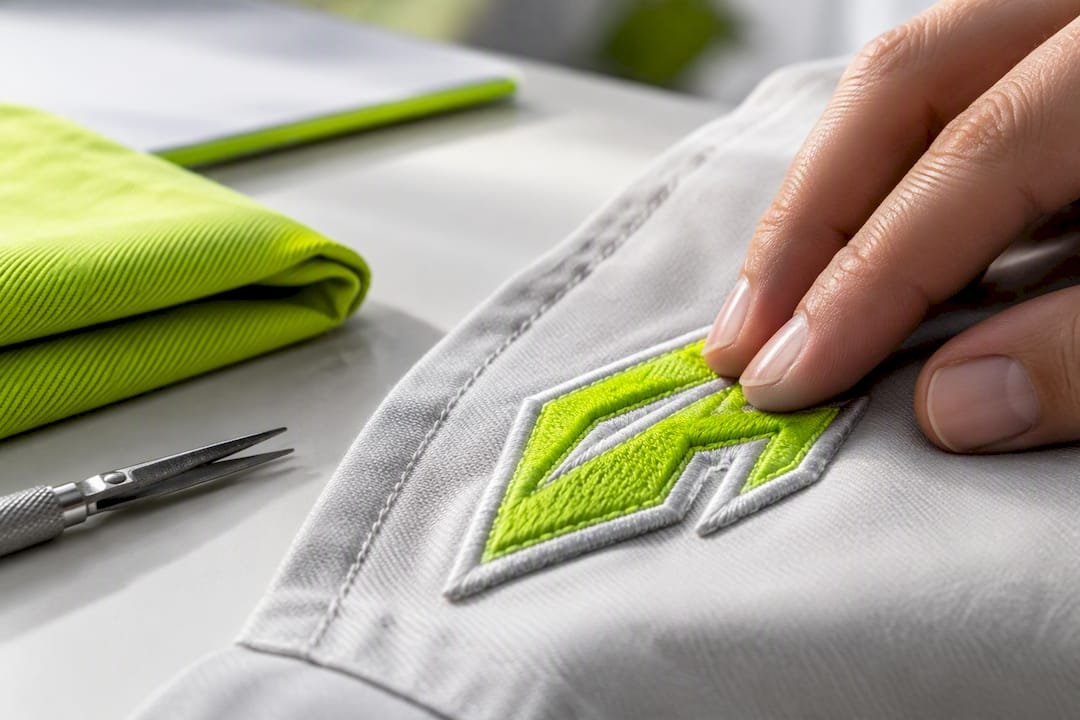
Design limits work differently here. Thread thickness and stitch coverage set the floor on detail, so tiny text or thin outlines tend to fill in or disappear. Bold block letters, simple mascots, and high-contrast logos hold up far better than intricate line art. Embroidery works best for bold, simple designs rather than anything with fine gradients.
Where embroidery earns its keep:
- Bold logos, mascots, and block lettering that need to pop at a distance
- Structured caps, jackets, and canvas totes that can support the added thickness
- Uniform crests and heritage patches where a raised, traditional look matters
- Merrowed edges for a classic finished border, or heat-seal edges for a cleaner, modern look
One trade off worth knowing before you order: on thin knit fabric, all that stitched thread can pull and pucker the base material if it isn’t properly stabilized first.
Woven vs Embroidered: A Side-by-Side Comparison
Here’s how the two stack up across the factors that actually change your buying decision.
| Factor | Woven Patch | Embroidered Patch |
|---|---|---|
| Construction | Woven on a loom, design integrated into the fabric | Stitched with thread on a twill or felt backing |
| Detail / text capability | Reproduces text down to about 2 to 4mm and smooth gradients | Best for bold logos and block type; fine detail fills in |
| Thickness / profile | Flat, low profile | Raised, tactile, more dimensional |
| Best fabrics / blanks | Beanies, backpacks, performance and stretch fabrics | Structured caps, jackets, canvas totes, uniforms |
| Durability / wash behavior | Lies flatter, less prone to puckering on lightweight fabric | Durable but can pucker thin fabric without stabilizing |
| Typical cost shape | Often more cost-effective for highly detailed art | Cost climbs with denser stitch coverage |
| Backing / edge options | Iron-on, sew-on, Velcro; clean laser-cut edge | Merrowed, heat-seal, or hot-cut edges; sew-on or Velcro |
A few practical notes behind those rows. Woven patches sit flatter and resist puckering on thin, stretchy fabric, which is exactly why they show up on athletic wear and knit hats more often than embroidery does. Embroidered patches, by contrast, can distort a lightweight shirt or drapey tote unless the fabric is backed with stabilizer during production.
On cost, the pattern flips depending on the art. Woven tends to be more cost-effective for detailed designs since the loom process handles fine work without adding thread volume, while embroidery gets pricier as stitch density and coverage climb.
Quick recommendations for common blanks:
- Beanies and soft-knit hats: woven, for a low-profile finish that doesn’t stiffen the fabric
- Structured caps and jackets: embroidered, for a raised look that reads at a distance
- Backpacks and totes: woven for detailed logos, embroidered for bold single-color marks
- Team uniforms: embroidered for crests and numbers, woven for sponsor logos with fine text
How to Choose Between Woven and Embroidered
Three quick rules cut through most of the guesswork. First, if your logo has text smaller than a dime or thin connecting lines, go woven. Second, if your blank is thin, stretchy, or knit, go woven to avoid puckering. Third, if you want a raised, traditional look on a structured item like a cap or jacket, embroidery wins every time.
Before you send art to production, run it through this checklist:
- Shrink your logo to actual patch size on screen. If the detail collapses or the text blurs, switch to woven instead of forcing embroidery to carry detail it can’t hold.
- Confirm the blank fabric can support the patch weight. Structured cotton twill or canvas handles embroidery fine; jersey knit and performance fabric usually can’t.
- Check that your backing choice matches how the item gets used. Iron-on works for retail merch, sew-on and Velcro hold up better for uniforms that see heavy washing.
Before placing a bulk order, ask your supplier a few direct questions: What’s their sample or proofing policy? What’s the actual lead time from art approval to delivery? Do they digitize embroidery artwork in-house, and can they show a proof before running the full batch? Skipping the digitizing step or the sample stage is the single most common cause of thread nests, lost detail, and distorted edges on a finished run.
Pro Tip: Order a small test run, even just five to ten units, before committing to your full quantity. A sample costs far less than reprinting hundreds of patches because the stitch density warped your logo or the weave dropped your smallest text.
Caring for Woven and Embroidered Patches Over Time
Woven patches, being flat and thin, tend to hold up well through repeated washing since there’s less raised thread to catch, fray, or snag on other fabric. Embroidered patches can develop loose stitches or frayed edges over time, especially with rough machine washing or high heat drying.
A few care habits extend the life of either type:
- Wash on a cold or gentle cycle, and turn the garment inside out to protect the patch surface
- Air dry when possible; high heat can loosen adhesive backing on iron-on patches
- Re-press a lifting corner with a hot iron and a cloth barrier before it fully detaches
- Replace a patch once the edge stitching frays past the border, rather than letting it unravel further
Environmental Impact of Woven vs Embroidered Patches
Patch production leaves a smaller footprint than most people assume, but the two methods differ in resource use. Woven patches use less raw thread overall because the loom integrates color directly into the weave rather than layering stitches on top of a backing fabric. That generally means less material waste per patch and less energy spent running dense stitch patterns through an embroidery machine.
Embroidered patches use more thread volume, particularly for designs with heavy fill stitching, and require a backing material (usually twill or felt) in addition to the thread itself. That backing layer adds a second material stream to account for at end of life, since twill and thread don’t always break down or recycle the same way.
Neither type is inherently disposable trash, and both can last years on a well-cared-for garment, which matters more for sustainability than the manufacturing method alone. A patch that survives five seasons on a team jacket has a smaller footprint than five cheaper patches replaced annually. If sustainability is a priority for your brand, ask your supplier about thread sourcing and whether backing materials use recycled content. Durability, though, remains the biggest lever: choosing the right patch type for your fabric in the first place, so it doesn’t peel, fray, or need replacing, does more for your environmental footprint than any single material choice.
Customization and Design Revision Flexibility
Woven and embroidered patches don’t offer the same flexibility once you move past the concept stage. Woven patches require the design to be set up for loom weaving, which handles color gradients and fine detail well but makes small revisions, like nudging a color boundary or resizing a single letter, a bigger production step since it reworks the weave file.
Embroidered patches get digitized into a stitch file before production, and that file is generally easier to tweak incrementally. A digitizer can often adjust stitch density, resize a logo slightly, or swap a thread color without rebuilding the entire design from scratch. That makes embroidery a bit more forgiving during the proofing stage if you’re iterating on a logo with a small team or client.
Both methods benefit enormously from catching problems before the full run. Whichever type you choose, ask for a digital proof and, ideally, a physical sample before locking in quantities above a few dozen units. Revisions after a bulk run are expensive regardless of patch type, but they’re especially costly with woven patches since the loom setup is more rigid once it’s programmed.
Where Each Patch Type Dominates by Industry
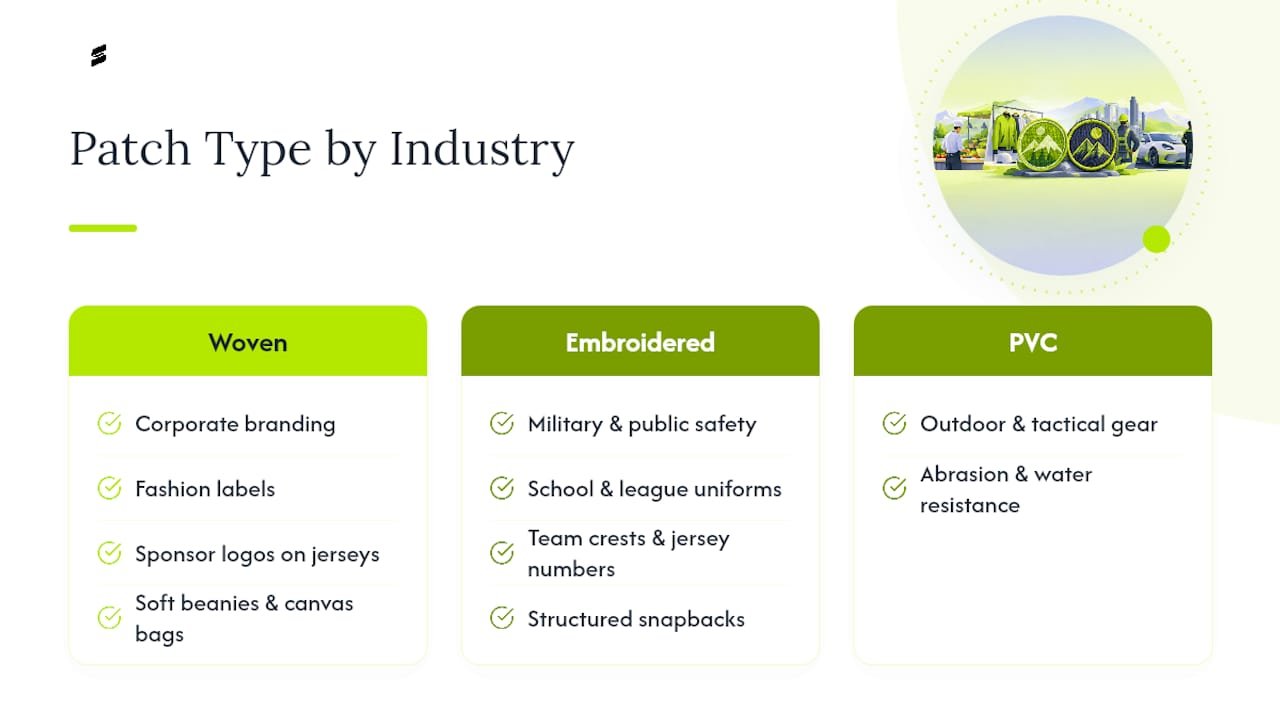
Certain industries lean hard toward one patch type, and the pattern isn’t random. Corporate branding and fashion labels tend to favor woven because precision and color fidelity carry more weight than raised texture when the goal is a clean, retail-ready look on a jacket tag or hangtag.
Military, public safety, and many school or league uniforms lean embroidered, largely out of tradition and durability expectations. A raised chest crest or shoulder patch has been the standard look for decades in those spaces, and the tactile finish signals rank, team, or unit in a way people recognize instantly. Outdoor and tactical gear often reaches for PVC patches instead of either fabric option, since rubber-based patches handle abrasion and water exposure differently, though that’s a separate category from the woven versus embroidered comparison.
Youth and recreational sports sit somewhere in between. Team crests and jersey numbers usually go embroidered for durability through a full season of washing, while sponsor logos or small text elements on the same jersey often go woven to keep fine print legible. Merch brands selling hats and totes split the difference by product: structured snapbacks get embroidery, soft beanies and canvas bags get woven.
Capra Sports’ Take: Matching Patches to the Product
Patch choice affects more than looks. It changes how a garment photographs, how it feels in someone’s hands, and whether it survives a season of washing. Woven works best on soft-knit beanies and lightweight blanks; embroidered earns its place on structured caps and uniform jackets where a raised crest reads well in team photos. Get this pairing wrong and returns tend to follow, since a stiff patch on a soft hat looks and feels off in person even when the product photography looked fine online.
— Agha
A Different Route: Let Capra Sports Handle the Whole Uniform
If sourcing patches separately feels like one more decision on top of fabric, cut, and sizing, there’s a simpler path. Capra Sports designs and produces sublimated team uniforms directly, which means patch placement, backing choice, and fabric pairing get handled as part of one build instead of three separate vendor conversations.
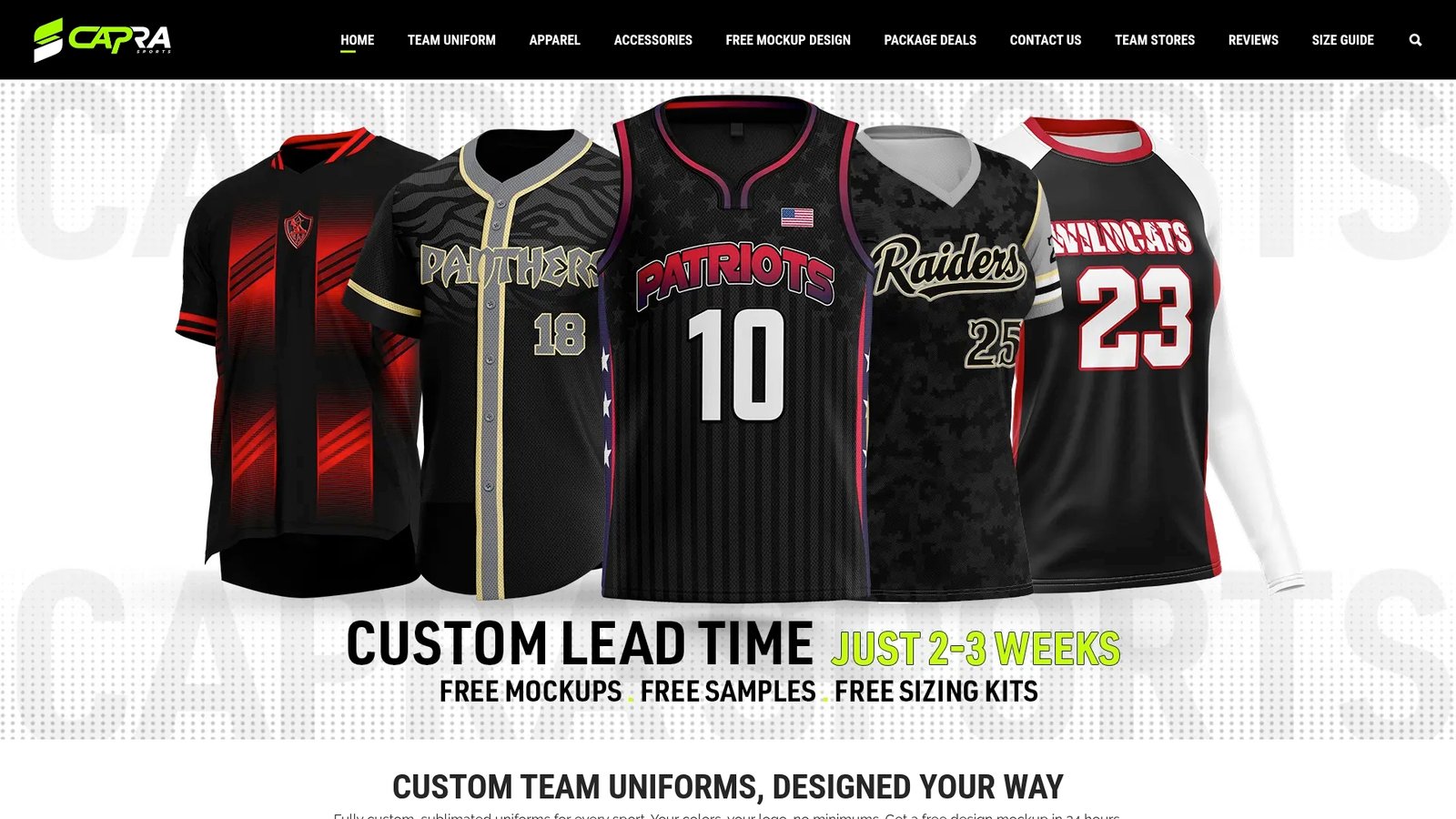
Sublimation itself sidesteps a lot of the woven versus embroidered debate for team logos and numbers, since the design gets dyed directly into the fabric rather than added as a separate patch. For teams that still want a traditional patch feel, such as a crest on a warmup jacket, Capra Sports’ designers can advise on whether a raised or flat application fits the blank you’re ordering, based on the same construction principles covered above. You can see how that process runs from concept to finished product in this walkthrough on how custom uniforms are made from free mockup to delivery.
Every order starts with a free design mockup and one sizing sample at no extra charge, so you can check fit and finish before committing to a full team order (a 10-set minimum applies). Basketball uniforms run $35.99 to $39.99 per piece, with baseball, soccer, football, and volleyball priced separately on the same page. If your team needs uniforms and patches working together rather than sourced piecemeal, start with a custom basketball uniform mockup and see the design before you commit to anything.
Sources
- Embroidered vs Woven Patches: Guide to Choosing the Right One – Apex Patches
- Embroidered vs Woven Patches – Printify knowledge hub
- PVC Vs Embroidered Vs Woven Patches Compared | Owl Badges
- Custom Patches Guide 2026: Types, Costs & Selection Tips
FAQ
What’s the Difference Between Woven and Embroidered Patches?
Woven patches are made on a loom with fine thread woven directly into the fabric, giving a flat finish that handles small text and gradients well. Embroidered patches stitch thicker thread onto a twill backing, creating a raised, textured surface better suited to bold logos.
What Is the Difference Between Embroidery and Patches?
Embroidery is a stitching technique used to decorate fabric directly or to build a patch on a separate backing. A patch is the finished, separate piece of material, made either by embroidery or by weaving, that gets attached to a garment afterward.
What Are the Three Common Types of Patches?
The three types most buyers compare are woven, embroidered, and PVC (a molded rubber-style patch). Woven suits fine detail, embroidered suits bold raised designs, and PVC is typically recommended for tactical or outdoor gear that needs water and abrasion resistance.
What Does “Woven Patch” Mean?
A woven patch is a patch made by weaving colored thread directly into the fabric on a loom, rather than stitching a design on top of a backing. That process gives it a flat surface capable of reproducing small text and smooth color gradients.
Does Capra Sports Offer Patches Separately?
Capra Sports focuses on complete sublimated team uniforms rather than standalone patches, working with sport-specific pricing listed on its pricing page. For teams that want patch-style detail integrated into a uniform, the design team can advise on placement and finish during the free mockup process.