
Set-In vs Raglan Sleeves for Team Uniforms: How to Choose
Choose set-in sleeves when you want a crisp, defined shoulder line and a classic uniform look. Choose raglan sleeves when players need to reach overhead and you want a softer shoulder that forgives different body shapes. Both work for team uniforms. The right one depends on your sport, your players’ builds and the look you want on the field or court.
This guide explains how each sleeve is built, how each one behaves in motion, what to check on your sample and how to tell your designer what you want.
TL;DR
- A set-in sleeve is a separate piece sewn into an armhole, so the seam sits at or near the natural shoulder. A raglan sleeve runs on a diagonal seam from underarm to neckline.
- Raglan generally gives easier overhead movement and fits a wider range of shoulder widths. Set-in gives a sharper, more structured shoulder.
- Think about the motion in your sport first: spiking, pitching, throwing and shooting all load the shoulder.
- Judge your sample with your arms raised and hanging. Look for smooth shoulders with no puckers, and a seam that sits where it should.
- Capra Sports offers a free design mockup within 24 hours, and one sizing sample at no extra charge, so you can check the sleeve before you commit a full order.
Table of Contents
- What each sleeve construction actually is
- Fit and movement: what the evidence says
- How they look on a team uniform
- Matching the sleeve to the sport
- A quick decision table
- What to check on your sample
- Sleeve choice and sizing together
- How to tell your designer what you want
- Ready to see your uniform both ways?
- FAQ
- Sources
What each sleeve construction actually is
The difference is where the seams go.
A set-in sleeve is cut as its own piece and stitched into an armhole on the body of the garment. It is shaped to curve over the top of the shoulder. New Mexico State University’s sewing guide on sleeves describes it as a sleeve fitted into a defined armhole and shaped over the shoulder. The University of Kentucky’s publication on sleeve types calls it the most popular sleeve type and notes that its sleeve cap has to be eased into the armhole.
A raglan sleeve has no conventional armhole curve. The seam runs from the underarm up to the neckline, so the sleeve becomes part of the neckline and shoulder. According to the same NMSU guide, a raglan sleeve can be one piece or two, and the shoulder shaping comes from a dart or a seam. On a finished jersey you see a diagonal line from the collar down to the armpit.
A quick way to tell them apart on a jersey you already own:
- Look at the top of the shoulder. A seam running across it, roughly where your shoulder ends, means set-in.
- Look at the collar. A seam running diagonally from the neck to the underarm means raglan.
- Look at the sleeve color. If a design has contrasting sleeves that start at the collar, it is almost certainly raglan.
The seam layout is more than a style choice. It changes how the fabric moves when your arm moves, how much room the shoulder has and how the printed design flows across the chest and sleeve.
Fit and movement: what the evidence says
Most coaches ask the same thing: which one lets players move more freely? The research gives a nuanced answer.
Why raglan feels freer overhead
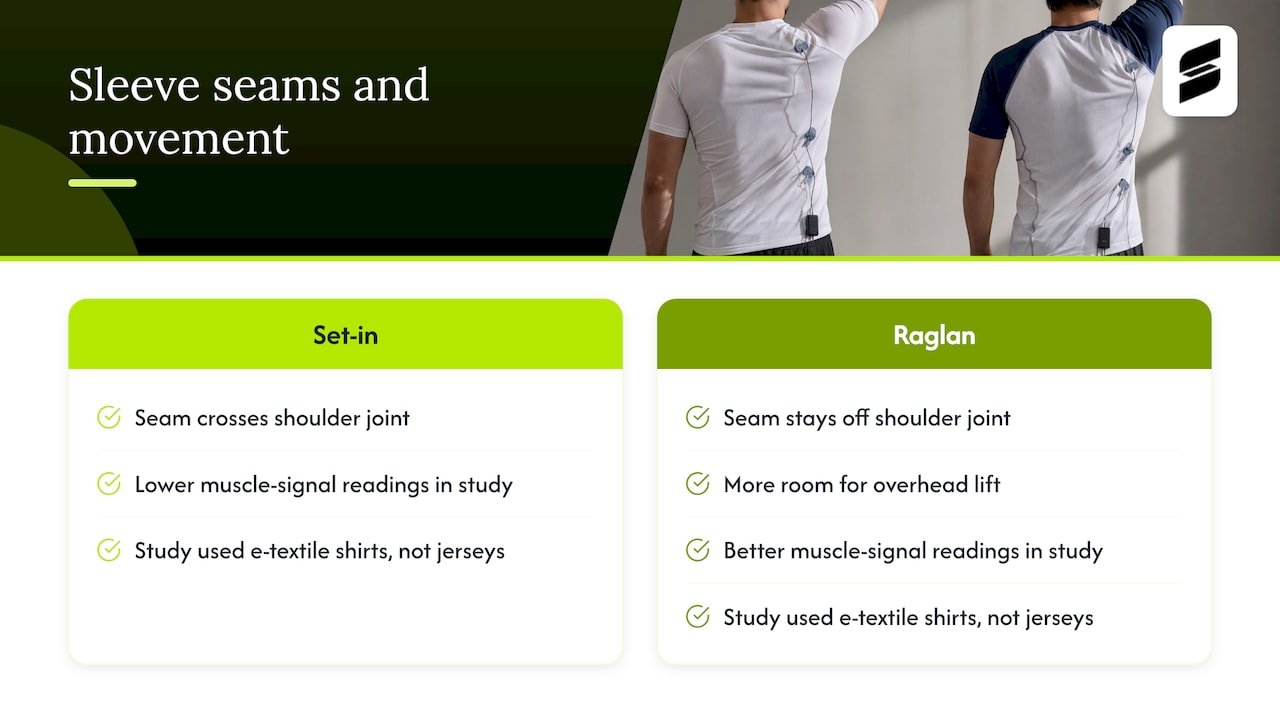
On a raglan, no conventional seam crosses the top of the shoulder joint, and the diagonal seam gives the arm more room to lift. A peer-reviewed 2021 study in the journal Sensors, comparing sleeve pattern and fit in e-textile shirts, found that the raglan shirt produced better muscle-signal readings than the set-in shirt. The authors attributed this partly to the absence of a seam directly on the shoulder joint.
That study tested instrumented shirts, not team jerseys, so treat it as a pointer rather than a promise. It is still a useful signal. For sports with repeated overhead reach, a seam that stays off the joint is worth taking seriously.
NMSU’s guide also describes raglan sleeves as comfortable to wear, which matches what many players tell coaches.
Why set-in can still be the right call
Set-in sleeves are the standard for a reason. Because the sleeve is a separate piece, the pattern maker can shape it precisely to the arm and shoulder. The University of Kentucky notes that a classic set-in sleeve carries about 1½ to 2 inches of sleeve-cap ease, the extra fabric that allows the arm and shoulder to move comfortably. When that ease is right, a set-in jersey moves well and looks tidy.
The same Sensors study adds a useful detail about fit. The set-in shirt performed well when it was snug but declined substantially when it was loose. The raglan shirt was less affected by whether it was snug or loose, and it performed best in the custom-fit condition. For a team, that suggests a practical rule:
- If you are ordering precise sizes and checking them on a sample, set-in will serve you well.
- If your roster has a wide mix of builds, or players between sizes, raglan gives you more margin.
What a shoulder position does to a sleeve
A Virginia Tech research record on shoulder position and sleeve/bodice structures reports a study that compared set-in and raglan constructions under different shoulder positions. It measured how much the garment slipped at the wrist, waist and center back. The takeaway for coaches is simple: how a sleeve behaves depends on how the athlete holds and moves the shoulder, not only on how the jersey hangs on a hanger. That is why a sample worn in sport positions tells you more than a size chart.
How they look on a team uniform
Fit is only half the decision. Your uniform is also your identity, so the look matters.
Set-in sleeves create a defined shoulder line. The seam sits at or near the natural shoulder, which gives a structured, familiar silhouette. It reads as traditional and sharp, and it suits designs where you want the chest panel and the sleeve to look like two separate elements.
Raglan sleeves create a soft, rounded shoulder with a diagonal line that draws the eye up toward the neck. That diagonal is a built-in design feature. Many teams use it to add a color block: a body in one color with sleeves in another, so the uniform has a strong contrast without extra graphics.
A few design points to weigh:
- Sublimated graphics. Sublimation prints the design on the fabric panels before they are sewn, so seam placement affects how a pattern lines up. A flowing graphic across the shoulder behaves differently when the seam runs across the shoulder than when it runs diagonally to the collar. Ask your designer to show how the pattern breaks at the seam on the mockup.
- Sleeve patches and logos. Where the seam sits changes where a patch or logo can go cleanly. Our sleeve patch placement guide covers how placement differs between the two constructions.
- Color blocking. Raglan makes two-tone sleeves easy. Set-in makes it easier to carry a continuous shoulder yoke or stripe pattern.
- Team consistency. Pick one construction for the whole roster, including warmups, so everyone matches in photos and on the field.
Matching the sleeve to the sport
No rule says a sport must use one construction. Use the motion of the sport to guide you, then confirm with a sample.
Volleyball
Hitters, setters and servers lift the arm overhead hundreds of times a match. A raglan cut gives the shoulder room, and many teams like the clean look of a short sleeve that does not ride up. If you are comparing sleeve lengths as well as constructions, see our short-sleeve volleyball jerseys and long-sleeve volleyball jerseys. For ideas on color and layout, browse our volleyball uniform designs.
Baseball and softball
Pitchers, catchers and fielders throw constantly, and a sleeve that binds at the shoulder is a distraction by the third inning. Raglan has long been a familiar choice for baseball-style tops, and it pairs well with two-tone color schemes. Set-in suits teams that want a sharp, formal look. Our guide to choosing custom baseball and softball uniforms walks through the other decisions, and you can compare pullover jerseys with button-down styles before you settle on a cut.
Basketball and soccer
Many basketball uniforms are sleeveless, so the question is the armhole rather than the sleeve. For sleeved soccer jerseys, both constructions are common. The main concern is that the sleeve does not pull at the neck or underarm when players reach, jostle or throw in. Test this on a sample, not on a chart.
Football and 7v7
Quarterbacks, receivers and defensive backs need full reach. Football jerseys often combine a tighter athletic cut with stretch fabric, so a sample matters even more. If your players are on the muscular side, read our piece on athletic fit vs regular fit for muscular builds before you pick sizes.
Warmups and layers
If players wear a warmup shirt or arm sleeves under the jersey, bulk at the shoulder changes the picture. A raglan cut often leaves more room for a layer. Our custom arm sleeves are one option teams add under a jersey, so check how the layers sit together on your sample.
A quick decision table
| Question | Lean set-in | Lean raglan |
|---|---|---|
| Do players reach overhead often? | Sometimes | Often |
| Is your roster a mix of builds and ages? | Narrow range, precise sizing | Wide range, between sizes |
| Do you want a structured, classic shoulder? | Yes | No, you prefer a soft line |
| Do you want a two-tone sleeve and body? | Possible | Easy and common |
| Will players layer underneath? | Check sample carefully | Often more room |
| Are you leaning on exact sizing from a sample? | Good fit | Good fit |
If your answers split evenly, request a mockup of each and compare. It costs you a day, not a deposit.
What to check on your sample
A sample is the cheapest way to avoid reordering a whole roster. Oregon State University’s guidance on set-in sleeves gives a clear standard that applies to any team jersey. A well-fitted set-in sleeve forms a smooth curve over the shoulder with no puckers or wrinkles. When the arm hangs naturally, the seam follows a straight line from the shoulder to the side.
The University of Kentucky guide adds the broader point that teams should check bodice and shoulder fit and make sure the armhole allows free movement.
Turn that into a checklist and put the sample on a real player:
- Arms down. Is the shoulder smooth, with no puckering at the top of the sleeve? Does the seam sit where it should, near the natural shoulder for set-in or along a clean diagonal for raglan?
- Arms overhead. Raise both arms as if blocking, shooting or reaching for a high pass. Does the hem ride far up the torso? Does the neckline pull toward the arm?
- Throwing or swinging motion. Have the player mimic the motion of their position. Look for pulling at the underarm or across the back.
- Layers. If players wear an undershirt or arm sleeves, try the sample with them on.
- Sleeve length. Check that the cuff lands where you want it with arms raised, not only at rest.
- Sizing across the roster. Have the smallest and largest players on your team try on the same size sample, if you can, or compare against the size chart.
Oregon State also notes that fabric stability or stretch, sleeve-cap shape and length, and the sewing method all affect how a set-in sleeve should be constructed, and that low-cap sportswear and knit patterns may use a flatter method. In plain terms, a stretchy performance knit behaves differently from a woven fabric, so your sample should be made in the fabric you are ordering.
Sleeve choice and sizing together
Sleeve construction and size interact. A set-in sleeve is less forgiving when it is too loose, and a snug set-in is a good outcome. A raglan tolerates more variation in fit. Neither one fixes a wrong size.
Some practical habits help:
- Measure players rather than guessing from age or grade.
- Record chest and shoulder width, not only height and weight.
- Put any player between sizes in the larger size for raglan, and test both sizes for set-in.
- Make notes on the sample, then send them to your designer with photos.
For youth teams, remember kids grow. A raglan’s wider tolerance can help a jersey last through a growth spurt, though nothing replaces measuring.
How to tell your designer what you want
A clear request saves rounds of revisions. When you send your order details, include:
- The sport and the positions that move the shoulder most.
- Your preferred construction, or a request to see both.
- Any sleeve graphics, stripes, patches or sponsor logos.
- Whether players will wear layers underneath.
- Any players with unusual builds you want to flag.
We return a free design mockup within 24 hours, so you can look at the two cuts side by side before you decide.
Our perspective
We design uniforms for teams, and sleeve construction comes up in nearly every conversation about fit. Our advice is to decide with the motion of your sport in mind and the team’s range of builds in front of you, then confirm with a physical sample rather than a size chart.
A set-in sleeve gives you structure and a classic shoulder. A raglan sleeve gives you a softer line and more margin across a mixed roster. Neither is wrong. What hurts teams is choosing on looks alone and discovering at the first practice that a player cannot lift an arm without the jersey pulling.
That is why we work with you directly on the design. Our designers can show you a mockup within 24 hours, and your order includes one sizing sample at no extra charge, so you can check the shoulder, the underarm and the layering before the full run. Team orders start at 10 sets.
Agha
Ready to see your uniform both ways?
Send us your sport, your roster details and your colors, and we will build a mockup so you can compare constructions on your own design. Pricing for each sport is on our pricing page, with current per-piece figures shown as [PRICE TBD] here so you always see the live number there. Team orders start at 10 sets, and your sizing sample comes at no extra charge.
If you already know your sport, start from the page that matches: custom baseball uniforms, custom soccer uniforms or custom football uniforms. You can also try our baseball uniform builder to play with colors first.
FAQ
What does raglan style mean?
A raglan sleeve is joined to the garment with seams that run from the neckline to the underarm, so the sleeve forms part of the neckline and shoulder. The result is a diagonal line on each side of the chest. There is no separate shoulder seam across the top.
Which is better for sports, raglan or set-in?
Raglan usually gives easier overhead movement, and a 2021 Sensors study found better signal performance in a raglan shirt, partly because no seam crosses the shoulder joint. Set-in works well when it is sized precisely and gives a more structured look. For a team, the sample test decides.
Can a team mix set-in and raglan jerseys?
It is better not to. Mixed constructions look different in team photos and can make sizing harder to compare between players. Pick one for the roster, and apply it to warmups too so everything matches.
Does sleeve construction change the price?
It can depend on the design and the sport, so we do not quote a figure here: [PRICE TBD]. Ask for a mockup and the current pricing for your order on our pricing page, then compare the two cuts on the same design.
Sources
- Sewing Sleeves, New Mexico State University
- Types of Sleeves, University of Kentucky
- Set-in Sleeves, Oregon State University
- The effects of shoulder position on four sleeve/bodice structures, Virginia Tech
- The Effect of Sleeve Pattern and Fit on E-Textile Performance, Sensors (2021)