
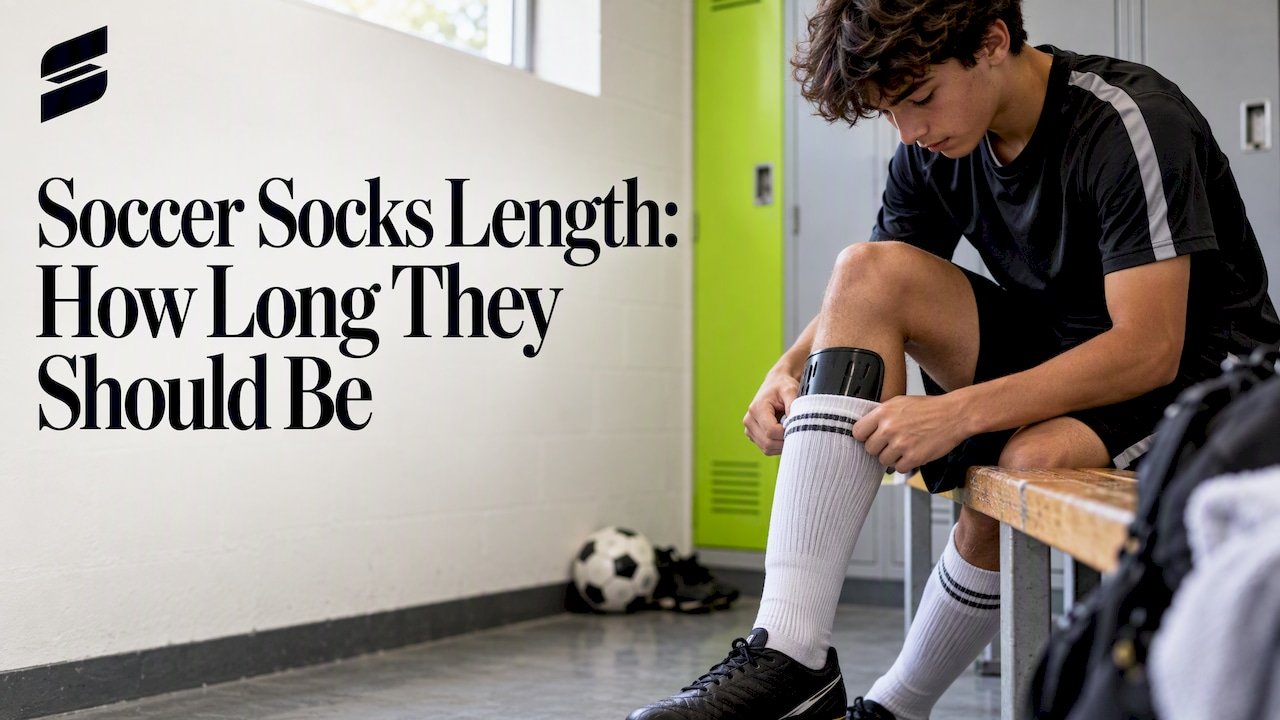
Soccer Socks Length: How Long They Should Be
Soccer socks should be long enough to cover the shin guard completely, and in practice that means over-the-calf, knee-high socks. The rulebook sets no measurement in inches. It sets a job for the sock: cover the guard. This guide shows where socks should sit on the leg, how to size them for youth and adult players, and how to keep socks and uniforms looking like one kit.
TL;DR
- The laws of the game require socks and require them to cover the shin guards. They do not name a length in inches or require a sock to reach the knee.
- Knee-high socks are the standard because they hold the guard in place and protect the shin. Training socks can be shorter.
- Size socks by shoe size and check the leg length against the player’s shin guard, not against age.
- Socks should be pulled up over the guards, never worn under them, and any tape on the socks should match the sock color.
- Decide on socks when you design the uniform so the colors, stripes and sizes work together.
Table of Contents
- What the rules say about soccer sock length
- How tall soccer socks are, and where they should reach
- How to measure a player for sock length
- Soccer socks versus other sock lengths
- Matching sock length and color to the uniform
- Perspective
- Order a matching soccer kit with Capra Sports
- Buying socks for a team: a short checklist
- FAQ
- Sources
What the rules say about soccer sock length
Many coaches assume there is a required sock height. There is not. Law 4 of the IFAB Laws of the Game requires players to wear socks. It also requires shin guards to be an appropriate size, to give reasonable protection and to be covered by the socks. The law describes the result you need, not a measurement.
This matters because it shapes how you buy. A sock is the right length when, with the player standing and then running, the guard stays covered from top to bottom. If a guard peeks out above the cuff, the sock is too short or too far down the leg for that player.
A few related points come up on game day:
- Guards go under the socks. A U.S. referee guidance document explains that guards “covered entirely by the stockings” means the guards are worn under the socks. Guards worn on top of the socks do not meet the law.
- Local leagues add detail. One American Youth Soccer Organization region describes guards that reach from just under the knee to just above the ankle, with issued socks required to cover them entirely. Your league may have its own wording, so read its equipment rules before ordering.
- Tape follows the sock. Under Law 4, tape or other material worn externally must be the same color as the part of the sock it is applied to or covers. If your players tape socks at the top or over the guard, plan for tape that matches each sock color.
For referee-facing questions about a specific competition, check the rules your league or association publishes. Youth leagues often adapt the standard laws.
How tall soccer socks are, and where they should reach
Long soccer socks are made to come up to the knee or just below it. The sock covers the foot, runs over the calf and ends just below the kneecap when pulled up. Sizes grow with the player, so a sock for a 7-year-old is much shorter in the leg than a sock for an adult, even though both are called knee-high.
Here is a simple way to think about the leg zones:
- Ankle to mid-calf. This is where short training socks end. They work for light practice but do not hold a guard well.
- Mid-calf to just under the knee. This is the working zone. The cuff sits just below the kneecap and the sock covers the full guard.
- Over the knee. Socks that reach past the knee are not needed. They can restrict bending and bunch up behind the joint.
The cuff should sit snug but not tight. A cuff that cuts off circulation leaves red marks and is a sign to size up. A cuff that slides down at the first sprint is a sign to size down or add a sock tape or a sleeve underneath, worn in the sock color.
Why soccer players wear long socks
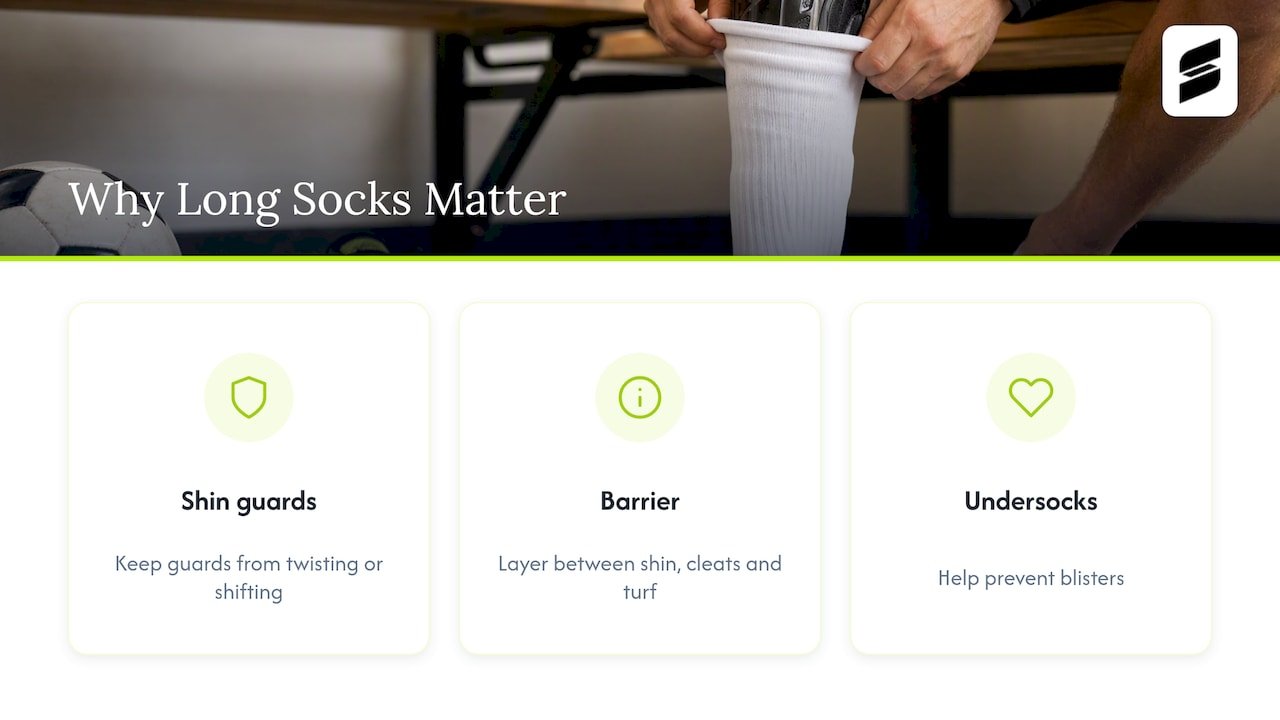
Long socks do two jobs. They keep shin guards in place so the guard does not twist or shift during play. They also add a layer between the shin and the cleats and turf that every player meets during a match. Special Olympics North Carolina’s attire guidance recommends long, knee-length socks to cover shin guards and describes an undersock as useful for helping prevent blisters.
There is also a team-identity reason. A pair of socks in the team color with matching stripes is the finishing piece of a kit. That is why most coaches order socks at the same time as jerseys and shorts.
Pulled up or folded down
Players often fold the cuff down in warm-ups or between plays. The law cares only that guards are covered during play. If your players like a lower look, the safe rule is simple: the sock should still cover the guard when the player stands, jumps and runs. For younger players, a coach who sets a “socks up at kickoff” habit avoids arguments with referees.
How to measure a player for sock length
Most sock charts list sizes by shoe size, because the foot sets the fit. Leg length matters too, so a quick check at home saves a bad order. This works for a youth player, a high school player or an adult.
- Measure the shin guard. Lay the player’s guard flat and measure its length. The sock must cover all of it with room to spare above the top edge.
- Measure the leg. With the player standing, measure from the floor at the back of the heel up to just below the kneecap. This is the length a knee-high sock needs to reach when pulled up.
- Check the shoe size. Use the player’s current cleat size, not last season’s. Growing feet are the most common reason for a sock that is too tight in the foot.
- Compare to the size chart. Use the seller’s own chart. Do not assume “medium” means the same thing across brands.
- Try the pair on with the guards in. Stand, squat and jog in place. The cuff should stay above the guard and the heel should stay on the heel.
A good fit has the heel pocket on the heel, the toe seam flat and the fabric snug across the foot without sagging. If the sock bunches below the cuff, the guard’s outline shows through. If it is too tight, it can press the guard into the shin. Both are signs to try the next size.
Sizing youth players
Youth sock sizes are tied to shoe size, not age. A nine-year-old with large feet may need the next size up, and a tall 12-year-old with narrow feet may fit a smaller one. Size ranges also differ by model. One adult-size sock may cover youth sizes at the bottom of its range and men’s and women’s sizes above it, so read the chart rather than the label.
A few habits help with young players:
- Size to the cleat, not the hope. Parents often buy big so the sock lasts two seasons. A sock that is too large bunches and shows the guard.
- Measure again each season. Kids can change a shoe size between fall and spring.
- Order a spare pair for each player. Socks go missing at the field. A spare in the same size keeps the kit consistent.
- Send the size list with the order. A team manager who collects shoe sizes in one sheet makes ordering simple.
Sizing adults and rec league players
Adult sizes cover a wide range of shoe sizes, so the same sock may fit a size 7 and a size 12 in different ways. Rec league players often swap between cleats and indoor shoes, so fit the socks to the shoe they use most. Players with wide calves should check the cuff for stretch, and tall players should check that the sock reaches the knee when pulled up.
Soccer socks versus other sock lengths
People often ask how soccer socks compare with the crew, quarter and ankle socks they wear in other sports. The short answer is that soccer socks are the longest of the group, because they have to cover a guard.
| Sock type | Where it ends | Best use in soccer |
|---|---|---|
| Ankle / no-show | At or below the ankle bone | Not suitable for matches |
| Quarter | Just above the ankle | Not suitable for matches |
| Crew | Mid-calf | Light training without guards |
| Training sock | Often about halfway up the calf | Non-contact practice |
| Knee-high soccer sock | Just below the knee | Matches and full practices with guards |
Crew socks are the most popular athletic sock length across sports, but they do not reach high enough to cover a guard in a match. Short training socks are fine for drills where you are not wearing guards, but a team playing games needs the long sock.
Are soccer socks compression socks?
Not in the medical sense. Some soccer socks use targeted stretch zones to hold the foot and shin in place, but that is a fit feature, not a treatment. One U.S. sock maker states that its targeted-compression soccer socks are not medical-grade compression socks. If a player has a circulation or swelling concern, a doctor or physical therapist is the right person to advise on compression garments, not the coach or the sock label.
Matching sock length and color to the uniform
Sock length affects how your uniform looks as a set. A long sock has a lot of visible color from cuff to ankle, so it carries the team’s stripes, numbers or a contrasting top band. Think of it as a third piece of the kit, along with the jersey and shorts.
Here is how to plan it:
- Pick the sock color first for away and home kits. If your home kit is red and black, decide whether the socks match the shorts or the jersey. Referees need to tell teams apart, so avoid a sock color that clashes with the other team’s kit.
- Keep tape in the same color. Because tape worn over a sock must match the sock color, order or buy tape in the sock shade.
- Plan for numbers and logos. Some teams put a small logo or stripe at the cuff. Keep it clear of the zone where the guard sits so it does not wrinkle.
- Think about the full set. A mismatch between jersey, shorts and socks is the most common look that bothers coaches at picture day.
If you want ideas, our soccer uniform design pages show color combinations in gold, gray, red and black, and black with aqua or teal that you can use as starting points for a sock plan.
Perspective
Every season coaches tell us the same story: the jerseys arrive on time and look great, then the team shows up with a mix of white, black and almost-black socks. Socks are the part that gets decided last, and it shows.
Our view is that the sock should be planned alongside the jersey and shorts from the first design. When we work with a team on a mockup, our designers can show the full look, and we turn mockups around within 24 hours. That gives a coach something concrete to compare against the sock they have in mind: the color match, the stripe, the contrast with the away kit.
The same thinking applies to size. A guard that shows through a sock that is too big, or a cuff that digs in because it is too small, spoils both comfort and appearance. This is why we offer one sizing sample at no extra charge. It lets a coach check fit on a real player before the full order goes in. Our team minimum is 10 sets, which suits most youth and rec squads.
Our advice: measure the leg, check the shoe size, decide on the color story early and lock it in with a mockup before you place the order.
Agha
Order a matching soccer kit with Capra Sports
If you are building a team look, start with the uniform and let the sock color follow it. Capra Sports makes custom sublimated soccer uniforms for youth teams, school programs and adult rec leagues. You work with a professional designer, get a free mockup within 24 hours and can request revisions until the design is right. Orders start at a 10-set team minimum, and one sizing sample comes at no extra charge.
Browse custom soccer uniforms and kits for teams, check the soccer uniform size chart for jersey and short fit, or see current pricing on the pricing page ([PRICE TBD] for the soccer line here). Send us your colors and we will show you the full kit before you commit.
Buying socks for a team: a short checklist
Use this list before you order socks or confirm your team’s equipment rules:
- Read your league’s equipment rules. Some leagues require certain colors or specific guard types.
- Collect shoe sizes and guard lengths. Put them in one sheet, with names and numbers.
- Pick two sock colors. One for home, one for away, so you are never caught by a color clash.
- Plan for spares. Order at least a few extra pairs in the common sizes.
- Test the fit. Have at least one player of each size try a pair with guards in before the full order.
- Give the cuff a job. If you use tape or a band, make sure it matches the sock color.
- Talk to the players. A sock they hate wearing will end up folded down or in the bag.
FAQ
How tall are soccer socks?
Soccer socks are knee-high, meant to reach just below the kneecap when pulled up. Their leg length depends on the size, so youth socks are shorter than adult socks. The test is whether they fully cover the shin guard when the player is standing and moving.
Is there a required length for soccer socks?
No measurement is set. IFAB Law 4 requires players to wear socks and requires the socks to cover the shin guards. Leagues and tournaments can add their own details, so check your league’s equipment rules.
Why do soccer players wear such long socks?
Long socks keep shin guards in place and protect the lower leg. They also give the team a place to show its colors and stripes. Special Olympics North Carolina’s guidance recommends long socks to cover guards, with an undersock to help prevent blisters.
Can players fold their socks down?
Yes, as long as the guards stay fully covered during play. Most referees expect socks to be up at kickoff. Guards must also be under the socks, not on top of them.
Are soccer socks the same as compression socks?
No. Soccer socks may have snug zones for fit, but they are not medical compression garments. A player with a circulation or swelling concern should ask a doctor before using compression wear.
Sources
- Law 4, The Players’ Equipment, IFAB
- Law 4 shinguards guidance for referee administrators
- AYSO region equipment information
- Special Olympics North Carolina soccer attire guidance