
How to Add a Sponsor to Your Team Jerseys: A Coach’s Guide
To add a sponsor to your jerseys, get written approval from your league or school first, then pick a placement that stays clear of numbers, names and league patches, send the sponsor’s logo as a clean vector file, and approve a mockup before anything is produced. The order matters. Most sponsor jobs go wrong because the logo was designed before anyone asked what the league allows.
We build sublimated team uniforms at Capra Sports, so this guide covers the whole path from the first call with a sponsor to the first game in the finished jersey. If you want the sponsor on the design from the start, our designers build it into your free mockup, which comes back within 24 hours.
TL;DR
- Ask your league, school or athletic association for approval before you promise a sponsor any space. Many youth organizations require board sign-off.
- Put the sponsor where it cannot collide with numbers, names or required patches. The back nameplate area, a sleeve or a fixed shoulder spot are the usual choices.
- Size limits are real: NCAA Division I allows two logos up to 4 square inches each, and the NAIA allows one logo of about 2.25 inches square.
- Send the sponsor’s logo as a vector file with exact brand colors, then approve a mockup before production.
- Adding the sponsor during the original design is the cleanest route, and our designers can include it in your free mockup.
Table of Contents
- Step 1: Get the right approval before you promise space
- Step 2: Choose where the sponsor goes
- Step 3: Know the size and count limits for your level
- Step 4: Prepare the sponsor’s logo file
- Step 5: Pick a decoration method that fits the budget
- Step 6: Approve a mockup before production
- Step 7: Plan the sizing and the timeline
- Step 8: Keep sponsor logos looking good
- What we do at Capra Sports
- Our perspective on sponsor jerseys
- FAQ
- Sources
Step 1: Get the right approval before you promise space
A sponsor deal is a promise about real estate on a jersey you may not fully control. Settle who approves it before the sponsor writes a check.
The rules differ by organization, so start with whoever governs your team:
- Youth soccer clubs and recreational leagues. One U.S. youth soccer association states that sponsors and logos require board approval, and that sponsor additions for its U11 to U19 kits go through a special order. A soccer club’s published policy says its approved kits cannot be altered without authorization, that only its recreational program permits sponsor printing, and that sponsor space cannot be offered without board authorization.
- Little League. A Regular Season or Tournament Team may put a sponsor name on its uniform if it does not conflict with Little League rules, and the sponsor cannot control league or team operations. The same page says that after a Tournament Team’s first International Tournament game, company, product, service or organization references may not be added to its uniform, apparel or equipment. If your team could advance, plan the sponsor so the jersey works for the regular season and a clean version is ready for tournament play.
- High school. State associations follow NFHS rules and add their own policies. Ask your athletic director in writing before you design anything.
- College and club programs. NCAA and NAIA rules set size and count limits, covered below.
Get the answer in an email. A forwarded reply from the league president is enough to protect you if a parent or an umpire questions the jersey in April.
Step 2: Choose where the sponsor goes
A jersey already carries a lot: team name, player number, player name, league patches and sometimes a manufacturer mark. The sponsor has to fit around all of it.
Little League’s purchasing guidance suggests a simple split: the league name on the front and a sponsor name on the back nameplate area. That gives the sponsor good visibility while keeping individual player customization limited and the front clean.
Other common placements, with the rule that governs them in each case:
- Back, above or below the number. Highly visible to spectators in the stands. Check that the number size and spacing stay within your league’s rules. If you also print player names, our guide on jersey name placement shows how to keep the required clearance.
- Sleeve. A good low-conflict spot, especially opposite a league patch. A Little League discussion thread shows the typical pattern, with a sponsor on the front or sleeve opposite the league patch and another on the back, though your own league’s rules decide what is allowed.
- Front shoulder panel. The NAIA’s rules identify the primary sponsor location as the front shoulder panel opposite the manufacturer logo, between the neckline apex and the shoulder seam. For baseball and softball it also permits the centered bottom of a sleeve, with a back neckline location as a fallback when the others are unavailable.
- Chest. The most valuable spot and the most regulated. Many leagues reserve it for the team name or league mark.
For a baseball-specific walkthrough, see our sponsor logo placement rules for youth baseball.
Placement checklist
- Does the logo touch or crowd the player number? It should not.
- Is it on the same spot on every jersey? Consistency across the team is a common requirement.
- Does it block a required league or association patch?
- Will it still read when the jersey is stretched on a moving player?
Step 3: Know the size and count limits for your level
Sizes are where leagues are most specific. These are the published limits for the organizations most coaches ask about.
| Organization | Sponsor limit | Source |
|---|---|---|
| NCAA Division I | Up to two additional commercial or nonprofit logos, each no more than 4 square inches, applied consistently and not interfering with required markings | NCAA Legislative Services Database |
| NCAA Division I baseball | Two logos, each no more than 4 square inches, on the front, back or sleeve | NCAA commercial logo summary, updated August 17, 2026 |
| NAIA | One sponsor logo or patch, generally no larger than 2.25 inches square | NAIA uniform sponsorship rules, modified October 14, 2025 |
| NFHS baseball (manufacturer logo, Rule 1-4-4) | No more than 2-1/4 square inches, one per item, outside | NFHS Rule 1, Section 4 |
Two cautions on reading this table. First, the NFHS figure covers a manufacturer’s logo, not a team sponsor, so it tells you how strict high school associations are about marks on a jersey, not what your state allows for sponsors. Ask your state association. Second, the NAIA also prohibits sponsors of legalized drugs, alcohol, tobacco and businesses whose primary function is sports gambling. Even in leagues without a written list, avoid those categories on youth jerseys.
Rules also move. The NCAA’s Division I Cabinet reversed a 2017 interpretation in January 2026, and competition identification materials may now include the competition’s sole corporate title sponsor in preseason, regular season and non-championship postseason competition. Check the current document before every season rather than relying on last year’s email.
For Little League specifics beyond sponsors, our Little League uniform rules and sizing checklist pulls the season’s changes together.
Step 4: Prepare the sponsor’s logo file
This is the step coaches skip and the one that decides whether the logo looks sharp or fuzzy. Sponsors often hand over whatever is on their website, which is usually a small screen image.
Ask the sponsor for:
- A vector file. Formats such as AI, EPS, SVG or a vector PDF scale to any size without blurring. A small JPG or screenshot cannot be enlarged cleanly.
- Exact brand colors. A sponsor’s red is rarely just “red.” Ask for the color values from their brand guide so the logo matches their signs and cards.
- A one-color version. If your league limits colors or the logo is small, a single-color version often stays more legible at 2 or 3 inches wide.
- Clear space and minimum size. Many logos include fine text that disappears below a certain width. Ask the sponsor what the smallest acceptable size is.
- Permission to use it. A short email from the sponsor confirming you may reproduce the logo on team apparel avoids awkward conversations later.
Then measure the real placement against your league’s limit. A logo drawn to fit a 4 square inch cap on a flat design can look different once it wraps a sleeve, so confirm the final dimensions on the mockup, not just in the file.
Step 5: Pick a decoration method that fits the budget
The method decides how the logo looks after a season of washing. The three common options are sublimation, screen printing and heat transfer. Sublimation uses heat to bond dye into polyester fabric, so the logo becomes part of the fabric instead of sitting on top of it. That is why sublimated logos handle full-color artwork and gradients well, and why a sponsor’s logo placed during the original design costs less effort than a patch added later.
If you are comparing methods, we break them down in sublimation vs screen printing vs heat transfer and embroidered vs sublimated for team jerseys.
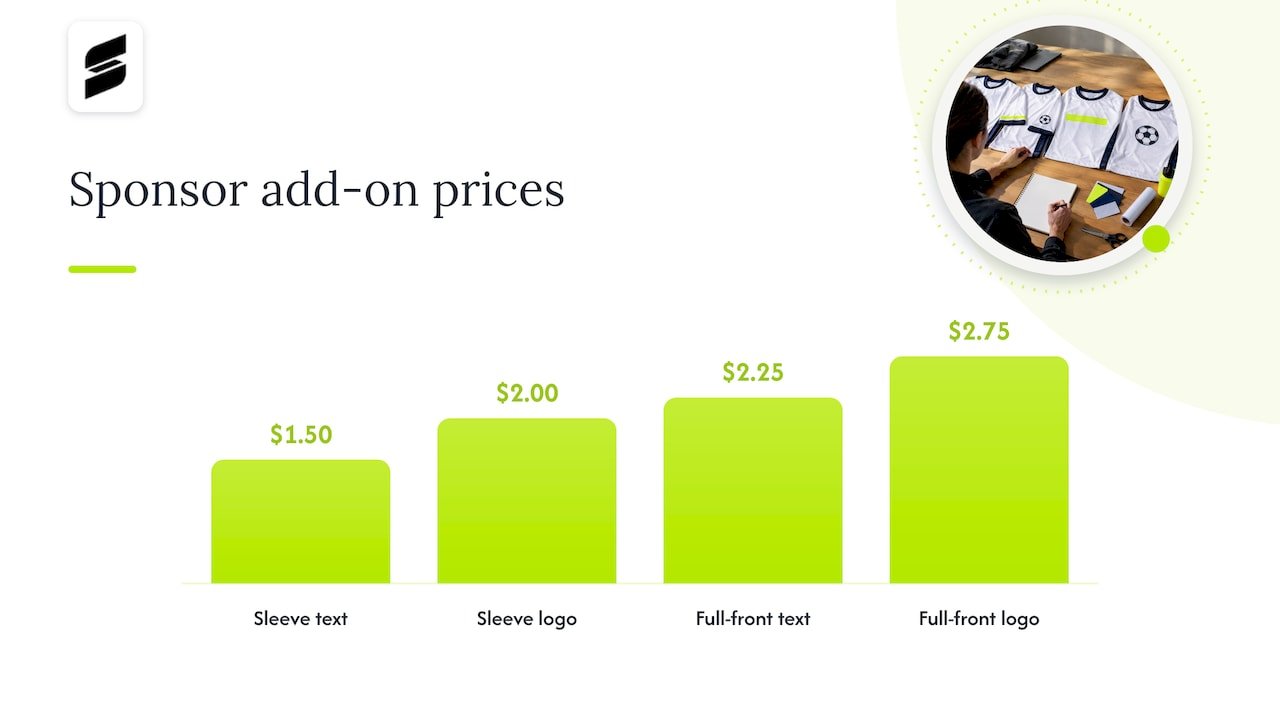
For context on how add-on pricing works in the field, one youth soccer association lists sponsor additions per shirt: one-color sleeve text at $1.50, one-color sleeve logo at $2.00, one-color full-front text at $2.25 and one-color full-front logo at $2.75, with $1.00 more for each additional color. That is one association’s schedule for add-ons to existing kits, and it shows the logic: placement, size and color count each move the price. Little League’s purchasing guidance advises setting a per-player budget and deciding up front whether the league or parents pay for each component, including full-color logos, embroidery, screen printing and official patches.
For Capra Sports pricing, see our pricing page. Quotes for sponsor work are [PRICE TBD] until you send us your design.
Step 6: Approve a mockup before production
Never approve a sponsor placement from a description. Look at it on the jersey.
A good mockup review checks:
- Sponsor logo size against your league’s limit
- Distance between logo, number and name
- Logo color against the jersey background, since a dark logo on a navy sleeve disappears
- Mirror placement on every jersey in the set, including goalies, pitchers or liberos if their jerseys differ
- Spelling of the sponsor’s name
Send the mockup to the league contact and the sponsor for sign-off before you pay. This is the cheapest moment to fix a mistake. After sublimation, a mistake is a reorder.
Step 7: Plan the sizing and the timeline
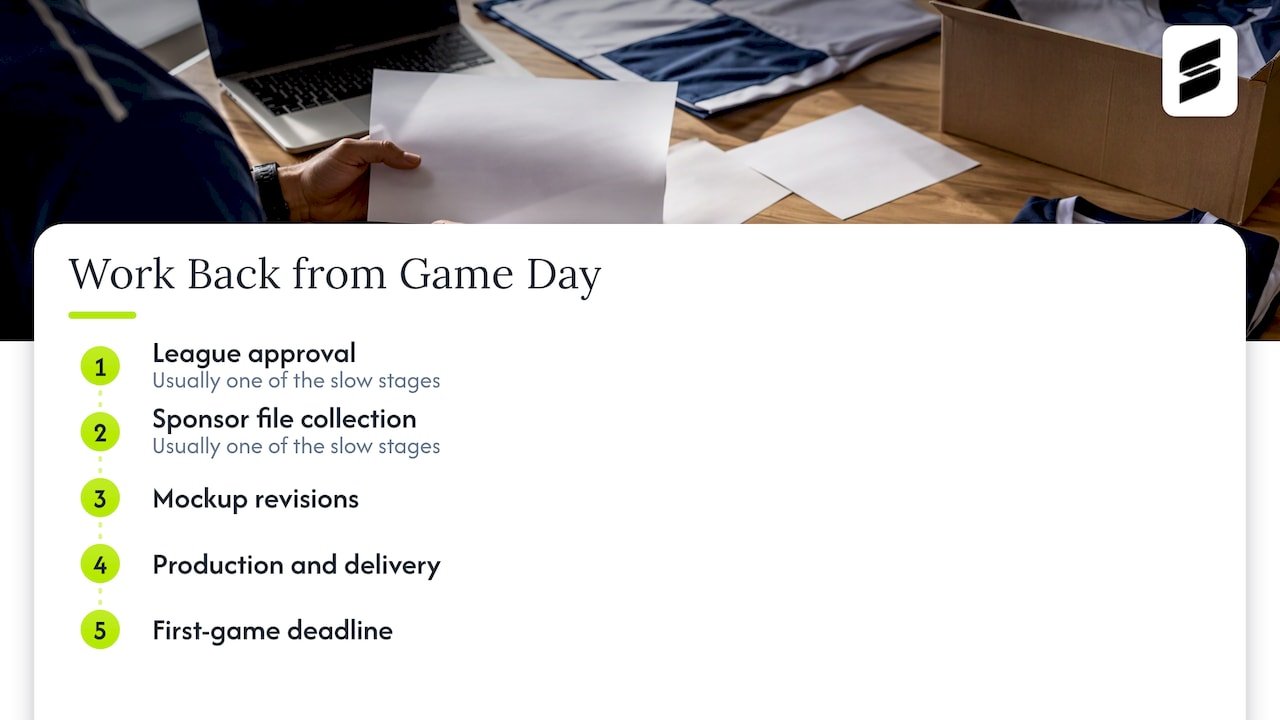
Sponsor deals often have a first-game deadline, like opening day or a sponsor night. Work backward from it. Allow time for league approval, sponsor file collection, mockup revisions, production and delivery. Approvals and file collection are usually the slow parts, not the printing.
Also confirm sizing before the whole order goes in. At Capra Sports, we include one sizing sample at no extra charge, so you can check the fit before committing the team order. Our team orders start at 10 sets.
Step 8: Keep sponsor logos looking good
A sponsor who sees a cracked or faded logo in June will not renew. Care is part of the deal. Sublimated artwork is part of the fabric, which makes it durable, but rough laundering still shortens the life of any jersey. Wash in cold water with mild detergent, skip bleach, and avoid high-heat drying, which are standard practices for performance fabrics. Our guide to washing sublimated jerseys walks through the routine you can hand to parents.
What we do at Capra Sports
We make custom sublimated uniforms for basketball, baseball, softball, soccer, football, volleyball and cheer teams. When you tell us a sponsor is part of the plan, you work directly with a professional designer who builds the logo into the layout. Revisions are unlimited, and the free design mockup is delivered within 24 hours. That makes it easy to show the league, the sponsor and the parents the same picture and get approval before production.
If you are ready to start, see custom baseball uniforms for teams or our pricing page. Send us the sponsor’s vector logo, your league’s size limit and the placement you want.
We also build jerseys for other sports, so the same process works for a soccer club’s sleeve sponsor or a basketball team’s shorts logo.
Our perspective on sponsor jerseys
Coaches usually come to us after the sponsor has already said yes. The best outcomes are the ones where the sponsor was part of the design conversation from the first mockup.
A sponsor logo added late tends to fight with the number, the name and the patches. A sponsor placed in the original layout becomes one balanced element. That is the case for working with a designer instead of dropping a logo on a template.
Sublimation helps here. The logo is printed into the fabric, so it moves with the jersey and does not sit on it like a patch. Combined with unlimited revisions, you can adjust size and spacing until the league contact and the sponsor both say yes.
Start with approval, then placement, then the file. In that order, the sponsor job is easy.
Agha
FAQ
Do I need permission to put a sponsor on youth jerseys?
Usually yes. Many youth associations require board approval for sponsor logos, and Little League requires that a sponsor name not conflict with its rules or give the sponsor control over the team. Ask your league in writing before you design or order.
Where is the best place for a sponsor logo on a jersey?
The back nameplate area, a sleeve or a fixed shoulder spot are the safest choices because they stay clear of numbers and patches. Little League’s guidance suggests the league name on the front and the sponsor on the back. Your own league’s rules make the final call.
What file format should the sponsor send?
Ask for a vector file such as AI, EPS, SVG or a vector PDF, plus the exact brand colors. Vector files scale to any size without blurring, which matters when the logo is only 2 to 4 inches wide.
Can a sponsor be added after the jerseys are made?
Sometimes, but it is harder to match. Some associations handle it through a special order with per-shirt charges. Designing the sponsor into the original uniform is cleaner and keeps placement identical across the set.
Sources
- Uniforms, SnVYSA
- Uniform Branding and Logo Policy, WH America Soccer Club
- Uniform Buying Tips for the Purchasing Agent, Little League
- Fundraising for Tournament and Commercialization, Little League
- NAIA Uniform Sponsorship Rules Modifications
- NCAA Division I commercial and nonprofit logos summary
- NCAA Legislative Services Database
- Report of the NCAA Division I Cabinet, January 7, 2026
- NFHS Rule 1, Section 4, Uniforms