
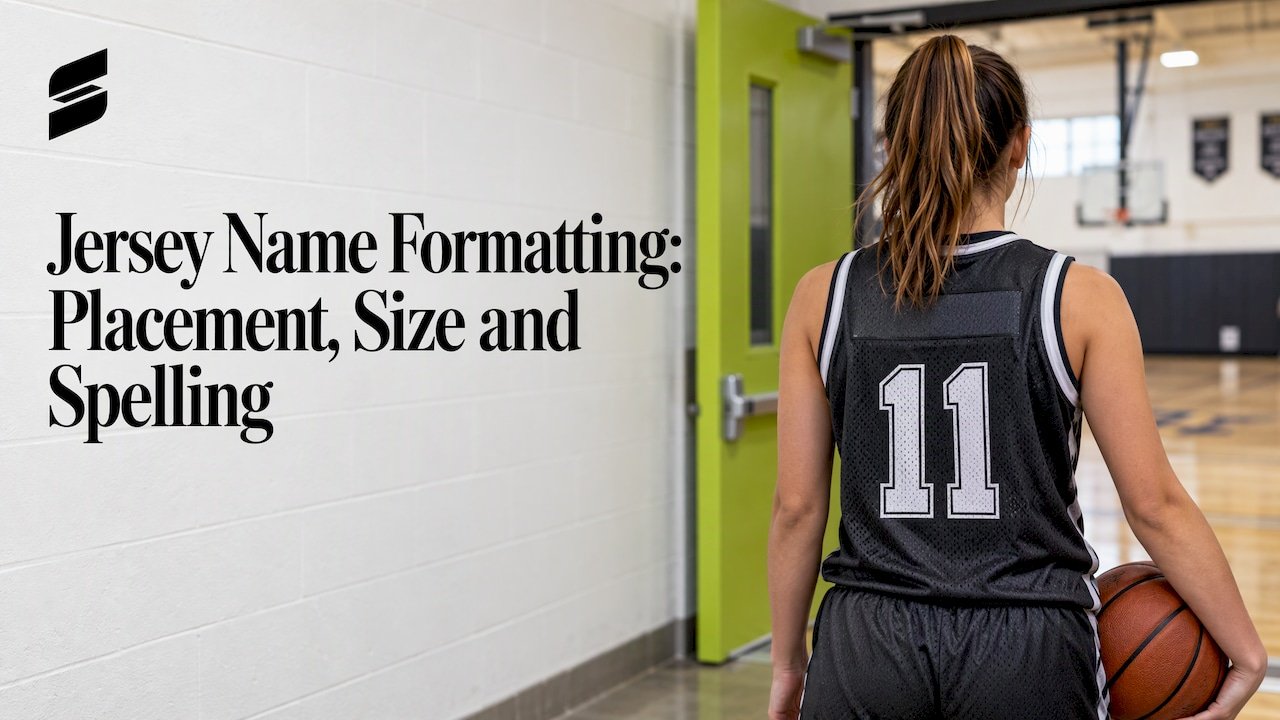
Jersey Name Formatting: Placement, Size and Spelling
Format a jersey name once, for the whole team, before anyone orders. Use the surname in capital letters, centered across the upper back, set horizontally in a plain block font. Size it by sport and age (roughly 2 inches for youth, 2.5 to 3 inches for adults). Keep it at least 1 inch from the number wherever your league follows NFHS rules. A team that agrees on these few choices up front avoids most reorders, and at Capra Sports a free design mockup lets you check the result before production.
TL;DR
- Use one format for every player: surname, all capitals, one font, one color, one placement.
- Typical name height is about 2 inches for youth and 2.5 to 3 inches for adults, depending on the sport.
- NFHS rules for basketball and field hockey keep name lettering at least 1 inch from any number and require it to be horizontal.
- Collect names in a spreadsheet with exact spelling, and send long names in for a fit check early.
- Approve a mockup before production so every name is read against the template.
Table of Contents
- What “formatting” a jersey name actually covers
- Placement: where the name goes on the back
- The 1-inch clearance rule
- Letter height by sport and age
- Font, capitals and spacing
- Spelling, punctuation and what to put on the name
- Why some jerseys have no names
- Name formatting checklist to send with your order
- How Capra Sports handles names
- Our view on name formatting
- FAQ
- Sources
What “formatting” a jersey name actually covers
Formatting is a set of decisions made once and applied to every jersey: what text appears (surname, nickname, school name), how it is capitalized, which font, how tall the letters are, how they are arranged (straight or arched), and where on the back the name sits relative to the collar and the number.
The usual convention is a surname on the back of the jersey, traditionally above the number, though some teams put the name below it. Nicknames are also common, according to a general reference on sports names. Many youth and rec teams skip names altogether to save cost and avoid duplicates, which is a legitimate choice. If your league wants names, the rest of this guide applies.

Placement: where the name goes on the back
The name sits centered on the upper back, above the number. A decoration guide from a heat-transfer supplier places the name 2 to 3 inches from the collar, with the number 2.5 to 3 inches below the name. The same guide notes that exact placement depends on the jersey, and that buttons or collar shape can force a shift. What matters most is consistency: record the distance and use it on every jersey.

The distance from the collar is a starting point, not a rule. A button-down baseball or softball jersey, a V-neck soccer shirt and a sleeveless basketball jersey each have different upper-back geometry, so check the placement against the specific cut in your mockup.
Straight or arched
A straight line is the safest choice, and the easiest to read. NFHS basketball rules allow lettering that is straight or arched, as long as the first and last letters stay on the same horizontal plane. A gentle arch follows the shoulders and suits a long name. A steep arch, where the end letters drop, does not meet that wording.
The 1-inch clearance rule
NFHS is the National Federation of State High School Associations, the body whose rule books most U.S. high school sports follow. Two of its uniform documents set the same spacing limit:
- Basketball: a player name, school name, nickname, school-logo name or official school abbreviation may appear horizontally on the back, and lettering must be at least 1 inch from any number.
- Field hockey: a player’s name is permitted on the top, lettering must be horizontal, and letters must be no closer than 1 inch to any point on a number (2025 requirements).
The practical effect: if the name and number are both large, the back gets crowded. Lock the layout so the gap holds on the longest name, not just the shortest. Our guide for coaches on locking templates for 1-inch name clearance walks through that check. For the rules in other sports, see our summary of NFHS uniform rules.
College teams face another limit: NCAA football jerseys may carry only listed items, each no larger than 16 square inches. Whatever your level, read your own league’s rule book before finalizing, because state associations and leagues can add to the national text.
Letter height by sport and age
Name lettering commonly runs 1.75 to 3 inches tall, depending on sport and age group, with 1.75 inches for youth soccer, football and cross country at the small end. A second decoration reference lists about 2 inches for youth and 2.5 to 3 inches for adults. In its adult table, soccer, football, softball, basketball, lacrosse and volleyball are 2.5 inches, while baseball and hockey are 3 inches.
| Group | Typical name height |
|---|---|
| Youth, most sports | About 2 inches (1.75 for youth soccer, football) |
| Adult soccer, football, softball, basketball, volleyball | 2.5 inches |
| Adult baseball | 3 inches |
These are industry conventions, not league rules. Numbers are different: the 2025 NFHS football rules require back numbers at least 10 inches tall and front numbers at least 8 inches. Name height is a design choice, and number height is often a rule. Our jersey number size guide covers the second half of the back.
A worked example
Take a 12-player youth basketball team. You choose a 2-inch name, set straight, in capitals. The longest surname is 11 letters. At that height, an 11-letter name in a blocky font can run wider than a back panel’s comfortable width, so you either narrow the font, drop to a slightly smaller height for the whole team, or use a shallow arch. You do not shrink only that one player’s name, because mixed sizes look like an error. Our page on fitting the longest name on a jersey covers this in detail.
Font, capitals and spacing
Choose a font for readability from the bleachers and the sideline. Typography guidance for sports favors traditional blocky forms, simple slab serifs and clear letter shapes, because they stay legible on television and in motion. Highly decorative or curved forms get hard to identify during play.
In practice:
- Use all capitals for names. They are uniform in height, which keeps the line tidy.
- Keep the name font the same family as the number font, or a plain companion, so the back reads as one design. See our notes on number fonts that are production-ready.
- Pick high contrast against the jersey color. A light name on a light jersey disappears whatever the font.
- Leave a little extra letter spacing on small youth names, so the letters do not blur together.
- Avoid script fonts for names. Fonts we have covered by sport are in our basketball and baseball font guides.
Spelling, punctuation and what to put on the name
Most reorders are not design problems but data problems. Treat the roster as a document:
- Collect names in one spreadsheet, one row per player, with jersey number, size and the exact name to print.
- Have a parent or player confirm spelling in writing. Do not copy from a sign-up sheet.
- Decide how to handle hyphens, apostrophes and spaces (O’Neil, De La Cruz, Smith-Jones) once, and apply the same rule to everyone.
- Decide on suffixes (Jr., III). Most teams drop them to save space.
- Settle duplicates: if two players share a surname, add an initial for both, not just one.
- Check that your league allows what you plan to print. A nickname, school name or abbreviation may be permitted in one rule book and not in another.
Why some jerseys have no names
Names are optional in many leagues, and teams leave them off for practical reasons: lower cost per jersey, easy reuse of jerseys from season to season when players change, and avoiding mistakes. If your team might hand jerseys down, a number-only back is the flexible choice.
Name formatting checklist to send with your order
- Name text: surname, nickname or school name, one choice for everyone.
- Capitalization: all capitals, unless your league says otherwise.
- Font and color: one font, one color, with contrast checked against the jersey.
- Height: matched to your age group and sport, applied to the whole team.
- Layout: straight or shallow arch, centered, horizontal.
- Placement: distance from the collar, and the gap to the number, written down.
- Clearance: at least 1 inch from the number where NFHS rules apply.
- Roster: exact spellings, confirmed by each player or parent.
How Capra Sports handles names
Capra Sports makes custom sublimated team uniforms for basketball, baseball, softball, soccer, football, volleyball and cheer. You work directly with professional designers, with free design mockups and unlimited revisions, so you can see your names set on the real jersey layout and fix a spacing problem before anything is produced. Our policy is a 10-set team minimum, and one sizing sample comes at no extra charge. Prices are listed on our pricing page ([PRICE TBD]). If you are starting with a sport, the basketball team uniform page or soccer jersey page is a good place to begin.
Send us your roster and your league’s rule sheet, and we will set the names to match.
Our view on name formatting
Most name problems we would want to prevent are planning problems. A team picks a font it likes, then discovers the longest surname does not fit, or that the name crowds a number the league says must have space around it.
Our approach is to settle the rules first: the format, the height, the gap. Then we build the mockup around the longest name on your roster, not the shortest. That is why we offer free mockups and unlimited revisions with a professional designer: you should see every name on the jersey before it is made.
A consistent, readable back is worth more than a clever one. Plain capitals, a clear font and honest spacing look professional on a youth team and a varsity squad alike.
Agha
FAQ
What font is commonly used for jersey names?
Blocky, slab-style or simple sans fonts are the usual choice because they stay readable in motion. Decorative and script fonts are harder to identify during play. Use the same family as your numbers for a consistent look.
How big should a name on the back of a jersey be?
Common references put youth names at about 2 inches and adult names at 2.5 to 3 inches, depending on the sport. Check your league’s rule book first, because some set their own limits.
Should the name go above or below the number?
Above is traditional, with the number below it, though some teams reverse it. Whichever you choose, apply it to every jersey and keep any required clearance, such as the NFHS 1-inch gap in basketball and field hockey.
Do all jerseys need names?
No. Many leagues leave names optional, and some teams skip them to reduce cost or reuse jerseys. If names are printed, use one format for the whole roster.
Sources
- Name (sports), reference overview
- NFHS basketball uniforms
- NFHS field hockey uniform requirements, 2025
- NFHS football jersey and pant rules, 2025
- NCAA football Rule 1-4-5
- Design placement guide
- Recommended jersey letter and number sizes
- Fall sports team jersey decoration guide
- The challenging game of designing for sports