
V-Neck vs Crew Neck: Which One Actually Fits You
The crew neck wins as the default choice for most people, most of the time. It sits close to the collarbone, works with nearly any face shape, and never looks out of place. The V-neck earns its spot when you want a specific effect: a longer-looking neck or a slimmer line across a rounder face. Men’s Health frames it the same way, and Boring Label backs it with a simple rule of thumb: flatter the face first, then worry about build.
Here’s the fast version before you dig into why:
- Default pick: Crew neck, unless you have a specific reason to reach for a V.
- Choose a shallow V for smart-casual layering over a collared shirt.
- Choose a crew for solo wear, graphic tees, and anything athletic.
- Avoid a deep V unless you’re intentionally going for a bold, casual look.
- Caprasport builds both neckline styles into custom team gear, and testing a free sample before you order a full roster is the easiest way to settle the debate for your squad.
Key Takeaways
Crew necks work as the safest all-purpose choice, while V-necks earn their place only when the goal is a longer neck line or a slimmer face.
| Point | Details |
|---|---|
| Default to crew | Crew necks flatter the widest range of faces and builds with the least risk. |
| Use V-necks strategically | Reach for a V to lengthen a round face or slim a broader chest, not as a default. |
| Depth decides the effect | Shallow Vs give most of the benefit with far less risk than deep Vs. |
| Match fabric to neckline | Heavier cotton stabilizes crews; fine merino or Pima cotton lets Vs drape cleanly. |
| Test before ordering for a team | Caprasport’s free mockups and samples let coaches confirm neckline fit before a full uniform order. |
Table of Contents
- V Neck vs Crew: What Each Neckline Actually Is
- What Counts as a True Crew Neck
- Comparing V-Neck and Crew Neck Side by Side
- Which Face Shapes and Body Types Each One Flatters
- Getting the Depth and Fit Right
- How to Style and Layer Each Neckline
- Mistakes That Undercut Either Neckline
- The 60-Second Neckline Checklist
- Choosing Necklines for Team Uniforms
- Are V-Necks Still in Style?
- The Proportion Trick Nobody Talks About
- Which Neckline Works Best for the Weather
- A Quick Test You Can Run Tonight
- Custom Uniforms Built Around the Right Neckline
- Sources
- FAQ
V Neck vs Crew: What Each Neckline Actually Is
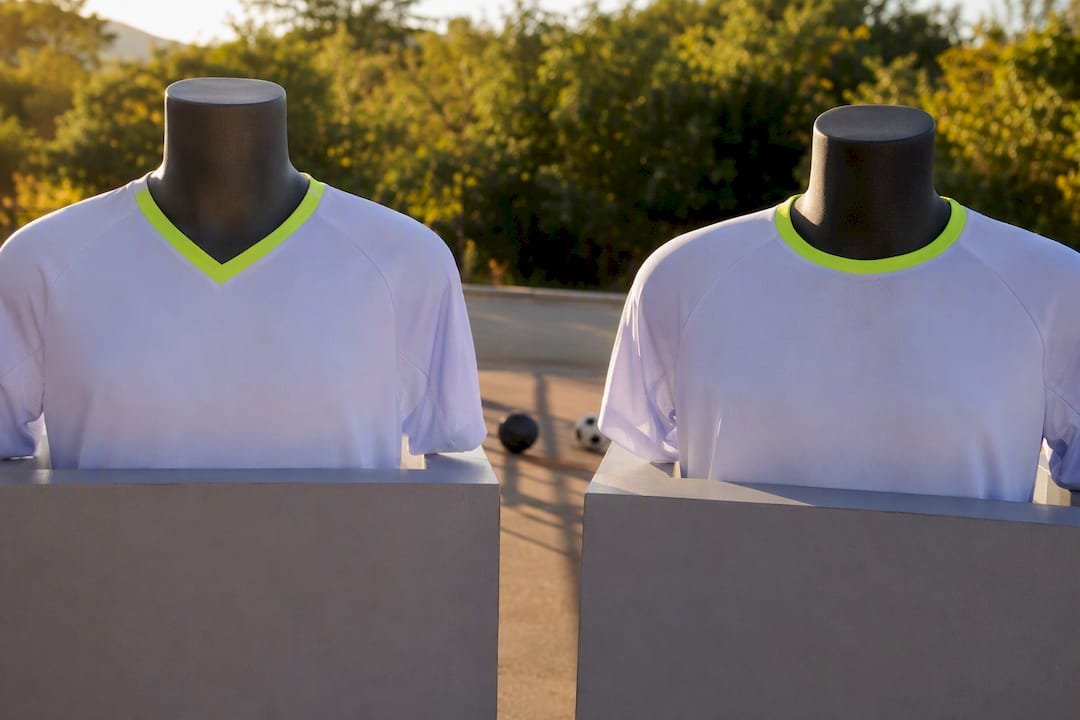
A V-neck is exactly what it sounds like: a collar that angles down from the shoulders to a point somewhere on the chest. Depth is what separates a tasteful V from an awkward one. A shallow V drops an inch or two below the collarbone and reads as barely different from a crew at a glance. A moderate V shows a few inches of chest and starts to visually lengthen the neck. A deep V plunges well past that and becomes a deliberate style statement rather than a background choice.
Where you’ll see each:
- Shallow Vs on dress shirts, polos, and fine-gauge sweaters meant to sit under a jacket or over a collared shirt.
- Moderate Vs on casual sweaters and knitwear worn without a layer underneath.
- Deep Vs on fashion-forward tees and going-out shirts where the point is to be noticed.
The Wikipedia entry on T-shirts traces the V-neck’s rise as a layering-friendly alternative to the round collar, and that’s still its main job today: it’s built to show a sliver of what’s underneath without shouting about it.
Pro Tip: Depth matters more than the V-vs-crew debate itself. A shallow V does almost all of the flattering work a deep V does, with a fraction of the risk of looking like you tried too hard.
What Counts as a True Crew Neck
A crew neck sits high and close, tracing a tight circle around the base of the neck with a ribbed band that holds its shape. That rib is the giveaway. Pull on a true crew and it should spring back rather than stretch and stay loose.
Common places you’ll find one:
- The standard cotton T-shirt, printed or plain.
- Athleisure and gym wear, where a stable collar matters during movement.
- Layering pieces worn under a jacket, hoodie, or team warmup.
- Graphic tees, where the collar needs to frame the design rather than distract from it.
Not every round collar is a true crew, though. A relaxed round neck uses the same basic shape but sits looser and lower, with a softer, less structured band. It reads more casual and slightly less clean-cut. The term “crew neck” and “round neck” get used interchangeably in a lot of casual conversation, but the construction difference shows up the moment the shirt goes through a few wash cycles: a true crew holds its shape, while a loosely knit round neck starts to sag around the collarbone.
High crews sit closer to the throat and can crowd a shorter neck. Low, open crews drop slightly wider and lower, which softens that effect and works better on people with less neck length to spare.
Comparing V-Neck and Crew Neck Side by Side
Six factors decide which neckline wins for a given person and a given outfit: how it frames the face, how it reads against different builds, how dressy it looks, how it behaves under layers, how it feels to wear, and whether it risks looking dated.
| Dimension | V-Neck | Crew Neck |
|---|---|---|
| Face-shape flattery | Lengthens and slims round or square faces | Neutral on most faces; can shorten a long face |
| Body/build suitability | Slims broader chests and shoulders | Adds visual width to slim or narrow frames |
| Formality | Higher; works under blazers and with collared shirts | Casual by default; harder to dress up |
| Layering visibility | Frames a collared shirt or tie cleanly | Can peek out awkwardly under another crew |
| Comfort/ventilation | More open chest, cooler in warm weather | Snug at the throat, warmer, more coverage |
| Trend risk | Moderate; deep Vs can feel dated fast | Low; rarely goes out of style |
A round-faced guy with a broader chest gets real mileage out of a V, since it works two angles of the same problem at once. A slim-framed reader in a graphic tee gets nothing from a V and plenty from a crew, which adds the visual width a narrow chest is missing. Neither one is universally correct. That’s the whole point of a comparison, not a ranking.
Which Face Shapes and Body Types Each One Flatters
The order of operations matters here: flatter the face first, then use build as the tiebreaker. People notice your face before they register your chest width, so that’s where the neckline should do its heaviest lifting, a point Men’s Health makes explicitly when comparing the two shapes.
Round or square faces benefit most from a V. The downward line breaks up width at the jaw and cheeks and creates the illusion of length. Long, narrow, or angular faces usually look better in a crew or round neck, since the horizontal line across the collarbone adds width the face is missing on its own. Oval faces are the flexible middle ground. Either neckline works, so build and occasion get to decide instead.
Build works as a secondary filter:
- Broad, athletic builds can use a V to visually narrow the shoulders and chest.
- Slim or narrow frames often look better in a crew, which fills out the shoulder line instead of emphasizing how little chest there is to slim.
- When face shape and build point in opposite directions, Boring Label’s advice holds: go with what helps the face.
Two quick profiles show how this plays out. A stocky rec-league catcher with a round face and wide shoulders gets a genuine visual win from a shallow V sweater over his street clothes. A lean cross-country runner with a long face and narrow shoulders gets the opposite benefit from a crew neck tee, which softens the length of his face and adds shoulder presence a V would strip away.
Pro Tip: Stand in front of a mirror wearing both a crew and a V of similar color and fabric. Snap a photo of each from the same distance. The difference in how your face reads is usually more obvious in a photo than in the mirror itself.
Getting the Depth and Fit Right
Picking “V-neck” or “crew neck” is only step one. The actual cut inside that category decides whether it flatters you or just sits there.
- Estimate V depth relative to your collarbone. A shallow V lands one to two inches below it. A moderate V lands three to four inches below. Anything deeper counts as a deep V and starts reading as a fashion statement rather than a quiet upgrade.
- Match depth to context. Shallow for anything worn under a jacket or layered over a collared shirt. Moderate for casual solo wear. Deep only when the goal is to stand out, not blend in.
- Check crew snugness at the collarbone. The rib should sit flat against the skin without digging in or gapping when you turn your head.
- Watch neck height on a crew if your neck is short. A high, tight crew crowds a short neck fast. A slightly lower, more open crew gives breathing room.
- Inspect the stitching. Nemoshirt’s guide points out that fabric weight changes everything: heavier ring-spun cotton keeps a crew’s collar from sagging, while longer-staple cotton or fine-gauge merino lets a V drape cleanly instead of curling at the point.
Pro Tip: Try the shirt on and raise both arms overhead, then drop them. If the collar gaps or twists out of shape, that’s the fabric or construction failing, not your body. Move to a heavier weight or better stitched version before writing off the neckline entirely.
How to Style and Layer Each Neckline
The neckline you pick changes what it can be layered with, not just how it looks on its own.
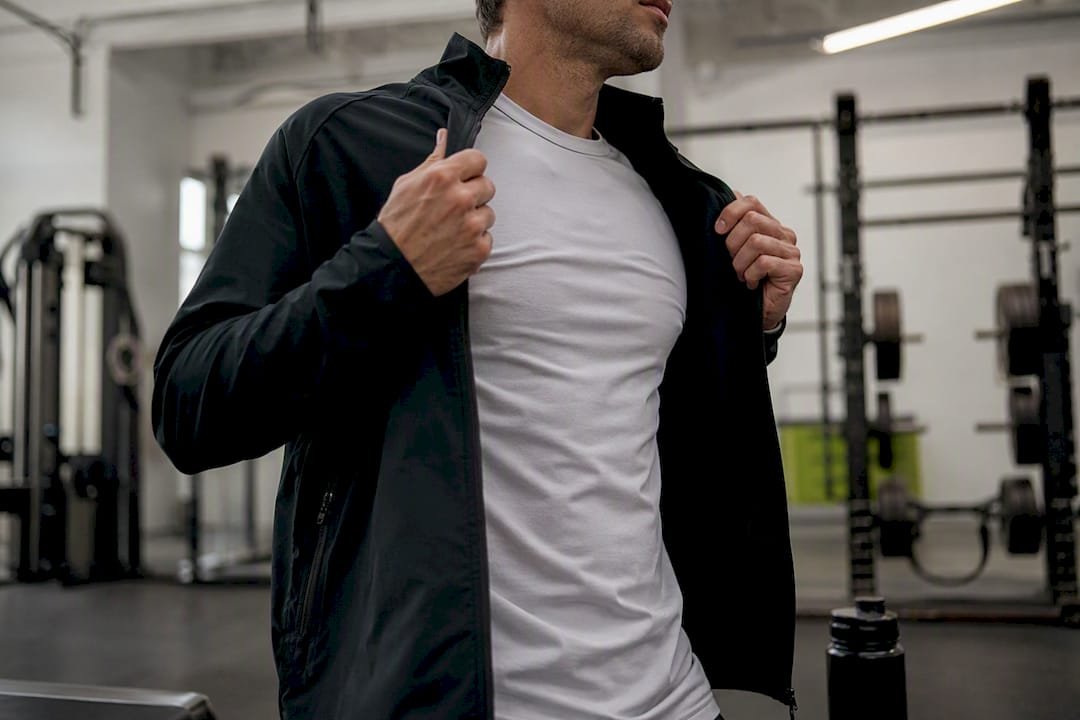
Crew necks pair naturally with denim jackets, bombers, and anything casual. Graphic tees almost always live in crew territory since the design needs a stable frame, not a V slicing through the art. For athletic and training gear, a crew’s tighter collar holds up better through repeated movement, which is part of why Q-Finder’s outfit breakdown puts crews at the top for graphic tees and athleisure.
Shallow V-necks do their best work under unstructured blazers or open jackets, where the point of the V lines up with the jacket’s lapel line instead of fighting it. A V-neck sweater over a dress shirt, finished with a tie, is a business-casual staple for a reason: the V frames the collar and tie knot instead of hiding them.
One layering mistake to watch: stacking two identical necklines. A crew sweater over a crew tee often creates an awkward double collar peek at the throat, an effect Men’s Health flags directly in its layering advice. A V-neck under a crew, or a crew under a V-sweater, tends to read cleaner because the two collar lines don’t compete for the same real estate.
Climate factors into the choice too. Ventilation-first pieces, like Capra’s sleeveless jersey builds for hot-weather play, lean on open necklines and cut for airflow. Cooler-weather layering, covered in FS9 Tactical’s guide to climate-based layering, follows the same logic outdoor and tactical gear uses: base layer tight at the neck, mid layer looser, outer layer weatherproof.
Pro Tip: Darker, matte fabrics on a V-neck make the slimming line more pronounced. Bright colors or heavy texture on a crew neck draw the eye upward and outward, which is exactly what a narrow frame wants.
Mistakes That Undercut Either Neckline
Most neckline problems trace back to depth, fit, or fabric, not the shape itself.
- Deep V on a slim build: it exposes more chest than it slims, with nothing to visually fill the gap. Fix: drop to a shallow or moderate V, or switch to a crew that adds width instead.
- High, tight crew on a short neck: it crowds the throat and shortens the whole upper body. Fix: look for a lower, more open crew collar.
- Sagging collar after a few washes: almost always a fabric or construction issue rather than a design flaw. Nemoshirt points to fabric weight as the fix, heavier cotton for crews, quality knits for Vs.
- Stacking identical necklines when layering: creates an odd double collar line at the throat. Fix: alternate neckline shapes between layers.
- Buying based on trend alone: a deep V or an oversized crew that’s popular this season can look dated fast. Fix: buy for your face and build first, trend second.
The 60-Second Neckline Checklist
When you’re standing in a fitting room or staring at your closet trying to decide, run through this in order:
- Face shape first. Round or square: lean V. Long or angular: lean crew. Oval: either works.
- Build second. Broader chest and shoulders: V helps slim. Slim or narrow frame: crew adds width.
- Occasion third. Business-casual or layered look: shallow V. Casual, athletic, or graphic tee: crew.
- Layering plan fourth. Wearing it under a jacket: shallow V. Wearing it alone or under a warmup: crew.
- Tiebreaker: if face and build disagree, the face wins. If you’re still stuck, default to a crew or a shallow V; both carry the lowest risk of looking wrong.
Fabric and season matter here too. A merino V-neck sweater is a cold-weather layering tool. A lightweight cotton crew tee is a summer default. Matching the fabric to the season keeps either neckline from working against you.
Choosing Necklines for Team Uniforms
Neckline choice on a team uniform isn’t just about looks. It affects how sublimation printing sits across the chest, how the collar behaves under a warmup jacket, and whether players are still comfortable in the fourth quarter.
A few things matter more on team gear than on a single shirt:
- Sublimation reads differently near a V point than around a crew collar, so mockups matter before locking in a design.
- Crews hold up better under warmups since the collar stays put through repeated pulling on and off.
- Shallow Vs work on larger builds where a standard crew can look tight across a wider chest and shoulders.
- Consistency across a roster matters more than individual flattery, since every player needs to look uniform, literally.
Caprasport builds both neckline options into its custom team uniforms, backed by free design mockups, low minimum orders, and factory-direct pricing that skips the markup other suppliers add. Requesting a free mockup before committing to a full order lets a coach or athletic director actually see the neckline on the design before fifteen or twenty jerseys get printed.
Pro Tip: For activewear that needs a stable collar through sprints, dives, and constant motion, a crew almost always outperforms a V. Save V-neck options for warmup layers or presentation gear rather than in-game jerseys.
Are V-Necks Still in Style?
V-neck sweaters have staying power. They’ve held their place in business-casual wardrobes for decades and show no sign of disappearing, since they solve a real problem: framing a collared shirt without a stiff, buttoned-up look.
V-neck T-shirts are a different story. Mens Fashioner’s coverage of current casual wear notes that crew neck tees remain the standard default, while V-neck tees have slipped in mainstream popularity over the past several years. Deep V tees in particular carry more dated-trend risk than almost any other neckline choice, tied to a specific stretch of fashion history rather than a timeless cut.
That split matters for how you shop. If you’re buying a sweater for layering over a dress shirt, a V is still a safe, classic call. If you’re buying a plain T-shirt to wear on its own, a crew is the lower-risk pick, and a V-neck tee needs a specific reason to earn a spot in the rotation rather than a default assumption that it will.
Casual online discussion backs this up too. Threads on r/malefashionadvice repeatedly favor crew necks for modern minimalist wardrobes, though preferences shift with age group and subculture, which is worth remembering before treating any single source as gospel on trend direction.
The Proportion Trick Nobody Talks About
A neckline doesn’t just frame the face. It resets how long your neck and torso appear to a stranger glancing at you for two seconds.
A V-neck creates a vertical line running from the shoulders to a point on the chest, and vertical lines read as length. That’s why a V makes a neck look longer and a torso look slightly leaner, even when nothing about your actual proportions has changed. It’s the same visual trick a pinstripe suit uses, just applied to a T-shirt instead of a jacket.
A crew neck does the opposite. Its horizontal band across the base of the neck reads as width rather than height. On someone with a naturally long neck or torso, that horizontal line is useful, since it balances out length that might otherwise look gangly. On someone with a shorter neck, the same horizontal line can make things look compressed, especially if the crew sits high and tight.
This is why the face-shape rule and the proportion rule tend to agree more often than not. A round face usually comes with a shorter, fuller neck, so a V helps both at once. A long, narrow face usually comes with a longer neck already, so a crew’s width-adding effect balances things rather than exaggerating them. When the two rules point in different directions, which happens occasionally, the face-first tiebreaker from earlier still applies.
Which Neckline Works Best for the Weather
Ventilation and coverage flip the value of each neckline depending on the season.
In warm weather, a V-neck’s open chest lets more heat escape, which is part of why V-neck tees and shallow-V performance shirts show up in summer lines. A crew’s tighter, higher collar traps more warmth at the throat, which feels great in October and less great in July.
Cold weather reverses the advantage. A crew neck sweater or base layer keeps warmth in around the throat and upper chest, which matters more once temperatures drop. A deep V-neck sweater, by contrast, leaves a gap that lets cold air in right at the chest, which is why most technical base layers and cold-weather gear default to a crew or a high mock neck rather than a plunging V.
Fabric weight interacts with this directly. A fine merino V-neck sweater strikes a balance: warm enough for layering, open enough at the neck to not feel stifling under a jacket. A heavyweight cotton crew works best as a standalone piece in cool but not freezing conditions, since it traps warmth without the added bulk of a full sweater.
The practical takeaway: default to crews for cold-weather layering and athletic gear where warmth and stability matter, and reach for a V when ventilation or a lengthening effect matters more than heat retention.
A Quick Test You Can Run Tonight
Grab a crew tee and a V-neck in the same color, stand in front of a mirror, and take a photo in each. Look at your face first, then your shoulders. The neckline that makes your face look more balanced is usually the right long-term default, regardless of what looks trendier at the moment.
Coaches and team managers weighing necklines for a full roster face the same question multiplied by twenty players. Testing a physical sample before locking in a uniform order beats guessing from a flat design mockup every time.
Custom Uniforms Built Around the Right Neckline
Picking a neckline on paper is one thing. Seeing it on twenty different body types across a real roster is another. Caprasport solves that gap with free design mockups and physical samples, so a coach or athletic director can check how a crew or V-neck cut actually looks on the team before committing to a full order.

Every uniform is sublimated to order, with no minimum order quantity forcing a team to buy more than it needs and no middleman markup inflating the price. That factory-direct pricing model means a small rec league and a well-funded school program pay the same fair rate for the same quality. Teams working with a professional designer get unlimited revisions until the neckline, colors, and fit are right, not just approved on the first draft.
If your team is still deciding between a crew collar for durability or a shallow V for a sharper look, request a free custom mockup and see both side by side before a single jersey goes into production.
Sources
FAQ
Which is more flattering, V-neck or crew neck?
Neither wins universally. A V-neck flatters round or square faces and broader builds by adding visual length; a crew neck flatters long or narrow faces and slim builds by adding width.
Are V-necks better than crew necks overall?
No single neckline is better across the board. Crew necks work as the safer, more versatile default, while V-necks are the better pick specifically when the goal is lengthening the neck or slimming a rounder face.
Is a crew neck the same as a V-neck?
No. A crew neck forms a tight, ribbed circle at the base of the neck, while a V-neck angles down to a point on the chest, and the two create very different visual effects on the face and torso.
Are V-necks out of style?
V-neck sweaters remain a business-casual staple with no real decline. V-neck T-shirts, especially deep-cut versions, have lost ground to crew neck tees as the modern casual default.
What’s the safest neckline for a team uniform?
Crew necks tend to hold their shape better under warmup layers and repeated movement, which is why Caprasport recommends testing a free sample of both before finalizing a full team order.