
U.S. Little League Uniform Rules: 2026 Changes and Sizing Checklist
Every player’s uniform must be identical in color, trim, and style, carry a visible number, and include the official Little League shoulder patch in its exact required spot. Bats, helmets, and cleats have to meet Little League’s own equipment standards for their division, including USABat, BBCOR, or BPF 1.20 standards, along with NOCSAE-approved helmets. Since the 2025 season, jewelry is permitted unless an umpire considers it a safety hazard, and helmets may have limited stickers if not excessive or offensive, with umpire discretion overriding all.
TL;DR:
- Uniform colors, trims, and styles must be identical across the team, with visible numbers and the official patch placed according to sleeve type.
- Equipment standards require bats to meet specific certifications, helmets to be NOCSAE-approved, and cleats appropriate for the division, with strict rules for catchers’ gear.
- Starting in 2025, jewelry is allowed unless deemed a safety hazard, and helmet stickers can be used if not offensive or excessive, with umpire discretion.
- Most leagues supply jerseys, hats, and patches, but parents typically provide pants, socks, and cleats, making pre-season sizing and ordering crucial to avoid delays.
- Uniform violations during games usually result in on-field fixes, with equipment infractions like non-standard bats or cracked helmets leading to immediate removal from play.
Table of Contents
- What Are the Basic Little League Uniform Rules?
- Where Does the Official Little League Patch Go?
- What Equipment Standards Does Little League Require?
- What Changed for Pitcher Apparel, Jewelry, and Helmet Stickers?
- Who Supplies the Uniform, and How Do You Prepare for Sizing?
- How Do You Wash and Maintain a Little League Uniform?
- What Happens When a Uniform Violates the Rules During a Game?
- What Are the Rules for Hat Logos and Color Matching?
- Are Alternate Jerseys and Special Event Caps Allowed?
- Practical League Perspective: Streamlining Uniform Orders and Sizing
- Capra Sports: A Straightforward Option for Custom Team Uniforms
- Sources
- FAQ
What Are the Basic Little League Uniform Rules?
A compliant uniform comes down to five pieces: jersey, hat or visor, pants, belt, and socks. Every player on the roster wears the same color, trim, and style, and the jersey number has to be clearly visible from a reasonable distance. This “identical” standard exists so umpires and opposing coaches can tell your roster apart from the crowd at a glance, not because anyone cares whether your team’s piping matches perfectly.
Cleats matter more than most parents realize. Younger divisions must wear rubber or molded soles, with metal spikes only permitted at older levels where Little League’s regulations allow. Sliding shorts, undershirts, and sweatbands are all fine as long as they don’t create a mismatched look across the team or conflict with the pitcher-specific rules covered later.
Before the first game, run through a quick checklist with your team:
- Jersey with a legible, correctly sized number
- Matching hat or visor for the whole roster
- Pants and belt in the approved team color
- Socks matching in color and length
- Cleats appropriate for the division (rubber/molded for younger players)
Where Does the Official Little League Patch Go?
The official Little League patch is not optional decoration. It confirms a team is properly registered and chartered, and its placement follows exact measurements depending on sleeve style.
- Raglan sleeves: patch sits 3 inches below the left shoulder seam
- Set-in sleeves: patch sits 1 inch below the left shoulder seam
- Sleeveless jerseys: patch goes over the left breast
- Umpires: patch placement runs 4 inches below the left shoulder seam on set-in sleeves
If your league doesn’t supply the patch already applied, order it directly rather than improvising a substitute. Sewn application tends to survive a full season of washing better than iron-on backing, though plenty of leagues use iron-on for cost and speed. Little League even publishes a short video walking through the patch application process step by step, which is worth watching before you touch an iron to a brand-new jersey.
What Equipment Standards Does Little League Require?
Bats aren’t interchangeable across divisions, and this trips up more parents than any other rule on this list. Tee Ball, Minor, and Major divisions require the USABat standard, while older divisions move to BBCOR-certified bats. Softball uses BPF 1.20 bats instead. Buying the wrong bat standard for your child’s division is the single most common equipment mistake at registration, and it usually shows up as a bat getting pulled during a pre-game equipment check.
Pro Tip: Check the bat’s stamp before the season, not on opening day. A USABat stamp, BBCOR certification mark, or BPF 1.20 label is printed right on the barrel, and a five-second look at registration saves a scramble at the field.
Helmets need to carry NOCSAE approval, full stop. Leagues that share helmets across the roster should inspect them regularly for cracks and confirm the certification sticker is intact; decals and stickers are fine as long as they aren’t excessive or offensive. Cleat rules mirror the uniform section: rubber or molded soles for younger players, with metal permitted only where older-division rules allow it.
Catchers carry the heaviest equipment load on any roster:
- Helmet with mask and throat guard
- Chest protector sized to the player
- Shin guards
- A spare set for backup catchers whenever a league can manage it
What Changed for Pitcher Apparel, Jewelry, and Helmet Stickers?
The most talked about update heading into the 2025–2026 seasons removed Rule 1.11(j), the old blanket jewelry ban. Players can now wear jewelry unless it creates an actual safety hazard, and that judgment call still sits with the umpire on the field. Nothing about this rule is a free pass. An umpire can still ask a player to remove a necklace or bracelet at any point in the game.
Pitcher apparel rules stayed narrow and specific. In baseball, any exposed undershirt sleeve has to be a solid color and cannot be white or gray, since that can distract a batter trying to pick up the ball. Softball follows a similar logic in reverse: exposed undershirts just can’t match the color of the ball itself. Neoprene sleeves are allowed without an undershirt underneath, as long as the sleeve itself is solid colored and avoids white or gray.
- Jewelry: permitted since 2025, unless it poses a safety risk
- Helmet stickers: allowed if not excessive or offensive
- Pitcher undershirt sleeves: solid color, no white or gray (baseball)
- Softball undershirts: cannot match the ball’s color if exposed
- Neoprene sleeves: fine without an undershirt, same color restrictions apply
Pro Tip: Don’t assume your league’s local policy matches the national rule exactly. Some leagues still restrict jewelry locally for younger divisions, so check with your league before assuming the 2025 change applies at every level.
Who Supplies the Uniform, and How Do You Prepare for Sizing?
Most leagues supply the jersey, hat, and patch, while parents cover pants, belt, socks, and cleats, but that split varies by league and by how uniform budgets get allocated each year. Some leagues fold everything into registration fees; others ask families to buy pants separately. Confirm this at your first parent meeting instead of guessing.
Little League itself recommends holding a pre-season sizing event with sample garments on hand, so families can see actual sizes before anything gets ordered. A short registration checklist keeps this from turning into a last-minute scramble:
- Confirm league versus parent responsibilities in writing
- Schedule a sizing event with sample jerseys and pants on hand
- Collect measurements and sizes before placing any bulk order
- Set a hard order deadline with a buffer for late registrations
- Plan a distribution date at least one week before the first game
How Do You Wash and Maintain a Little League Uniform?
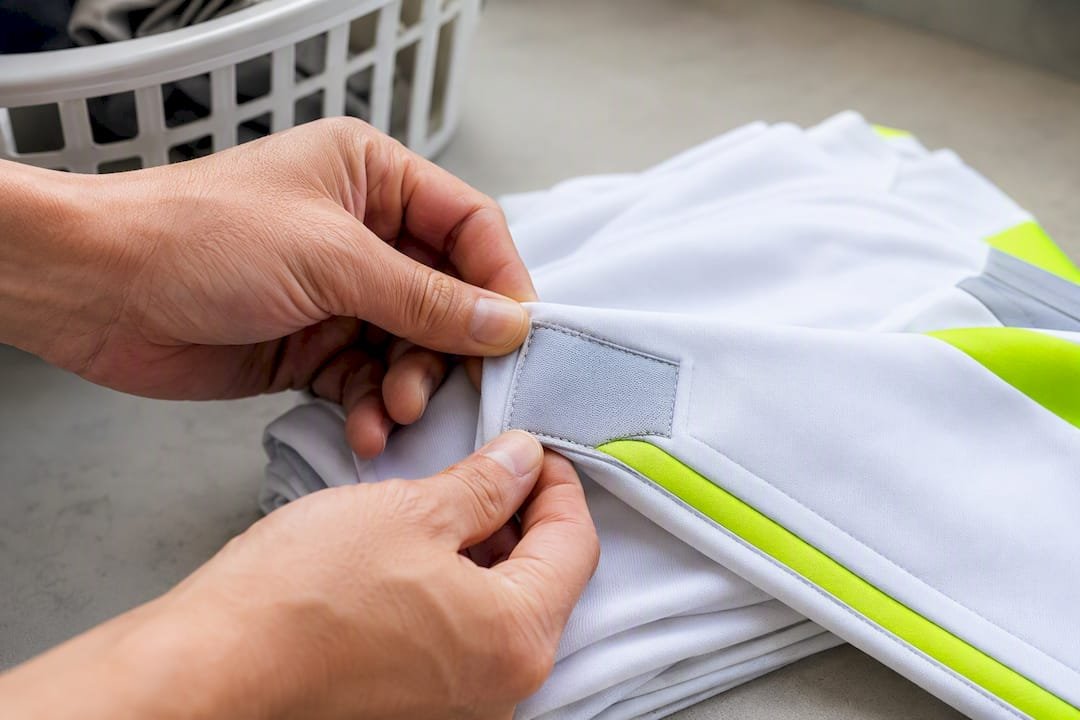
Sublimated jerseys and sewn patches both hold up best on cold water, gentle cycle, and air dry. Bleach and high heat are the two fastest ways to fade a printed jersey or loosen a patch’s stitching over a season.
Sewn patches generally outlast iron-on versions, especially on jerseys that get washed weekly. Iron-on patches work fine for a short season or a budget-conscious league, but they’re more prone to peeling at the corners after a dozen wash cycles. Inspect helmets, patches, and cleats every few weeks. Loose stitching, a cracked helmet shell, or a peeling patch corner are all easy fixes if caught early, and much harder to deal with mid-tournament.
What Happens When a Uniform Violates the Rules During a Game?
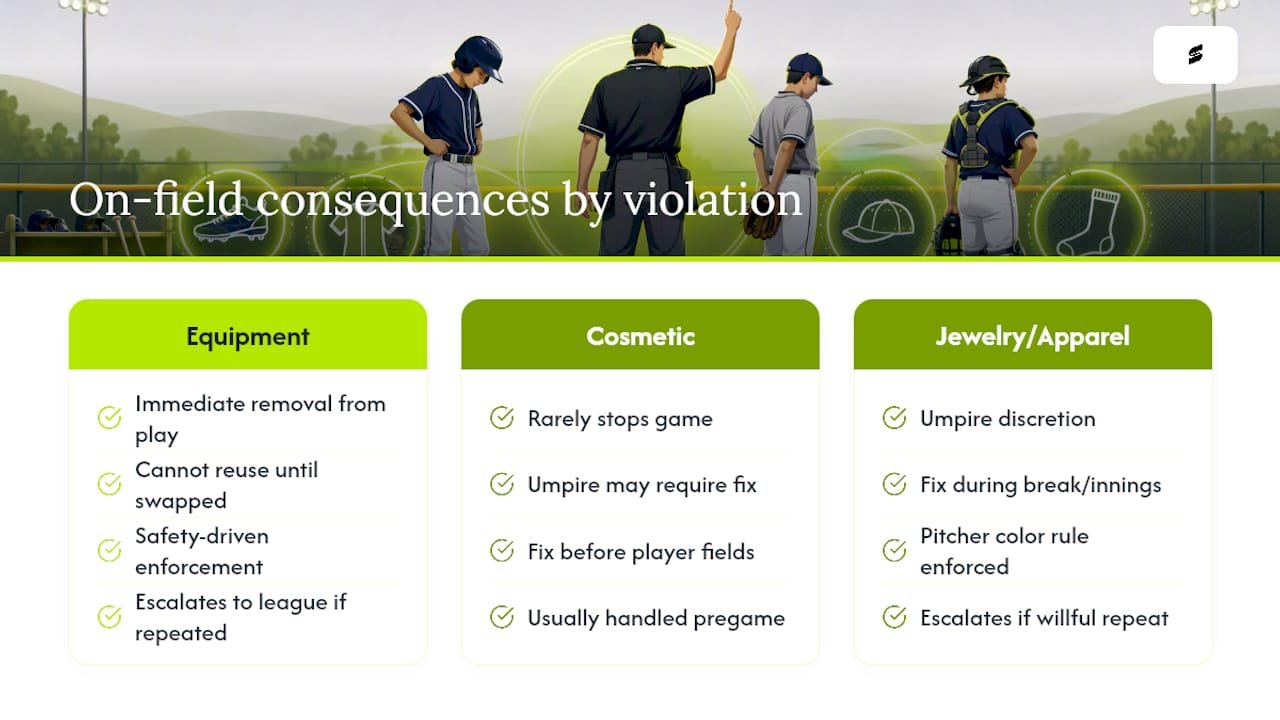
Umpires enforce uniform and equipment rules directly, and the consequences depend on what’s wrong and when it’s caught. A mismatched jersey or a missing patch rarely stops a game outright, but an umpire can require a fix before a player takes the field, especially if the issue involves something that creates confusion about eligibility or roster identity.
Equipment violations carry more weight than cosmetic ones. A bat that doesn’t meet the required USABat, BBCOR, or BPF 1.20 standard for that division gets pulled from play immediately once identified, and a player can’t use it again until it’s swapped out. A helmet missing its NOCSAE certification, or one with visible cracks, gets the same treatment. This isn’t about penalizing a team for a paperwork issue. It’s about a piece of equipment that could genuinely hurt a kid.
Jewelry and apparel calls sit squarely in umpire discretion territory. If an umpire decides a necklace, bracelet, or exposed undershirt sleeve creates a safety risk or violates the solid color rule for pitchers, the fix usually happens between innings or during a natural break in play, not mid-pitch. Repeated or willful violations, especially ones a coach was already warned about, can escalate to conversations with league officials rather than staying an on-field issue.
The practical takeaway for coaches: fix small stuff before the game starts. A pre-game equipment and uniform check, even a two-minute walk down the dugout, catches almost everything an umpire would otherwise flag once the game is underway.
What Are the Rules for Hat Logos and Color Matching?
Hats need to match across the roster in color and style, same as jerseys and pants. This isn’t just about looking sharp for team photos. A consistent hat color helps umpires and scorekeepers visually track which team is on the field, particularly in tournament settings where multiple teams share a single facility across a weekend.
League or sponsor logos on hats are standard and expected. Local leagues typically have their own branding guidelines for what goes on the front panel, whether that’s a league logo, a sponsor mark, or a team-specific design. What matters for uniform compliance is that every hat in the dugout matches every other hat. A team showing up with half solid navy caps and half caps with a different brim color creates exactly the kind of “not identical” situation the basic uniform rule is designed to prevent.
Color matching between the hat and the rest of the uniform isn’t a strict, measured requirement the way patch placement is, but leagues that skip this step tend to look disorganized at tournaments and All-Star events where uniform presentation gets noticed more. If your league is choosing hat colors as part of a broader uniform order, matching the hat to the jersey’s primary or trim color keeps the whole look consistent without requiring anyone to memorize a rule number. Practice hats or alternate colors used only for practice sessions don’t need to match game-day hats, but make that distinction clear to families so nobody shows up to a game in the wrong cap.
Are Alternate Jerseys and Special Event Caps Allowed?
Alternate jerseys and special caps show up most often during tournament play, All-Star season, or a one-off event like a season opener or a fundraiser night. Little League doesn’t forbid these variations, but the same identical-uniform principle still applies within whatever set a team is wearing that day. If the whole roster switches to a throwback jersey for one tournament game, everyone switches, not just half the lineup.
All-Star teams are the most common source of “special” uniforms, since a league often assembles a new roster from multiple teams and needs a distinct look for tournament play. These uniforms still need the official patch in its correct placement and still need to follow every equipment standard that applies during the regular season. A tournament setting doesn’t relax the rules; if anything, tournament umpires tend to be stricter about enforcement because more teams and more parents are watching.
Color-changing jerseys for a themed night, a breast cancer awareness game, or a military appreciation event have become common at the local level, and leagues generally have latitude to run these as long as the core rules around patch placement, numbering, and equipment still hold. Check with your league before ordering anything custom for a one-off event, since some leagues require these to be pre-approved to avoid a surprise at the plate.
Practical League Perspective: Streamlining Uniform Orders and Sizing
Most uniform headaches don’t come from confusing rules. They come from bad timing. A league that waits until three weeks before opening day to start sizing is setting itself up for mismatched jerseys, missing patches, and parents scrambling to find socks in the right shade of blue.
The fix is a two-stage process: run a non-binding sizing day with sample garments and mockups first, then collect firm orders with a short payment window once families have actually seen and touched the sizes. This single change eliminates most of the reorder chaos leagues deal with every August. Low order minimums matter here too, since a small team or a late addition to the roster shouldn’t be stuck waiting on a 20-jersey minimum just to get one kid outfitted. Before committing to bulk production, ask any vendor for a uniform mockup and a physical sample, and confirm lead times in writing before a single order gets locked in.
— Agha
Capra Sports: A Straightforward Option for Custom Team Uniforms
If your league is past the rulebook and now facing an actual order deadline, Capra Sports is built for exactly that moment. There’s no scrambling to hit a huge minimum order just to outfit one Little League team. There are options that provide factory-direct pricing with no minimum order quantity, free samples, and design mockups you can review with your coaching staff before anything goes into production.
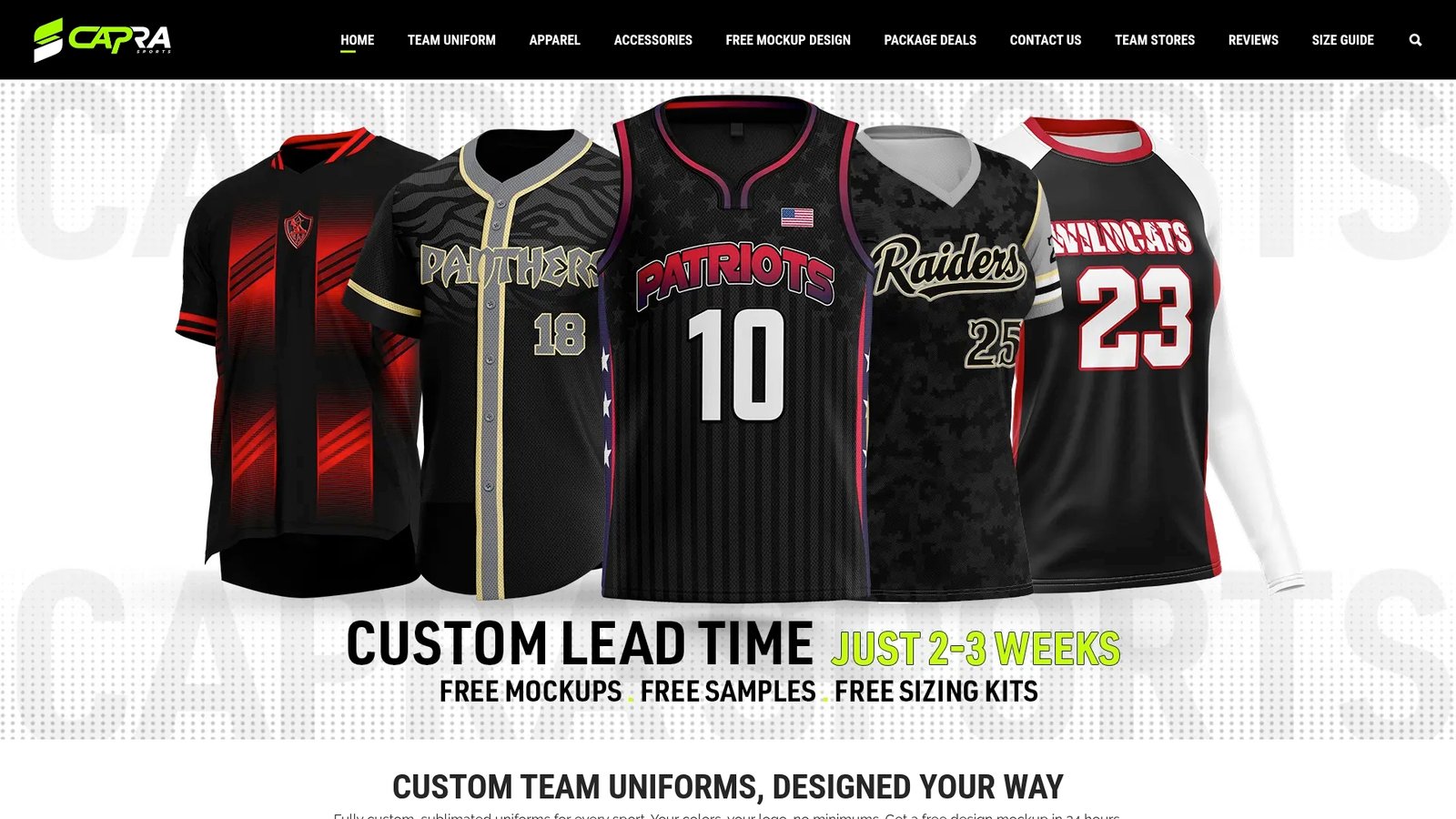
Request a sample and a mockup before finalizing your order. Seeing the actual fabric and fit ahead of time catches sizing issues before they turn into a locker room full of jerseys that don’t fit right. Coaches building out a full uniform plan can start with the coach’s guide to choosing baseball and softball uniforms, and teams ready to move forward can go straight to custom baseball jerseys or browse the full custom team uniform lineup to get a mockup started this week.
FAQ
What Are the Uniform Rules for Little League?
Uniforms must be identical in color, trim, and style across the roster, with a visible number on the jersey, the official Little League patch in its required placement, and equipment meeting Little League’s bat, helmet, and cleat standards.
What Are the New Little League Rules for 2026?
The major change carried into the 2025–2026 seasons from the 2025 update removed the blanket jewelry ban, allowed limited helmet stickers, and clarified pitcher undershirt and neoprene sleeve color rules.
Can You Wear No. 69 in Little League?
Little League doesn’t publish a list of banned jersey numbers, but leagues can set their own local numbering policies, so check with your league before assuming any specific number is available.
Why Do Little League Players Wear Sleeves?
Pitchers often wear neoprene or undershirt sleeves for arm support and comfort, and the rules require any exposed sleeve to be a solid color that isn’t white or gray so it doesn’t distract a batter picking up the pitch.
Who Is Responsible for Little League Patches?
Most leagues supply and apply the official patch as part of registration, though families should confirm this locally since some leagues ask parents to purchase and attach the patch themselves.