
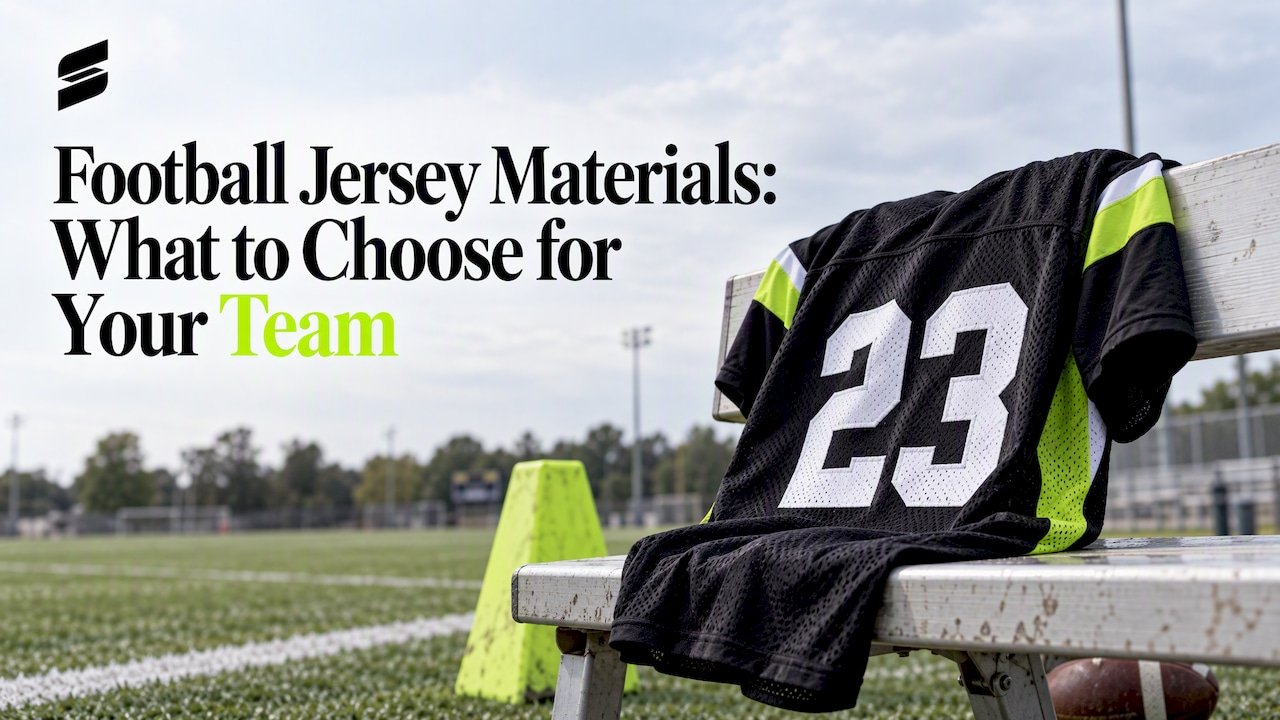
Football Jersey Materials: What to Choose for Your Team
For a football team, the best jersey material is almost always 100% polyester, usually a mesh or interlock knit, with a small amount of stretch where the cut calls for it. Polyester wicks sweat, holds up to tackling and washing, and accepts dye sublimation, which is the printing method that keeps colors sharp and the fabric light. Cotton still has a place in casual fan gear, but it is a poor fit for game-day uniforms.
This guide explains what each material does on the field, why the printing method and the fabric have to be chosen together, and what to ask before you place an order for a youth, school or rec-league team.
TL;DR
- Choose 100% polyester for game jerseys. It is the fabric that sublimation prints bond with best, and it manages sweat better than cotton.
- Mesh gives airflow, interlock gives a smoother and sturdier face, and a small stretch blend helps the fit. Most teams do well with a polyester mesh or interlock body.
- Cotton-rich fabric can be printed by sublimation only after a chemical pretreatment, and that reduces softness and compressibility.
- Fabric weight is not a quality score on its own. Compare construction, not just the GSM number.
- Before you order, check your league’s or state association’s jersey rules. Colors and numbers are regulated, and the material usually is not the issue.
Table of Contents
- Why football jerseys are made of polyester
- The main jersey fabrics compared
- Why the printing method and the fabric must match
- Comfort in the heat
- Durability across a season
- What the rule books say about jerseys
- Our perspective
- Ordering football jerseys from Capra Sports
- A checklist before you order
- FAQ
- Sources
Why football jerseys are made of polyester
Walk through any football field on a Friday night and nearly every jersey on both sidelines is a synthetic knit. That is not a fashion trend. Football asks three things from a jersey at once: it has to move sweat away from the body, survive contact and repeated washing, and carry bold team colors and numbers that do not crack or fade.
Polyester does all three at a reasonable cost. The fiber does not absorb much water itself, so moisture travels along the surface and evaporates instead of soaking in and getting heavy. It also holds its shape wash after wash, and it is the fiber that disperse dyes bond with during sublimation.
That last point matters more than most buyers expect. A Clemson study of team color consistency, which looked at 64 brand colors across several textile types and printing methods, found that dye sublimation on 100% polyester is the most durable and color-accurate approach for athletic apparel. If your school colors need to look like your school colors, the fabric decision and the print decision are really one decision.
The main jersey fabrics compared
Sellers use many names for what are, in practice, a handful of constructions. Here is how they differ for a football player.
| Material | What it feels like | Best for | Watch out for |
|---|---|---|---|
| Polyester mesh | Open, airy knit with small holes | Hot-weather games, practice jerseys, breathable panels | Can look less solid in very light colors if the mesh is open |
| Interlock polyester | Smooth, denser, slightly heavier knit | Game jerseys that need a clean face for graphics and numbers | Warmer than open mesh |
| Polyester with elastane (spandex) | Stretchy, close to the body | Fitted cuts, compression-style layers, sleeves and side panels | Too much stretch can distort large numbers if the print is not matched to the knit |
| Bi-layer knit (polyester inside, absorbent fiber outside) | Two distinct faces | Comfort-focused performance wear | Not a typical team-order fabric, and cotton outside limits sublimation |
| Cotton or cotton blend | Soft, absorbent, heavy when wet | Fan tees, warmup layers off the field | Holds sweat, sags, and is hard to sublimate without treatments |
Polyester mesh
Mesh is what most people picture when they think of a practice jersey. The open structure lets air pass through, which helps in August two-a-days and in warm climates. Because the surface is textured, very fine detail in a print can look a little softer than on a smooth knit, so bold shapes and large numbers work better than tiny script.
Interlock polyester
Interlock is a double-knit construction with a flatter, more even face. It is a common choice when a team wants strong, clean numbers and a design with big color blocks. It feels a bit more substantial in the hand, which many coaches read as quality, and it tends to hold its shape through a long season.
Stretch blends
A small percentage of elastane lets the fabric recover after being pulled. That helps with fit in the shoulders and sleeves, and it is one reason a jersey can feel athletic instead of boxy. It is a supporting player, not the main fabric. If you are curious how stretch affects sizing, our sizing guides cover that separately.
Bi-layer knits
Research groups have studied fabrics that put polyester against the skin and a more absorbent fiber on the outer face. A study of a bi-layer knitted structure for football sportswear tested polyester and cotton combinations, and the logic is sound: sweat moves off the skin and spreads to an outer layer where it evaporates. It is an interesting design, but for a printed team uniform the outer cotton works against sublimation, so single-layer polyester is the practical standard.
Cotton
Cotton feels good on a sideline sweatshirt. On the field it soaks up sweat, gets heavy, and dries slowly. For printing, it is the hard case. Sublimation on polyester and cotton blends has long needed a pretreatment so the cotton can accept disperse dye, and that extra step is exactly what changes the fabric hand.
Why the printing method and the fabric must match
There are two questions behind every jersey order: what is it made of, and how is the design put on it? Answering them separately is how teams end up with faded numbers or stiff, plasticky graphics.
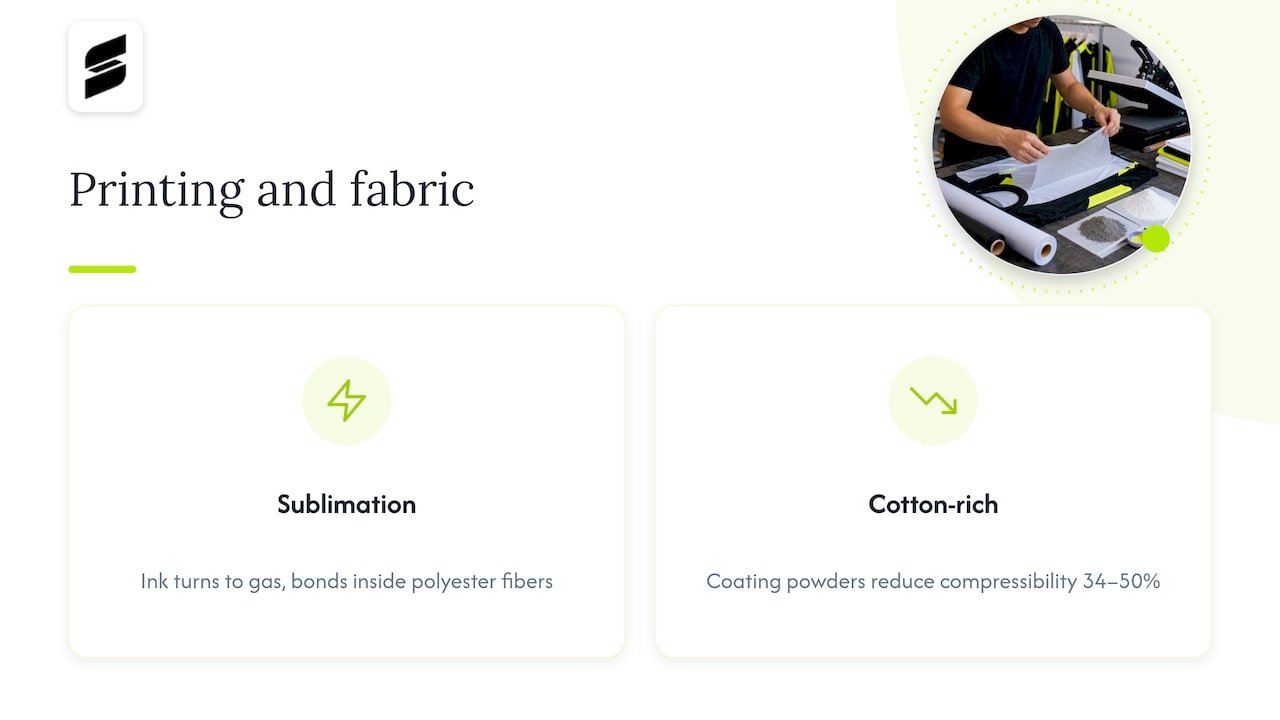
With dye sublimation, ink is turned into a gas under heat and bonds inside polyester fibers instead of sitting on top. The design cannot crack or peel because it is part of the fabric. The research backs up the trade-off: when cotton-rich fabric is treated with sublimation coating powders, the compressibility, a measure of fabric hand-feel, falls by roughly 34% to 50%. In plain terms, the shirt gets harsher against the skin.
If you want the full comparison, we lay it out in our guide to choosing sublimation for polyester jerseys and DTF for cotton. For how sublimation holds up against older methods, see sublimation vs screen printing vs heat transfer. And if you want to understand the process itself, how sublimation printing works walks through it step by step.
One practical note: sublimation works by adding dye to the fabric, which means it shows best on white or light polyester. Dark base fabrics need a different plan, which we cover in sublimation on dark jerseys.
Comfort in the heat
The fabric you choose changes how a player feels in the fourth quarter. Researchers have compared the comfort properties of four commercially available football jersey fabrics for hot and humid conditions, looking at how each handles heat and moisture. The takeaway for buyers is practical: two jerseys that both say polyester can feel very different, because knit structure, thickness and finish all matter.
What to look at when you compare options:
- Knit structure. Open mesh moves air. Interlock is denser and smoother.
- Panel placement. Mesh side or underarm panels add ventilation without changing the front graphics.
- Fabric weight. Heavier is not automatically better. Our piece on why a 200 GSM fabric varies so much explains why the number needs context.
- Moisture management. Wicking is a function of fiber and construction, not a label. See why breathability claims can mislead team buyers and what keeps teams cool.
Durability across a season
Football jerseys get pulled, grabbed, washed in bulk and left in bags. Polyester knits resist stretching out and shrinking, and sublimated graphics do not sit on the surface where they can crack. The things that shorten a jersey’s life are usually care mistakes: high dryer heat, fabric softener that coats the fibers, and bleach.
A simple care routine for a team set:
- Turn jerseys inside out and wash in cold or warm water on a gentle cycle.
- Skip fabric softener and bleach.
- Hang to dry, or tumble on low if the label allows.
- Wash after every game. Sweat left to sit can hold odor in synthetic fibers.
For a deeper look at what to expect from a printed jersey over time, read our sublimated jersey durability guide.
What the rule books say about jerseys
Governing bodies regulate how football jerseys look: colors, number placement and number size, and what a team must wear for home and away games. They are far less concerned with fiber content. That makes your fabric choice a performance and budget decision, but your design a compliance decision.
Before finalizing a design, check the rules for your level of play:
- High school teams: the NFHS publishes its annual football jersey and pant rules, and your state association may add its own requirements.
- College programs: the NCAA football playing rules are the starting point. The NCAA’s rules panel has also weighed jersey-color questions in the past, for example when it declined a proposal that would have required jersey or pant color to differ from the field of play.
- Youth and rec leagues: your league’s own rule sheet decides. Ask the commissioner before you order.
If you are choosing materials with a young player’s equipment in mind, there is also a useful way to think about custom equipment for youth players: fit, durability and comfort come first, and the look follows.
Our perspective
We get one question more than any other from football coaches and parents: “Is the cheaper fabric going to be fine?” Our answer is that the fabric itself matters less than whether it matches the print. A good polyester knit with sublimated graphics beats an expensive fabric printed the wrong way.
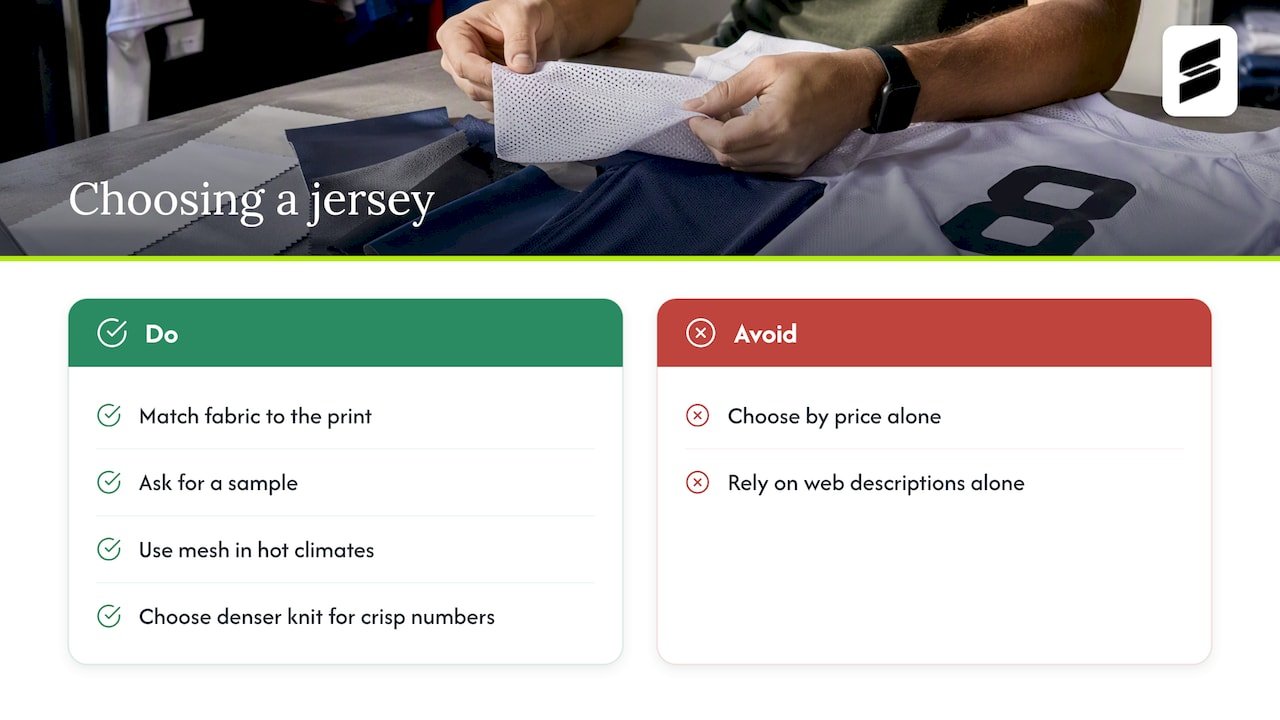
We build Capra Sports uniforms around sublimated polyester because it solves the problems teams complain about most: numbers that peel, colors that fade after a few washes, and jerseys that feel like a plastic bag by week six. When a coach tells us the team plays in a hot climate, we talk about mesh panels. When they want crisp numbers and bold blocks, we talk about a denser knit. Every project starts with a conversation, a design mockup, and a sizing sample so you are not guessing.
One more thing we tell every buyer: ask for the sample. A fabric description on a web page tells you very little. Holding the jersey, stretching it, and checking the fit on a real player tells you almost everything.
— Agha
Ordering football jerseys from Capra Sports
If you are ready to move from fabric questions to a real design, our custom football uniforms are sublimated, fully customized and designed with you. Our team works with you directly, and you receive a free design mockup within 24 hours. Pricing for football is [PRICE TBD], and you can see everything we offer on our pricing page.
Our policy is a 10-set team minimum, with one sizing sample at no extra charge so you can check fit before the full order is produced.
A checklist before you order
Use this list when you compare jerseys, from us or anyone else:
- Is the fabric 100% polyester, and what knit is it (mesh, interlock, or a blend)?
- Is the design sublimated, so the graphics are part of the fabric?
- Can you see a mockup before you pay?
- Can you check the fit on a sample first?
- Does the design meet your league or state association rules for colors and numbers?
- Does the climate you play in call for extra ventilation panels?
- Do you need matching pieces, such as pants, warmups or backpacks?
FAQ
What is the best material for a football jersey?
100% polyester is the best all-around choice. It wicks moisture, resists stretching and shrinking, and holds sublimated color better than natural fibers. Mesh suits hot weather, and interlock suits a clean face for big numbers.
Can you sublimate a cotton football jersey?
Not well. Sublimation works best on 100% polyester, and cotton-rich fabric needs a chemical pretreatment that makes the fabric less soft and compressible. If a team wants cotton, a different printing method is the better route, and we compare them in our sublimation vs DTF guide.
Is a heavier jersey fabric better?
Not necessarily. A heavier knit can be warmer and slower to dry, while a lighter mesh breathes better but may feel less substantial. Judge the construction and how it feels on a player, and compare using our fabric weight explainer.
Can I see a jersey before ordering for the whole team?
Yes. With Capra Sports you get a free design mockup within 24 hours, and one sizing sample at no extra charge. Our policy is a 10-set team minimum.
Sources
- Thermal Comfort Properties Of A Bi-Layer Knitted Fabric Structure For Football Sportswear (JTATM)
- Thermophysiological Comfort Assessment of Football Jersey Fabrics used in Hot and Humid Weather (International Journal of Integrated Engineering)
- Compression properties of knitted fabrics printed by sublimation transfer printing technique
- Clemson professors measure consistency of ACC brand team colors across athletic apparel
- Sublimation Transfer Printing of Polyester/Cotton Blends (Textile Research Journal)
- Football Jersey and Pant Rules 2026 (NFHS)
- NCAA Football Playing Rules
- Playing rules panel approves more stringent penalty in football (NCAA.org)