
Free Team Stores: How an Online Team Store Works and Pays for Itself
A team store is a private online shop stocked with your team’s custom gear. You approve the designs once, the store gets built for free, and you share one link. From there, parents pick their own sizes against the real garment chart, type the name and number, and pay by card at checkout. Nobody collects sizes in a spreadsheet, nobody fronts money, and when the store closes everything in it becomes one production order. Add a small markup to the items and the same store pays part of the season’s bills.
TL;DR:
- A team store moves sizing and payment from the coach to each family. The coach’s job shrinks to approving designs and sharing a link.
- Capra team stores are free. The only commitment is the normal 10-set team minimum once the store closes.
- Open the store for two to three weeks, not forever. A deadline is what gets orders in, and one close date means one production batch and one delivery.
- A markup you set once is applied at checkout and returned to the program. Five dollars on forty hoodies is two hundred dollars without a bake sale.
- Count backwards: store closes, then three to four weeks of production and shipping. Start the mockup about eight weeks before the kit is needed.
Table of Contents
- What Is a Team Store and How Does It Work?
- How Do You Set Up a Free Team Store?
- How Long Should a Team Store Stay Open?
- How Does a Team Store Raise Money for the Program?
- What Should Go in the Store?
- How Do Parents Get the Sizes Right?
- What Happens After the Store Closes?
- How Capra Sports Fits In
What Is a Team Store and How Does It Work?
Most team orders still run on a group chat, a spreadsheet and the coach’s own debit card. Someone asks for sizes by Friday, half the replies are wrong, and the coach ends up fronting several hundred dollars and chasing the last three families through October. A team store is the version of that job where the families do the data entry and the payment, and the coach keeps the part that matters: picking the gear.
Here is how the three common ways of running a team order compare on the things that actually eat a coach’s week.
| Group chat + spreadsheet | Coach collects cash | Team store | |
|---|---|---|---|
| Who enters sizes | Coach retypes every reply | Coach, from paper or texts | Each parent, on their own phone, against the garment chart |
| Who fronts the money | Coach or booster club | Coach, until everyone pays | Nobody. Each family pays at checkout |
| Chasing payments | Weeks of reminders | Weeks of reminders | None. An unpaid item is simply not ordered |
| Wrong size or misspelled name | Common. Every retype is a chance for an error | Common | Rare. The parent types it and sees it on screen |
| Fundraising | None | None | Optional markup goes back to the program |
| Coach’s time | Several evenings | Several evenings plus the bank | About an hour, mostly approving the mockup |
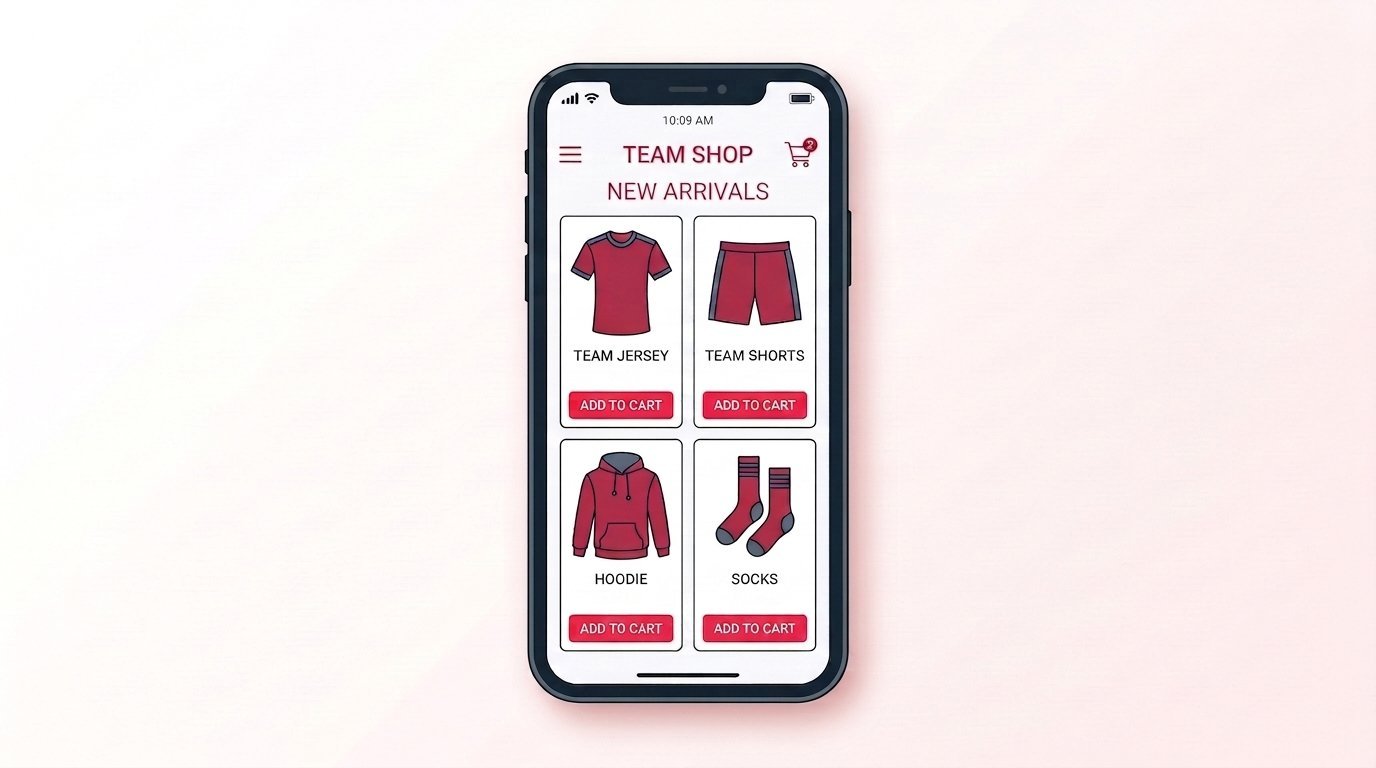
The store itself is a password-protected page on our site with only your team’s items in it. Each item carries a size dropdown, the garment-measurement chart for that exact piece, and whatever personalization the design uses: a player name, a number, or split sizes when a player needs one size in the jersey and another in the shorts. Parents pay by card, Apple Pay or Google Pay. Every order lands in one list with its size and personalization attached.
How Do You Set Up a Free Team Store?
Setting up a store takes less of your time than one round of collecting sizes. It starts the way every Capra order starts, with a free mockup, and the store is built around the design you approve.
- Send the mockup form. Team name, colors, logo if you have one, and which pieces you want. A designer sends back a mockup within 24 hours. Ask for changes until it is right, then approve it.
- Choose what the store carries. Just the game uniform, or the uniform plus a hoodie, a backpack, a shooting shirt. Some teams list one package, for example two uniform sets and a backpack as a single item, so a parent makes one decision instead of five.
- Set the window and the markup. Pick an open date and a close date, usually two to three weeks apart. Decide whether the program adds a markup, and how much.
- Review the private link. The store is built as a password-protected page. You get the link and password first and check every item, price and size option before any family sees it.
- Share one link. Announce it at practice, post the link and password in the group chat that evening, and let the store do the collecting.
Here is what the calendar looks like when the gear has to be on the players by a fixed date.
| Step | When | What happens |
|---|---|---|
| Mockup request | Week 0 | You send the form. A free mockup comes back within 24 hours. |
| Design approved | Week 0 to 1 | You review, request changes, approve. The store is built around this design. |
| Store opens | Week 1 to 2 | Private link and password go to the families. Orders and payments arrive on their own. |
| Store closes | Week 4 | Two to three weeks after opening. Everything in the store becomes one production order. |
| Production and shipping | Weeks 4 to 8 | About three to four weeks, the same as any team order. |
| One delivery | Week 8 | The whole team’s gear arrives together and is handed out at practice. |
If your families have never ordered this way, point them at the youth jersey sizing guide before the store opens. For teams that want certainty, a free sizing kit lets players try real samples first.
How Long Should a Team Store Stay Open?
Two to three weeks. Shorter than that and working parents miss it. Longer and the order never feels urgent, so the same three families are still missing on day thirty. A fixed window also keeps the whole team in one production batch, which is what makes everyone’s gear arrive together.
The communication plan is four messages, and none of them are chasing individuals.
| Message | When | What it says |
|---|---|---|
| Announcement | At practice, the day the store opens | What is in the store, what it costs, the close date. Then the link and password in the chat that evening. |
| Reminder one | One week before close | The close date, and that late orders cannot be added to the batch. |
| Reminder two | The day before close | Last call. This is the one that moves the stragglers. |
| Confirmation | The day after close | What was ordered, the delivery window, and when the next store will open. |
The 10-set team minimum still applies inside the window. A full roster clears it on its own. For a small squad, the sizing kit plus a nudge to the two or three families who have not ordered is usually all it takes. A family that misses the window can ask about a second run, which carries the same minimum.
How Does a Team Store Raise Money for the Program?
Families already spend real money on youth sports. The Aspen Institute’s 2024 parent survey put the average at $1,016 per child per year on a primary sport, up 46 percent in five years. A team store does not add to that bill. It redirects a slice of what families were going to spend on gear back into the program.
The mechanism is a markup you set once when the store is built. It is applied at checkout on every item, and the difference is returned to the program after the store closes. Spirit wear is where it works hardest, because grandparents and siblings buy hoodies too.
| Markup per item | 25 items sold | 40 items sold | 60 items sold |
|---|---|---|---|
| $3 | $75 | $120 | $180 |
| $5 | $125 | $200 | $300 |
| $8 | $200 | $320 | $480 |
Keep the markup small and say what it funds. Parents who know the five dollars pays for tournament entry fees buy a second hoodie. Parents who find a surprise markup do not. Set it, name it in the announcement, and leave it.
What Should Go in the Store?
Anything in your team’s design language, all sublimated to match. The mistake is listing everything. A store with twenty items sells less than a store with five, because parents stall. Start with what the whole roster needs, add two or three optional pieces families actually ask for, and stop.
| Item | Who buys it | Why it sells |
|---|---|---|
| Game uniform or uniform package | Every player | Required, so it anchors the store. Listing it as one package with a bag or a second set removes decisions. |
| Hoodie or quarter-zip | Players, parents, grandparents | The spirit wear piece. Highest markup potential because it sells beyond the roster. |
| Backpack or bat bag | Most players | Practical, lasts seasons, and carries the team mark everywhere. |
| Shooting shirt or warm-up | Players | Sells where the team warms up in front of a crowd. |
| Socks and arm sleeves | Players | Low price, easy add-on at checkout. |
One track program’s store sells exactly one item: a package of two compression sets and a backpack. Parents choose a cut and a size, add an athlete name if they want it, and check out. Nothing to compare, nothing to forget. If you are starting from scratch, the basketball, soccer, baseball and football package pages show what a complete set looks like, and hoodies and bags are the usual add-ons.
How Do Parents Get the Sizes Right?
Sizing moves to the family, which is where it belongs. The parent standing next to the player picks a better size than a coach guessing from a spreadsheet ever will. Three things make that work:
- Garment charts, not label sizes. Every item in the store links to the measurement chart for that exact piece. A youth large compression top and a youth large loose jersey are not the same garment. The sizing guide for coaches explains where the tape goes.
- Split sizes. A player who needs a medium jersey and a large short can enter both. The order form carries it through to production.
- A sizing kit before the store opens. For teams that want to be sure, real samples at one practice settle it. The free kit is worth doing for a roster of growing kids.
Teams that are not ready for a store, or that order from somewhere else, can still get the self-entry benefit with the free team uniform order form. It collects sizes, numbers and name spellings from one link without a store attached, and there is a t-shirt order form version for spirit wear and fundraisers. Our guide to collecting uniform sizes in one pass covers the deadline and the message to send.
The stores that work are boring on purpose. One package, one close date, one message a week. The coach who tries to offer everything, open-ended, is back to chasing people by week three.
Agha, Capra Sports
What Happens After the Store Closes?
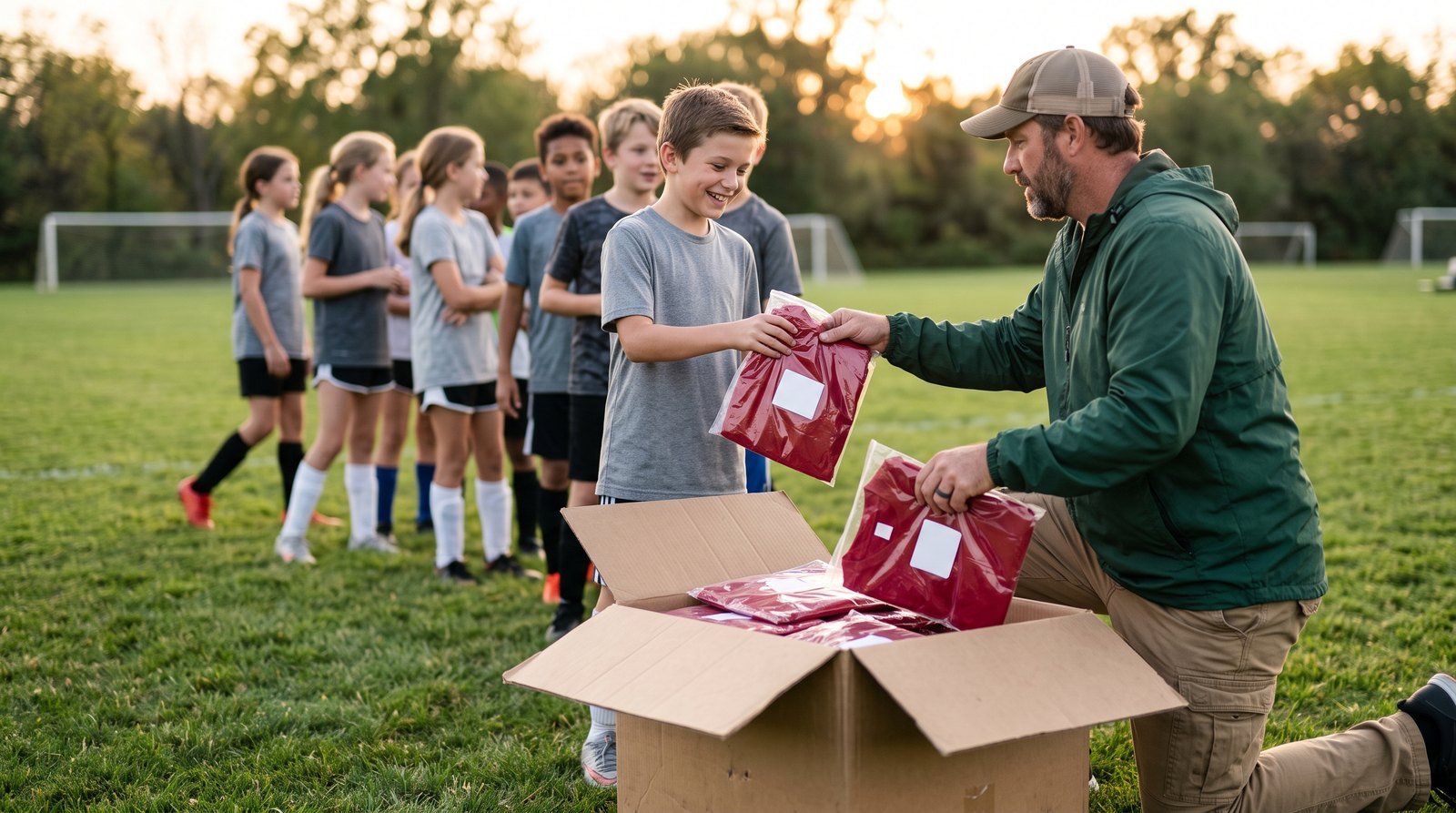
On the close date the store stops taking orders and everything in it becomes one production order. Sizes, names and numbers come straight from what parents entered, so nothing is retyped and nothing is lost between a text message and an order sheet. Production and shipping run on the same timeline as any team order, typically three to four weeks, and the gear arrives in one delivery for you to hand out at practice.
The markup total is settled with the program after close. A family that missed the window can ask about a second run; the same 10-set minimum applies, so it is worth batching late orders with next season’s spirit wear.
How Capra Sports Fits In
Capra Sports builds the store for free as part of a team order. Every item is the same fully sublimated gear as a normal order, priced from the published per-item pricing by quantity tier, with a free 24-hour mockup first and a 10-player minimum once the store closes. The store runs on our site, behind a password, with card, Apple Pay and Google Pay at checkout, and the coach gets the private link to review before anyone else. Browse the current team stores to see the format.
Get Your Free Mockup in 24 Hours
Send your team name, colors and logo through the free mockup form. A designer returns a mockup within 24 hours, you approve it, and the store comes with it. No setup fee, and no spreadsheet.
Sources
- Aspen Institute Project Play, Family spending on youth sports rises 46 percent over five years (Feb 2025)
- Capra Sports team uniform order form (free, no signup)
- Capra Sports size guide hub
Frequently Asked Questions
What is a team store?
A free, password-protected online shop for one team, stocked with that team’s custom gear. Players and parents pick their sizes, add names and numbers, and pay on their own. The coach approves the designs and shares the link.
Does a team store cost anything to set up?
No. Capra team stores are free. You approve the designs, the store is built, you share the link. The only commitment is the normal 10-set team minimum once the store closes.
How does a team store raise money for our program?
You set an optional markup once when the store is built. It is applied at checkout on every item and returned to the program after the store closes. Five dollars on forty items is two hundred dollars.
How long should a team store stay open?
Two to three weeks. Long enough for every family to order, short enough that the gear goes into production as one batch and arrives together.
How do parents order the right size?
Every item links to the garment-measurement chart for that exact piece, split sizes can be entered for jersey and shorts, and a free sizing kit before the store opens lets players try real samples.
What if a family misses the close date?
The store closes on the date you set so the whole team’s gear ships together. A late family can ask about a second run, which carries the same 10-set minimum, so late orders are usually batched with the next spirit wear store.
Is there a minimum order for a team store?
Yes, the standard 10-set team minimum. The store collects those orders from parents instead of from you.