

Mesh vs Interlock Fabric for Team Uniforms: How to Choose
Mesh is an open, airy knit that moves the most air. Interlock is a dense, smooth double knit that is stable, opaque and soft. For team uniforms, neither wins on its own. Mesh suits hot, high-sweat sports and ventilation zones. Interlock suits the main body of a jersey, where you want a clean surface, good coverage and a fabric that keeps its shape. Many jerseys combine the two.
This guide explains what the terms mean, how the two fabrics differ in breathability, opacity, durability and shrinkage, and how that affects a sublimated uniform order.
TL;DR
- Mesh describes an open structure with visible holes. Interlock is a specific double-knit construction that looks the same on both sides.
- Open mesh generally moves more air. Interlock is denser, more stable and gives better coverage.
- Research on knit structures found interlock had the lowest shrinkage compared with other knits.
- Printing method matters as much as fabric: heavy ink layers reduce airflow, which is one reason sublimation is popular for team wear.
- Combining interlock for the body with mesh at the sides or underarms is a common way to get both benefits.
Table of Contents
- What mesh and interlock actually mean
- Side-by-side: mesh vs interlock for team wear
- Breathability: where mesh earns its place
- Opacity and fit: the quiet problem with open mesh
- Durability, snagging and wear
- Do they shrink?
- Printing and fabric: why the surface decides the look
- The hybrid approach: interlock body, mesh where it counts
- How to decide: a short checklist for coaches and parents
- Order custom uniforms with Capra Sports
- FAQ
- Sources
What mesh and interlock actually mean
The two words are not parallel. They describe different things, and that is why shopping comparisons get confusing.
Interlock is a construction. It is made by knitting two 1×1 rib fabrics together, so both faces look the same, and the result is very stable and does not curl, according to CottonWorks’ guide to single and double knits. Because two layers are linked during knitting, double knits like interlock are generally heavier and steadier than single knits.
Mesh is more of a description than a single construction. In the same CottonWorks guide, a single piqué knit with a visible micro-mesh structure, meaning small holes, is described as suited to warm-weather and active apparel. A tuck-based knit can also produce a cellular surface that people call mesh, as CottonWorks’ knit basics page explains. So a seller can use the word “mesh” for several different open structures, with different hole sizes, weights and feel.
Two practical points follow:
- Mesh tells you about openness. It does not tell you the fiber. A mesh can be polyester, nylon or a blend.
- Interlock tells you about construction. It does not tell you the weight or the fiber either.
When you compare, you are really comparing an open, lighter structure against a closed, denser one. Weight, yarn and finish then adjust the result.
Side-by-side: mesh vs interlock for team wear
| What you care about | Mesh | Interlock |
|---|---|---|
| Airflow | More open, usually moves more air | Denser, less airflow |
| Feel against skin | Slightly textured, can feel rougher | Smooth and soft |
| Opacity | Larger openings can show through, especially when stretched | Closed surface, better coverage |
| Shape retention | Open structure is less stable under stress | Stable, resists curling |
| Surface for graphics | Holes break up large solid areas | Smooth base for full-coverage designs |
| Snagging | Open holes can catch on rough surfaces or fasteners | Closed surface is less likely to catch |
| Best use on a jersey | Side panels, underarms, back vents, warm-weather tops | Main body, shorts, warmup shirts |
The table reflects how the structures work, and the sections below add the evidence behind each row.
Breathability: where mesh earns its place
The logic is simple. Holes let air and heat pass. Open structures usually breathe better than tight ones, so a mesh panel is a natural choice for the places that get hottest, such as under the arms and along the ribs.
But the structure is not the whole story. Fabric weight, yarn size, the moisture-wicking finish and how the garment fits all change how cool a player feels. A loose, lightweight interlock can feel more comfortable than a heavy, tight mesh. That is why “mesh versus interlock” should be treated as a starting point, not a complete specification. For more on why airflow numbers can mislead buyers, see our piece on moisture wicking fabric and breathability.
Can you wear interlock in summer?
Yes. Interlock is not automatically a winter fabric. What matters is the weight and the fiber. A light interlock in a performance-oriented fiber is a normal choice for warm-weather sports, while heavier versions feel warmer. If your team plays in July heat, ask for a lighter body fabric and add ventilation panels rather than assuming you need an all-mesh shirt.
Sport and climate
Think about how your players actually sweat:
- Basketball and volleyball: indoor, fast, constant movement. Players run hot even in air-conditioned gyms. Ventilated panels help, and a smooth body fabric gives a clean look for big designs.
- Soccer: long continuous running outdoors. Airflow matters most in early-season and summer-league play. Our guide to soccer kit materials and airflow goes deeper.
- Baseball and softball: a lot of standing and sprinting in short bursts, often in direct sun. Coverage and durability matter, since players slide.
- Football and flag football: contact, grabbing and heat. Durability often outweighs maximum airflow.
Opacity and fit: the quiet problem with open mesh
Show-through is the reason many coaches end up unhappy with an all-mesh uniform. When mesh stretches across a shoulder or chest, the holes widen and the fabric covers less. This matters most with light colors such as white, gold or light gray, and with any design that relies on a solid block of color.
Interlock has a closed surface, so colors look solid and coverage stays consistent as it stretches. That is the main reason it tends to be used for the body of a jersey.

A useful habit is to judge a fabric as the finished garment will behave, not as a flat swatch. Hold a sample over your hand, stretch it the way a player’s shoulders would, and see what you can see through it. Parents notice this long before coaches do.
Durability, snagging and wear
Interlock’s double-knit build is why it is described as stable. It resists curling at edges and holds its shape. Open mesh is a different story: the holes can catch on rough surfaces, bench edges, fences or fasteners, and a pulled loop is hard to hide on a team photo day.
This does not make mesh a poor choice. It means you should place it where it makes sense:
- Use mesh on the sides, under the arms or on the back yoke, away from areas that rub on equipment.
- Use interlock for the front, the shoulders and anywhere a name, number or logo sits.
- For sports with sliding or contact, lean toward the closed fabric across more of the garment.
Do they shrink?
Shrinkage depends mainly on the fiber, not the mesh or interlock label. Still, structure plays a part. A 2025 study on knit comfort performance found that interlock fabrics showed the lowest shrinkage across various fiber compositions compared with other knit structures, which the authors link to their dense double-knit formation. The same research reports that polyester generally showed greater dimensional stability than cotton blends, and that 100% polyester structures deformed minimally after washing, with interlock showing high resistance to shrinkage under tensile stress (full paper).
For a team, the practical takeaways are:
- Polyester-based uniforms are generally the safer choice for stable sizing across a season.
- Always wash and dry by the care label. Cool or warm water and low heat protect printed graphics as well as fit.
- Sizing across your roster matters more than a fraction of a percent of shrinkage. That is why we send a sizing sample before you commit to a full order (details below).
Printing and fabric: why the surface decides the look
How a design is applied changes how the fabric performs.
Sublimation uses heat to turn dye into a gas that bonds with polyester fibers, so the color becomes part of the fabric instead of sitting on top of it. That is why sublimation is the standard approach for polyester team wear and why it keeps a jersey light. Read our explainer on what sublimation printing is and why it lasts, or the step-by-step sublimation printing process.
The alternative, a layer of ink or film on the surface, can seal the pores of a knit. In a Polish study of printed polyester fabric, screen printing reduced air permeability by 64%, while thermal transfer printing reduced it by roughly 26%. A fabric that breathes well on the swatch can feel much hotter once a big graphic is stacked on top. We compare the methods in sublimation vs screen printing vs heat transfer, and explain the cotton question in sublimation vs DTF.
Two design notes tied to fabric:
- Smooth, closed fabrics show full-coverage graphics most cleanly. Open mesh interrupts large solid areas with tiny holes, which is fine for patterns and gradients but less ideal for fine text.
- Dark colors on a light base need care. See sublimation on dark jerseys for what works.
The hybrid approach: interlock body, mesh where it counts
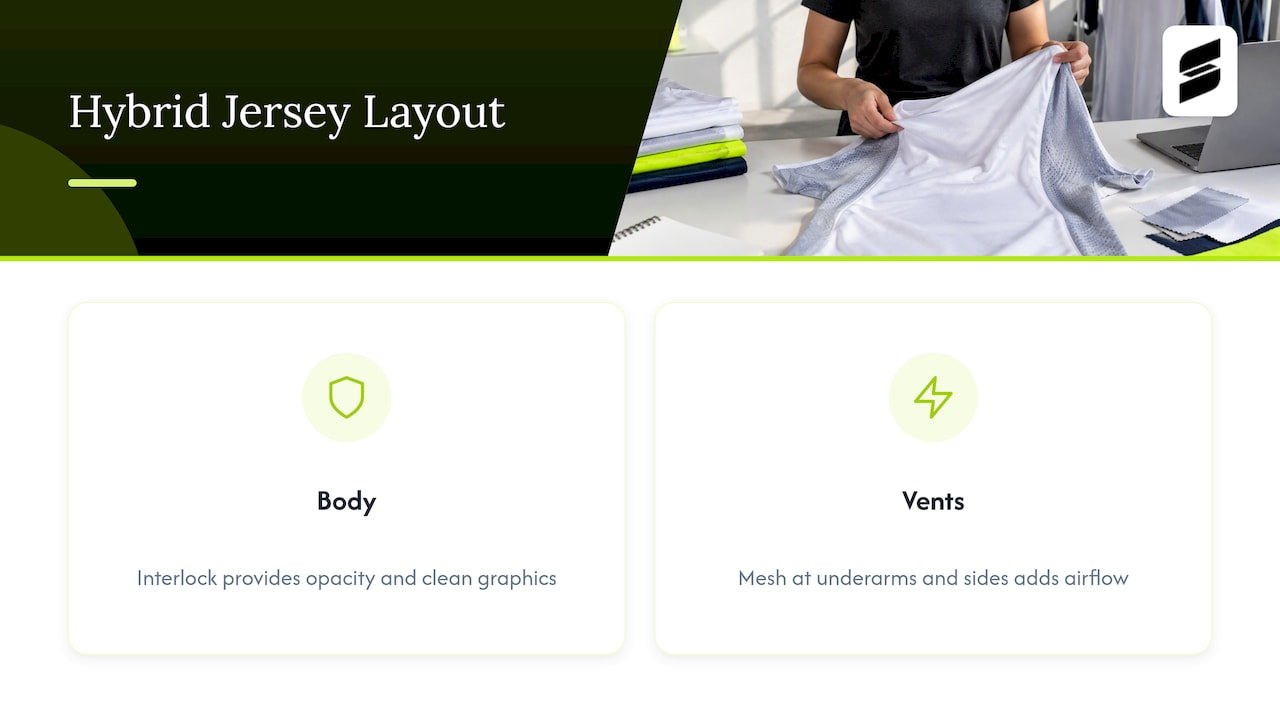
Many performance jerseys do not choose. They use a closed, stable fabric for the body and put mesh at the underarms and sides for ventilation. That gives you opacity and clean graphics where people look, and airflow where players overheat.
This layout works across sports. A hockey player, for example, already manages a lot of equipment, so a vented jersey sits alongside protective gear such as a hockey mouth guard to keep a full kit comfortable through a long game.
If you are weighing mesh against other jersey finishes such as dazzle, our comparison of mesh vs dazzle jerseys covers that decision. For a broader view, see the best fabric for jerseys and moisture wicking jerseys.
How to decide: a short checklist for coaches and parents
- Name the climate. Indoor gym, summer outdoor league or cool-weather season? Warmer play favors more ventilation.
- Pick your lightest color. If the main color is white or a pale shade, prioritize a closed fabric for the body.
- Look at the design. Large solid blocks and fine lettering suit a smooth surface. Patterns and gradients can handle some openness.
- Think about contact. Sliding, tackling and bench seating all raise the risk of snags on open structures.
- Check the sample. Stretch it, hold it to the light, then wear it for a few minutes of real movement.
- Plan the vents. Decide where mesh panels sit before the design is finalized, so graphics flow around them.
- Confirm the care. Choose something the club can wash easily and that parents will actually follow.
If you are an athletic director buying for several teams, standardize on one body fabric and vary the ventilation by sport. It keeps reorders simple.
Our perspective
We talk with coaches every week, and the same question comes up: “Should we get mesh or something heavier?” Our answer is that the label is the wrong starting point. Start with the player, the sport and the color scheme, then choose where air and coverage each need to go.
A sublimated polyester uniform lets us put the design inside the fabric, so graphics do not add a stiff layer on top. That frees you to choose a fabric for comfort and fit, not to work around the print.
Our designers collaborate directly with you on layout, including where ventilation panels sit relative to names, numbers and logos. You get a free mockup within 24 hours, with unlimited revisions, so you see the decision before you pay for it. We also send one sizing sample at no extra charge, so players can try the fabric and fit before the team order goes in.
Agha
Order custom uniforms with Capra Sports
Capra Sports makes custom sublimated uniforms for basketball, baseball, softball, soccer, football, flag football, volleyball and cheer, plus warmup shirts, hoodies and backpacks. Tell our designers where your players run hottest and what colors you want, and they will build the layout around it. Team orders start at a 10-set minimum, and each order includes one sizing sample at no extra charge. Pricing is [PRICE TBD] and you can see the current options on our pricing page.
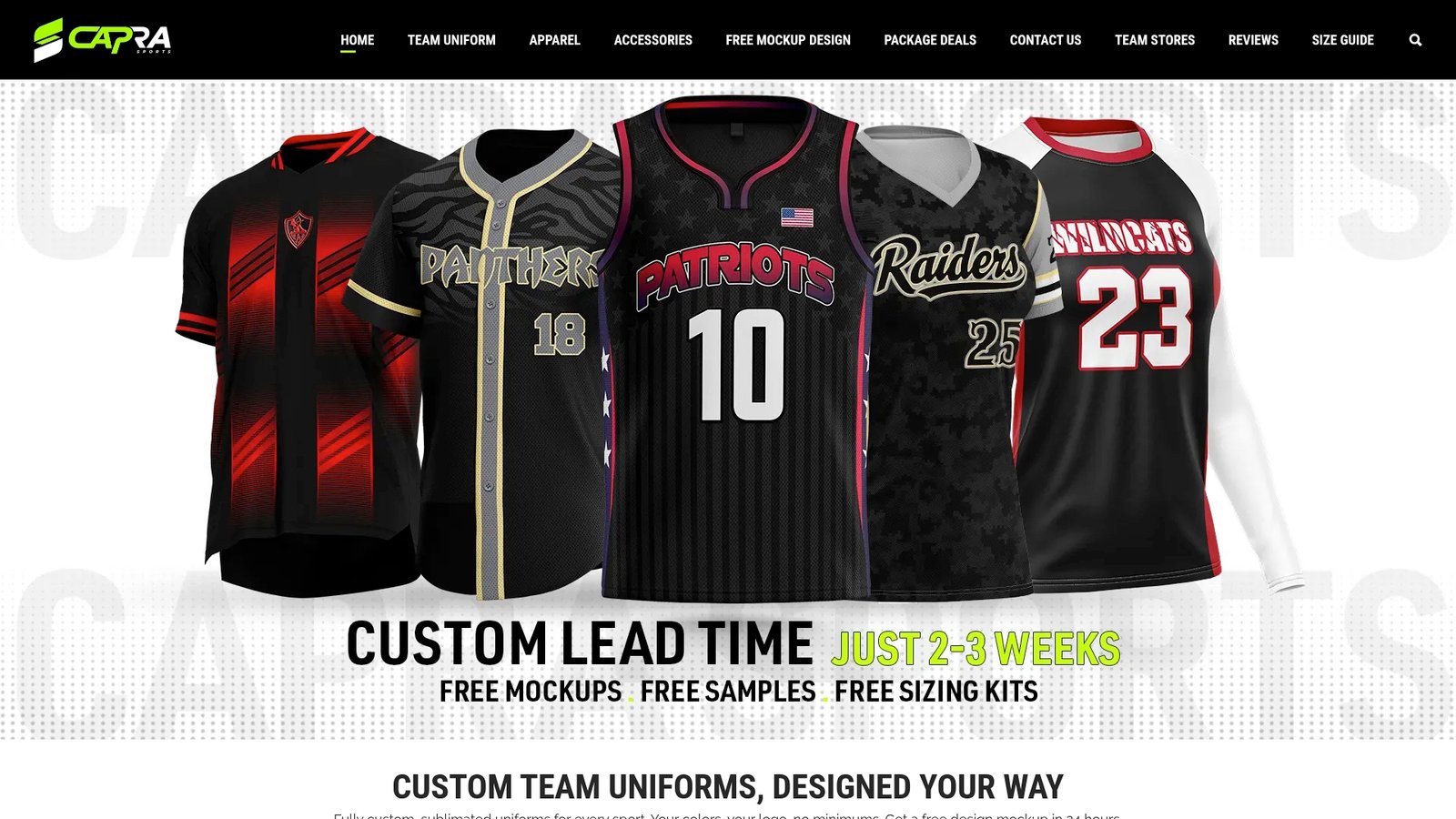
Ready to see your design? Start with a free mockup from our custom uniform lineup, delivered within 24 hours.
FAQ
What is the main difference between mesh and interlock?
Mesh is an open structure with small holes that lets more air through. Interlock is a dense double knit made from two linked rib fabrics, with the same face on both sides. Mesh favors airflow, while interlock favors smoothness, opacity and stability.
Is mesh or interlock better for hot weather?
Mesh generally moves more air, so it helps in the hottest zones. But weight, yarn and finish also affect comfort, so a lightweight closed knit can feel fine in summer. A jersey with a closed body and mesh side panels is a popular compromise.
Does interlock shrink less than mesh?
Research on knit structures found interlock showed the lowest shrinkage compared with other knits, thanks to its dense double-knit build. Fiber content matters too, and polyester is generally more dimensionally stable than cotton blends. Following the care label keeps any uniform closer to its original size.
Can mesh show through on light-colored uniforms?
Yes. Larger openings can show more through, particularly when the fabric stretches across the chest or shoulders. For white or pale uniforms, a closed fabric for the body and mesh only in side or underarm panels keeps coverage consistent.
Which should my team choose for a custom sublimated uniform?
The choice depends on your sport, climate and colors. Share those details with our designers, review your free mockup, and test the free sizing sample before placing a team order of 10 sets or more.
Sources
- Single & Double Knits, CottonWorks
- Knit Basics, CottonWorks
- Effect of Ecocell Fiber Blends on Comfort Performance, Scientific Research Publishing (paper page)
- Effect of Ecocell Fiber Blends on Comfort Performance, Scientific Research Publishing (PDF)
- Assessment of the Impact of the Surface Modification on Fabric Properties, PubMed Central