
Stop Guessing: Pick Sublimation for Polyester Jerseys, DTF for Cotton
Sublimation wins for light polyester and coated hard goods because it infuses color permanently into the fiber with no visible layer. DTF wins for cotton, dark garments, and mixed-fabric orders because it prints on nearly any blank, including black tees sublimation simply cannot touch. Sublimation costs less per unit at scale on the right fabric; DTF costs more per transfer but earns that back in flexibility.
TL;DR:
- Sublimation is only suitable for polyester or poly-coated fabrics, making it unsuitable for cotton or dark-colored garments, which require DTF for full opacity.
- DTF can print on a wider range of fabrics, including cotton and dark colors, using white ink, while sublimation cannot produce white or print effectively on dark bases.
- The cost advantage of sublimation appears at larger volumes on polyester, whereas DTF is often more economical for low-volume, mixed, or dark fabric orders.
- Proper curing and high-quality application are critical for DTF durability, but sublimation’s molecular dye bond ensures longer-lasting designs on compatible fabrics.
- For team sports uniforms and durable apparel, sublimation is the preferred method due to its long-term resistance to cracking, peeling, and washing.
Table of Contents
- Sublimation vs DTF at a Glance
- How Does Sublimation Printing Work?
- How Does DTF Printing Work?
- Sublimation vs DTF: A Full Head-to-Head Comparison
- Which Method Should You Choose?
- What Capra Sports Has Learned Printing Team Uniforms
- Our Take: Stop Treating This Like a Brand War
- Get Sublimated Team Uniforms Without the Guesswork
- Sources
- FAQ
Sublimation vs DTF at a Glance
Before you dig into equipment and chemistry, here’s the short version most people actually need.
- Fabric compatibility: Sublimation requires polyester or poly-coated surfaces; DTF works on cotton, polyester, blends, and dark fabrics alike.
- Color and white ink: Sublimation cannot print white and needs a light base; DTF prints white and full color on any garment shade.
- Hand feel: Sublimation disappears into the fabric with zero texture; DTF leaves a thin film you can feel under your fingers.
- Durability: Sublimated designs are effectively permanent on compatible blanks; DTF holds up well but can crack or lift at the edges if undercured.
- Best use cases: Sublimation suits jerseys, all-over prints, and mugs; DTF suits cotton event shirts, mixed orders, and small-batch dark garments.
- Cost at volume: Sublimation gets cheaper per piece as polyester orders scale up, since there’s no film or powder to apply. DTF holds a steadier per-unit cost regardless of volume, which makes it friendlier for one-off or mixed-fabric runs.
Neither method is objectively “better.” They solve different fabric problems, and the wrong pick shows up fast, either as a faded print on cotton or a heavy plastic patch on a jersey that was supposed to breathe.
How Does Sublimation Printing Work?
Sublimation printing works by turning solid dye into a gas that bonds directly with polyester fibers. You print a mirrored design onto special transfer paper using sublimation ink, then sandwich that paper against a polyester or poly-coated blank in a heat press. Under heat and pressure, the dye skips the liquid stage entirely, converts to a gas, and pushes into the open fibers of the polyester. When the fabric cools, the fiber closes back around the dye, and the color becomes part of the material itself rather than sitting on top of it.
Two variants exist. Transfer sublimation, the more common approach for garments, prints onto paper first and then presses that paper onto fabric. Direct dye diffusion sometimes skips the intermediate paper for certain hard goods, but for apparel, transfer paper is the standard.
The equipment list is short but specific: a sublimation printer loaded with sublimation ink (not standard inkjet ink), sublimation transfer paper, and a heat press capable of consistent temperature and pressure across the whole platen. Home craft heat presses can technically do it, but production shops run wide-format presses to handle full jersey panels in one pass. Transfer temperatures typically start around 350°F (175°C), and optimal ranges usually fall between 380°F and 420°F (195°C to 215°C), depending on the ink system and blank. Press time usually runs 30 to 60 seconds, though thicker or textured polyester may need longer dwell times.
Here’s why the fabric restriction is non-negotiable: sublimation dye needs open polymer fibers to diffuse into. Cotton fibers don’t have the right molecular structure to accept gaseous dye, so sublimating a cotton shirt leaves nothing behind but a faint, washed-out ghost of the design. The same problem applies to dark garments. Sublimation ink is transparent and additive, meaning it adds color rather than covering what’s underneath. Print a bright yellow logo on a navy shirt, and you get a subtle tint, not yellow.
That constraint also means sublimation cannot print white at all. White simply means “no ink applied,” letting the blank’s own light-colored base show through. This is why every sublimated garment starts life as white or light-colored polyester.
When it works, though, it works flawlessly. The dye bonds at the molecular level, which is why sublimated jerseys can go through hundreds of wash cycles without cracking, peeling, or fading in the way a printed layer eventually does.
How Does DTF Printing Work?
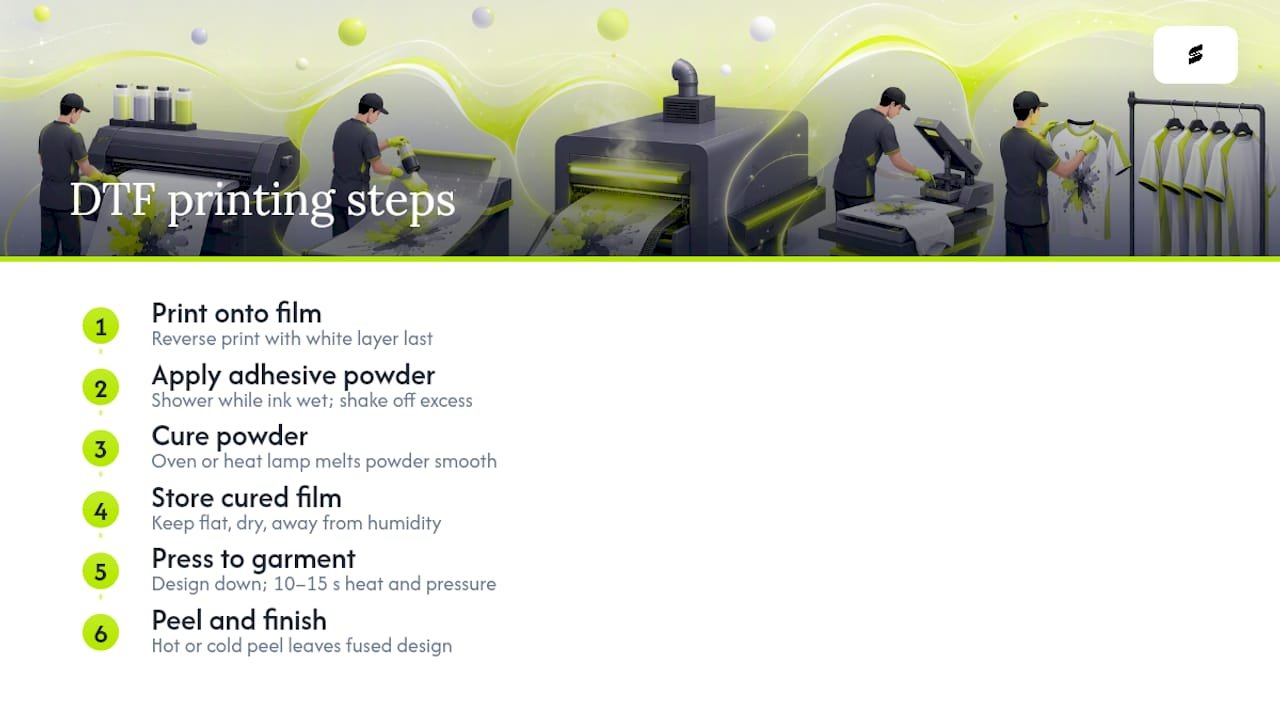
DTF, or direct-to-film printing, starts by printing your design in reverse onto a roll of PET film using DTF ink, which includes a white layer printed last so it sits closest to the garment. While the ink is still wet, the film passes over a hopper that showers it with adhesive powder. Excess powder shakes off, and the film goes into a curing oven or under a heat lamp to melt that powder into a smooth, tacky adhesive layer. The cured film gets stored flat until you’re ready to press it.
At application time, you lay the film design side down on the garment, press at heat and firm pressure for roughly 10 to 15 seconds, then peel the film away either hot or cold depending on the film brand. What’s left behind is the full-color, adhesive-backed design fused to the fabric surface.
This workflow is what lets DTF print on cotton, polyester, blends, and dark garments with equal ease. Since the design and its white base are printed onto film first, the fabric underneath never has to accept dye directly. A black cotton hoodie gets the same crisp print quality as a white polyester tee, which is the single biggest reason DTF exploded in popularity among small print shops.
Consumables run heavier than sublimation: PET film rolls, DTF ink (including that dedicated white channel), adhesive powder, and either a curing oven or a heat press doubling as a curing station. Storage matters more than people expect. Cured film sheets need to stay flat, dry, and away from humidity, or the powder can clump and cause uneven adhesion later.
The most common failure point isn’t the printer. It’s the cure. Undercured film is the leading cause of edge lift, cracking, and poor wash performance, because the adhesive powder never fully melted into a continuous bonding layer. Underpressing at the transfer stage causes the same symptoms from the other direction: the design looks fine fresh out of the press, then starts peeling at the corners after a wash or two.
For shops that don’t want to run the film, ink, and powder pipeline themselves, pre-made DTF transfers are a legitimate shortcut. You design digitally, order printed and cured transfers from a supplier, and press them yourself. This keeps quality consistent without the equipment investment, and it’s a common entry point for small businesses testing DTF before buying a curing setup.
Sublimation vs DTF: A Full Head-to-Head Comparison
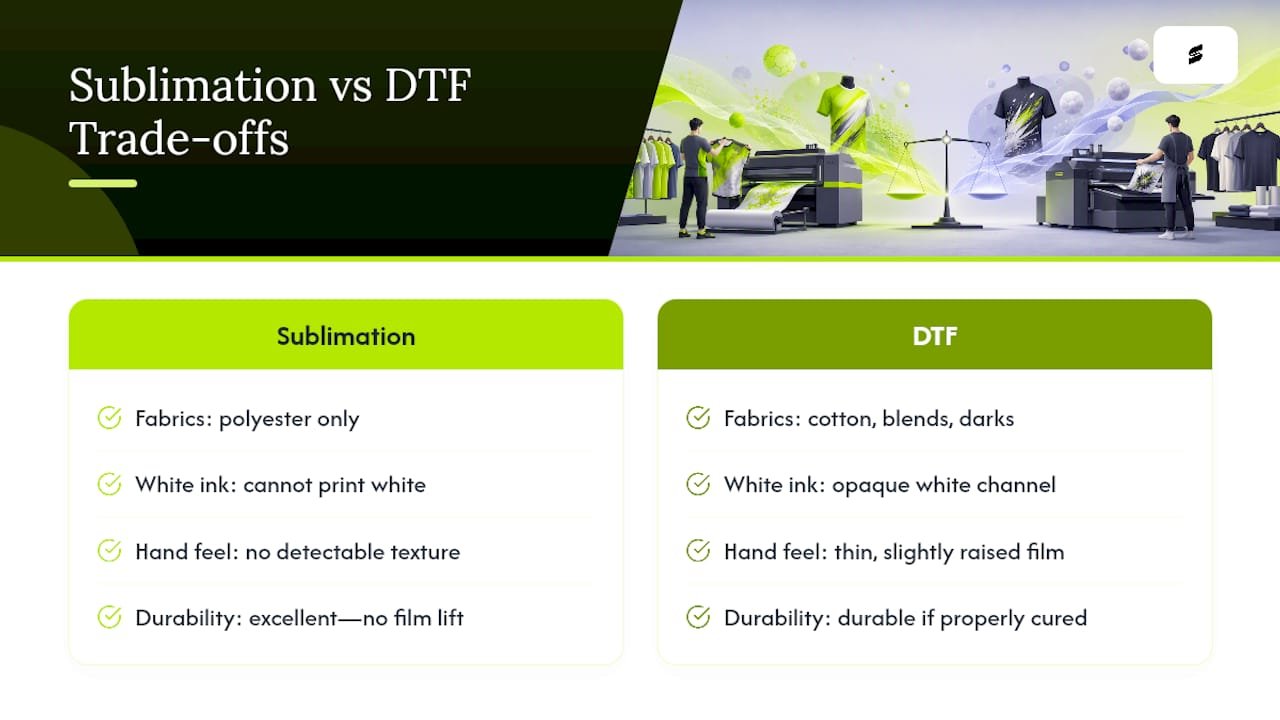
Fabric compatibility is where the two methods split hardest. Sublimation only bonds reliably with polyester or polymer-coated substrates, full stop. DTF works on cotton, blends, and dark fabrics without needing a special coating. If your blank isn’t light-colored polyester, sublimation is off the table before you even open a design file.
Statistic to remember: Sublimation’s ink activation range typically sits between 380°F and 420°F (195°C to 215°C), a tight enough window that most professional presses run on digital temperature and timer controls rather than manual guesswork.
Color and white ink capability follow the same fabric logic. Because sublimation ink adds color transparently, it cannot reproduce white, and it can’t overpower a dark base. DTF’s dedicated white ink channel means it can print bright, opaque colors on jet black fabric with no compromise.
Hand feel is the most noticeable difference to anyone actually wearing the garment. Sublimated prints become part of the fiber, so a player running the length of a soccer pitch in a sublimated jersey never feels the graphic at all. DTF leaves a thin, slightly raised film. Modern DTF films have gotten softer over the years, but on a large chest logo or full-back print, that texture is still detectable, especially after multiple washes when the film can stiffen slightly.
Wash durability favors sublimation on paper, but the real-world gap has narrowed. Properly cured DTF transfers, pressed at the right temperature and pressure, hold up through dozens of wash cycles. The risk sits entirely in execution: skip a full cure or underpress the transfer, and that’s where cracking and edge lift show up early. Sublimation removes that variable because there’s no separate film layer that can lift.
Print fidelity is a wash between the two for photographic detail and gradients. Both methods handle fine gradients and photo-realistic images well, since both are inkjet-based processes at the print stage. Sublimation has a slight edge for true all-over printing, where the design wraps seamlessly around sleeves and side panels with zero visible seams or borders, which matters a lot for basketball and soccer jerseys with edge-to-edge patterns.
Production speed depends on your order mix. DTF’s ability to batch pre-printed transfers and press them on demand makes it efficient for small, mixed orders, say, ten different shirt colors and sizes for one event.
Sublimation shines when you’re running a consistent batch of the same polyester blank, since the printer, paper, and press all move in one continuous rhythm without switching consumables between garments.
Per-unit costs flip depending on volume. At small scale, DTF often costs less to start because you can order pre-made transfers without owning a full production setup. At larger, consistent volumes on polyester, sublimation becomes the cheaper method per piece because there’s no film, powder, or adhesive layer to buy for every single unit; the cost is mostly ink and paper.
Environmental considerations lean slightly toward sublimation for polyester runs, since the process skips an extra consumable layer (film and powder) that eventually goes to waste after each transfer. DTF’s film and powder do add packaging and material waste per garment, though neither method involves the water-heavy processes associated with some older textile printing techniques.
A few concrete examples make the trade-offs click. A youth soccer team ordering matching polyester jerseys with bold, all-over sublimated patterns gets a lightweight, breathable kit that won’t crack after a season of games. A community event ordering cotton tees in five different colors for a 5K run needs DTF, because sublimation on cotton would produce nothing but a faded outline. A coffee shop selling branded mugs is squarely in sublimation territory, since ceramic with a polymer coating takes dye-sublimation beautifully. A boutique printing tote bags in mixed cotton canvas for a retail line needs DTF for the same reason as the cotton tees: the fiber simply won’t accept sublimation dye.
Which Method Should You Choose?
Start with the blank, not the design. The material you’re printing on eliminates one option before you’ve even opened your design software.
- Check the fabric first. If it’s 100% polyester or poly-coated, sublimation is available. If it’s cotton, a cotton blend, or anything other than light-colored polyester, move straight to DTF.
- Check the color. Need white in the design, or working with a dark garment? DTF is your only real option, since sublimation can’t lay down white or overpower a dark base.
- Check the print area. Full, edge-to-edge, wraparound graphics (common on basketball and soccer jerseys) favor sublimation for its seamless coverage. Chest logos or localized designs work fine with either method.
- Check your order volume. A large, consistent batch of the same polyester blank favors sublimation’s lower per-unit cost. A small, mixed-fabric, mixed-color order favors DTF’s per-piece flexibility.
- Decide whether to outsource or invest. If you’re only printing occasionally, ordering from a specialist keeps quality consistent without buying a press, oven, and ink system outright. If volume is steady and predictable, in-house equipment pays for itself faster than most shops expect.
For team sports specifically, sublimation is the default for a reason: polyester dominates athletic uniform fabric because it’s light, breathable, and moisture-wicking, and sublimation is the only method that prints on it without adding a heavier film layer that would trap heat.
Pro Tip: Order a physical sample before committing to a full team order. A swatch or sample jersey shows you exactly how the color reproduces and how the fabric feels under game conditions, catching a color mismatch or a texture surprise before you’re stuck with 20 identical mistakes.
What Capra Sports Has Learned Printing Team Uniforms
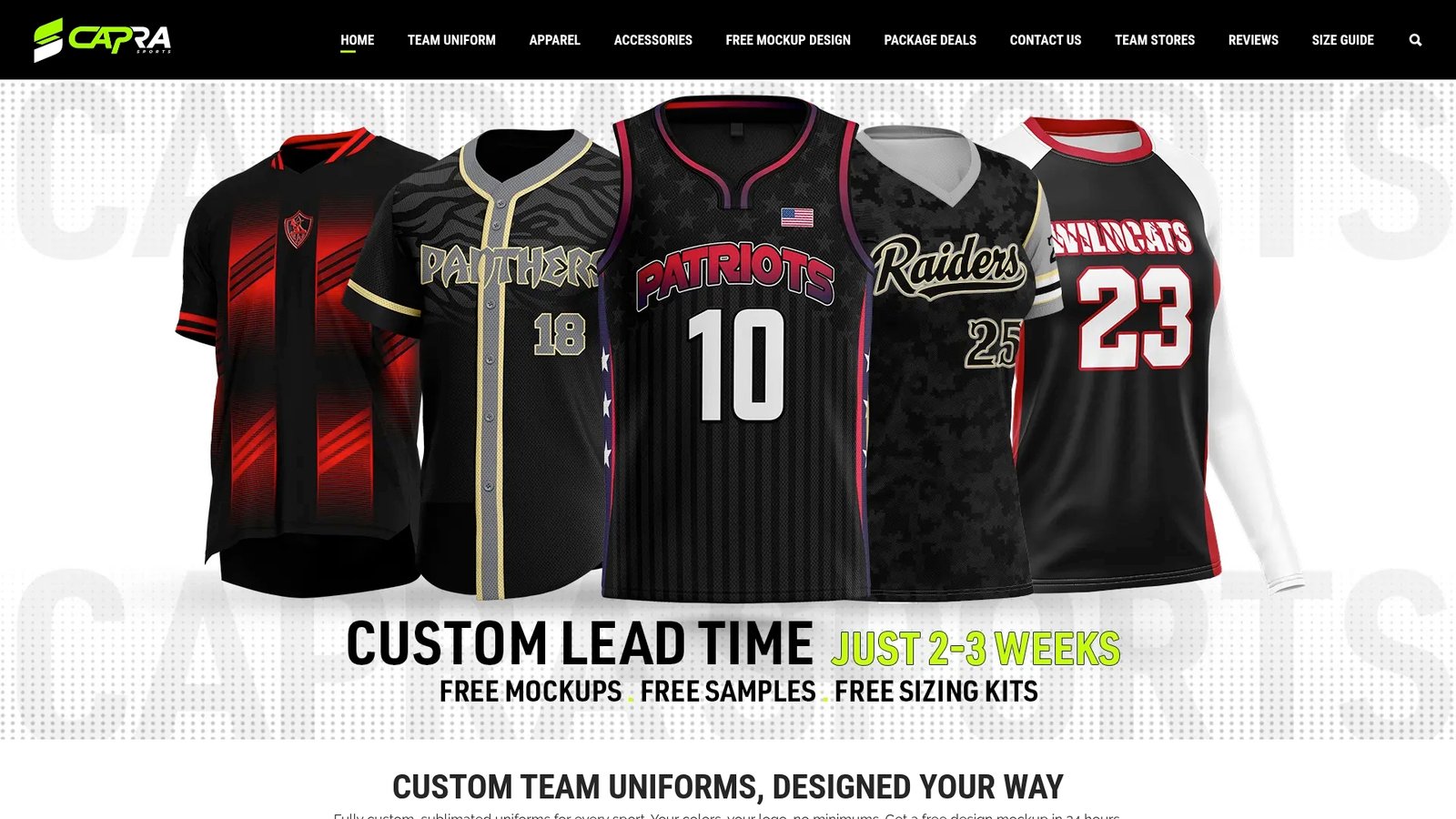
Capra Sports builds custom uniforms for basketball, baseball, softball, soccer, football, and volleyball teams using sublimated materials as the standard, not the upsell. That choice isn’t accidental. Teams need jerseys that survive a full season of practices, games, and washes without the print cracking, peeling, or feeling stiff against the skin, and sublimation’s dye-infused finish holds up to exactly that kind of abuse.
Uniform orders come with a sample before full production, low minimum order quantities, and collaboration with a designer through revisions, with pricing at the factory-direct level without markup from middlemen. For details on why the process holds up so well over time, our breakdown of how sublimation printing works and why it lasts covers the technical side in more depth.
Caring for a sublimated jersey is simple: wash cold, skip the bleach, and air dry or tumble dry low. Our guide to washing sublimated jerseys walks through the specifics that keep colors sharp for years, not seasons.
Our Take: Stop Treating This Like a Brand War
The sublimation-versus-DTF debate gets framed online like a rivalry, with forums picking sides as if one method is universally superior. That framing wastes your time. These are two tools built for different jobs, and the fabric in your hands already answered the question before you started reading reviews.
Where the conventional advice actually falls short is cost. Plenty of guides claim one method is flatly cheaper, without asking at what volume. A ten-shirt cotton order and a two-hundred-jersey polyester order live in completely different cost realities, and the “cheaper” method flips depending on which order you’re running.
Prioritize the fabric decision first, then the color and print-area requirements, and let cost fall out of those answers rather than driving them. Chasing the wrong method to save a few dollars per piece almost always costs more once reprints, complaints, or a season of cracked prints enter the picture. For polyester team uniforms specifically, sublimation isn’t the trendy pick. It’s the one built for how hard athletes actually use their gear.
— Agha
Get Sublimated Team Uniforms Without the Guesswork
Once your fabric and design decisions are settled, the fastest path to a finished uniform is working directly with a shop that specializes in exactly this. Jerseys can be obtained factory-direct with sublimated materials, low minimum order quantities, and a free sample sent before committing to a full order, allowing teams to see the real color and fabric feel before buying multiple jerseys.
If patches or embroidered team names round out your uniform design, custom patches pair well with a sublimated jersey base for added detail. When you’re ready to move forward, request a quote or browse custom football uniforms to see pricing and turnaround for your sport. Our designers work through unlimited revisions until the mockup matches what your team actually wants to wear.
Sources
- Dye-sublimation printing — Wikipedia
- How Direct-To-Film Printing Works: Simple DTF Transfer Guide — Shopify
- DTF vs Sublimation: Which One Your Fabric Allows (2026) — Atomm
- DTF vs sublimation: What’s the difference? — Printify
FAQ
Is Sublimation or DTF More Expensive?
It depends on volume. DTF often costs less for small, mixed-fabric orders since you can use pre-made transfers without buying equipment, while sublimation becomes cheaper per piece on large, consistent polyester runs because there’s no film or powder cost per unit.
Can DTF Print on Polyester Like Sublimation Does?
Yes, DTF works on polyester as well as cotton, blends, and dark fabrics, though it leaves a thin film on the surface rather than infusing dye into the fiber the way sublimation does.
Why Can’t Sublimation Print White?
Sublimation ink only adds color; it never removes it, so “white” areas of a design simply mean no ink is applied, letting the light-colored blank underneath show through.
Does DTF Feel Different From Sublimation on a Shirt?
Yes. Sublimated designs become part of the fabric with zero texture, while DTF leaves a thin, slightly raised film that’s noticeable to the touch, especially on larger prints.
Which Method Does Capra Sports Use for Team Uniforms?
Capra Sports uses sublimation as its standard process for basketball, baseball, softball, soccer, football, and volleyball uniforms, since it holds up to full-season wear without cracking or peeling on polyester fabric.