
Keep Teams Breathable All Season: Moisture Wicking Jerseys for Coaches
Moisture-wicking jerseys move sweat from the skin to the fabric’s outer surface, where it evaporates faster than it would on cotton, keeping athletes cooler and drier through a full game. For team orders, the smart pick is a technical synthetic or treated blend with mesh ventilation panels placed at the underarms and back. If you’re adding logos or numbers, sublimation holds up far better over a season than screen printing or heat transfer.
TL;DR:
- Polyester microfiber fabrics with strategic mesh panels at the underarms, back, and sides significantly improve thermoregulation during physical activity.
- Yarn-level construction, such as nanopores or additives like ground coffee, maintains wicking performance after multiple washes better than surface treatments.
- Flatlock seams and proper fit are crucial for comfort and durability, especially at high-friction points like the collar, underarms, and sleeve hems.
- Anti-odor treatments integrated into the yarn last longer and remain effective through many wash cycles compared to topical sprays or coatings.
- Sublimation printing ensures graphics are durable, breathable, and resistant to cracking or fading over a season, unlike screen printing or heat transfer methods.
Table of Contents
- How Does Moisture-Wicking Fabric Actually Work?
- Which Fabrics And Technologies Actually Deliver?
- Which Construction Details Actually Change How A Jersey Performs?
- Do Anti-Odor And Durability Treatments Actually Last?
- How Should Teams Wash And Dry Jerseys To Keep Them Working?
- Sublimation vs. Screen Printing vs. Heat Transfer: Which Holds Up?
- What Should Be On Your Jersey-Buying Checklist?
- Why Teams Choose Custom Sublimated Jerseys
- Three Lessons From Outfitting Teams
- Order Custom Moisture-Wicking Jerseys Built To Last A Season
- Sources
- FAQ
How Does Moisture-Wicking Fabric Actually Work?
The mechanism is simpler than the marketing copy suggests. Technical fabrics rely on capillary action, tiny gaps between fibers that pull liquid sweat away from your skin the same way a paper towel pulls water off a counter. That moisture travels along the fiber surface to the outside of the shirt, where more air movement and surface area speed up evaporation.
Polyester microfiber fabrics are built specifically around this transport system, pulling sweat away from the skin to the outer layer so it evaporates faster and helps athletes stay cooler than they would in cotton. That’s the whole point of a wicking jersey: it’s not absorbing sweat, it’s relocating it.
There’s a real difference between fabrics that just move liquid and fabrics engineered to speed up the vapor phase too. Some newer thermoregulation approaches, like Columbia’s Omni-Freeze ZERO, use mineral-based or treatment methods that accelerate heat loss once moisture turns to vapor, helping regulate body temperature during sustained effort. That’s a step beyond basic wicking. It’s active cooling built into the textile.
Cotton fails at this job because its fibers absorb water and hold onto it. Instead of moving sweat outward, cotton soaks it up and traps it against your skin, which is why a cotton practice shirt feels like a wet towel by the second quarter.
A few things separate a jersey that actually performs from one that just claims to:
- Fiber type: synthetic microfibers wick faster than natural cotton fibers.
- Yarn structure: engineered channels or nanopores increase the surface area available for evaporation.
- Surface finish: some treatments boost initial wicking but wash out over time.
- Weave tightness: looser knits breathe better but may sag or lose shape faster.
Reading a hangtag that says “moisture-wicking” tells you almost nothing about which of these mechanisms is doing the work.
Which Fabrics And Technologies Actually Deliver?
Not every fabric labeled “performance” performs the same way, and the differences matter more for team gear than for a single running shirt you replace every year.
Polyester microfibers are the backbone of most team jerseys, and for good reason. They’re lightweight, dry quickly, and hold sublimated dye well, which is exactly why systems like Nike Dri-FIT are built on polyester microfiber, designed to wick sweat away from the body and onto the fabric surface so it evaporates faster and improves mobility during play.
Merino wool and natural blends show up more in endurance and outdoor gear than in stock team jerseys, but they earn their reputation. Merino resists odor naturally and manages vapor well across temperature swings, which is why you’ll see it in base layers for cold-weather sports more than in a soccer kit.
Engineered yarn structures are where the science gets interesting. Some fabrics use nanopore-level construction, including yarns spun with additives like ground coffee, to increase evaporation surface area at the fiber level rather than relying on a coating. That distinction matters for team buyers because yarn-level performance survives washing in a way surface treatments don’t.
A quick spec-reading checklist:
- GSM (grams per square meter): lower GSM (120 to 160) breathes better; higher GSM (180+) lasts longer but runs warmer.
- Fiber content: 100% polyester dries fastest; poly-spandex blends add stretch at a small breathability cost.
- Recycled content: recycled polyester performs comparably to virgin polyester in most wicking tests.
Statistic to remember: mesh ventilation placement, not fabric type alone, is often the bigger swing factor. Strategic mesh panel placement at the underarm, back, and side seams has been shown to meaningfully improve thermoregulation compared with jerseys that skip targeted venting entirely, which means two jerseys made from identical fabric can perform very differently based on construction alone.
Not all wicking technology behaves the same way in the field, either. Mechanical fiber structures, mineral-based treatments, and natural fibers each respond differently depending on climate and exertion level, so matching the technology to the sport matters as much as picking a “premium” fabric.
Which Construction Details Actually Change How A Jersey Performs?
Fabric choice gets most of the attention, but construction decides whether that fabric does its job on a moving body.
Ventilation zone placement is the single biggest lever a jersey designer has. The underarms, upper back, and side panels are where the body dumps the most heat during exertion, and mesh inserts placed there pull noticeably more heat and moisture out than uniform, evenly-vented fabric across the whole shirt. A jersey with mesh scattered decoratively across the chest looks technical without actually functioning that way.
Seam construction affects comfort more than most buyers expect. Flatlock seams sit nearly flush against the skin instead of bunching into a ridge, which matters enormously under a shoulder pad or a repeated swinging motion. Bonded edges reduce fraying at high-stress points like the collar and sleeve hem, where standard stitching tends to fail first.
Fit changes the calculus entirely. A compression base layer is supposed to sit tight against the skin to maximize wicking contact, while a game jersey needs enough room to move without dragging fabric across pressure points. Sleeve and hem design should follow the sport: raglan sleeves reduce shoulder-seam chafing for throwing sports, while a longer drop-tail hem keeps a jersey tucked during full-speed sprints.
Quick construction checklist for reviewing a sample:
- Mesh panels sit at underarm, back yoke, or side seam, not just for visual pattern.
- Seams are flatlock or bonded at high-friction points (collar, underarm, hem).
- Fit matches the layer’s job: tight for base layers, athletic-cut for game jerseys.
- Hem length and sleeve style suit the sport’s dominant movement pattern.
Pro Tip: Order one sample and physically stretch the seam at the underarm and shoulder before approving a bulk order. If it puckers or the mesh panel doesn’t line up with where your athletes actually sweat, that flaw will show up on every jersey in the order.
Do Anti-Odor And Durability Treatments Actually Last?
This is where a lot of team budgets get wasted, because not every performance claim on a spec sheet survives a season of real use.
The critical distinction is between properties built into the yarn and properties sprayed or coated onto the fabric surface afterward. Yarn-level integration, like engineered nanopore structures, holds up wash after wash because the performance characteristic is part of the fiber itself, not a layer sitting on top of it. Topical anti-odor finishes, by contrast, often work impressively out of the box and then fade noticeably after a couple of dozen wash cycles.
Silver-ion and copper-based antimicrobial treatments are the most common odor-control approaches on the market, and they generally do reduce bacterial buildup early on. The tradeoff is durability. Surface-applied versions lose potency faster than treatments bonded at the fiber level, which is exactly why two jerseys claiming “odor-resistant” on the tag can smell completely different by week six of the season.
For team ordering, put these requirements in writing before you commit to a bulk order:
- Ask whether odor control is yarn-integrated or a topical spray finish.
- Request wash-cycle performance data, not just an out-of-box claim.
- Confirm color fastness testing has been done on the specific fabric weight you’re ordering.
- Get the fiber content percentage in writing, not just a marketing label.
A supplier who can’t answer these specifics probably hasn’t tested for them.
How Should Teams Wash And Dry Jerseys To Keep Them Working?
The fastest way to kill a jersey’s performance has nothing to do with wear and everything to do with laundry day.
- Wash in cold water with a mild, additive-free detergent. Detergents built with softening agents leave a surfactant residue on technical fabric that blocks the fiber’s ability to wick moisture, which defeats the entire purpose of the fabric.
- Skip fabric softener entirely. Softeners coat fibers with a film that clogs the exact capillary channels wicking depends on.
- Avoid bleach, which breaks down synthetic fibers and can degrade sublimated color faster than normal wash cycles would.
- Hang-dry when possible. Air drying protects both the fabric structure and any printed graphics from heat damage.
- Use low heat only if the care label allows dryer use, and always on a low or delicate setting.
- Treat stains as they happen rather than letting them set, and skip harsh spot removers that can strip the surface finish and void a supplier’s performance guarantee.
Print a laundry card and hand it to every parent or player at the start of the season. It’s a five-minute conversation that adds years to a uniform’s life.
Sublimation vs. Screen Printing vs. Heat Transfer: Which Holds Up?
The decoration method you choose can undo everything the fabric and construction got right, so this decision deserves as much attention as the fabric spec itself.
Sublimation turns dye into a gas that bonds directly with polyester fibers, so the graphic becomes part of the fabric instead of sitting on its surface. That’s why sublimation printing preserves breathability and durability far better than surface-applied methods, especially on the polyester microfibers most team jerseys are built from. There’s no ink layer to crack, peel, or block airflow through the mesh panels you paid extra for.
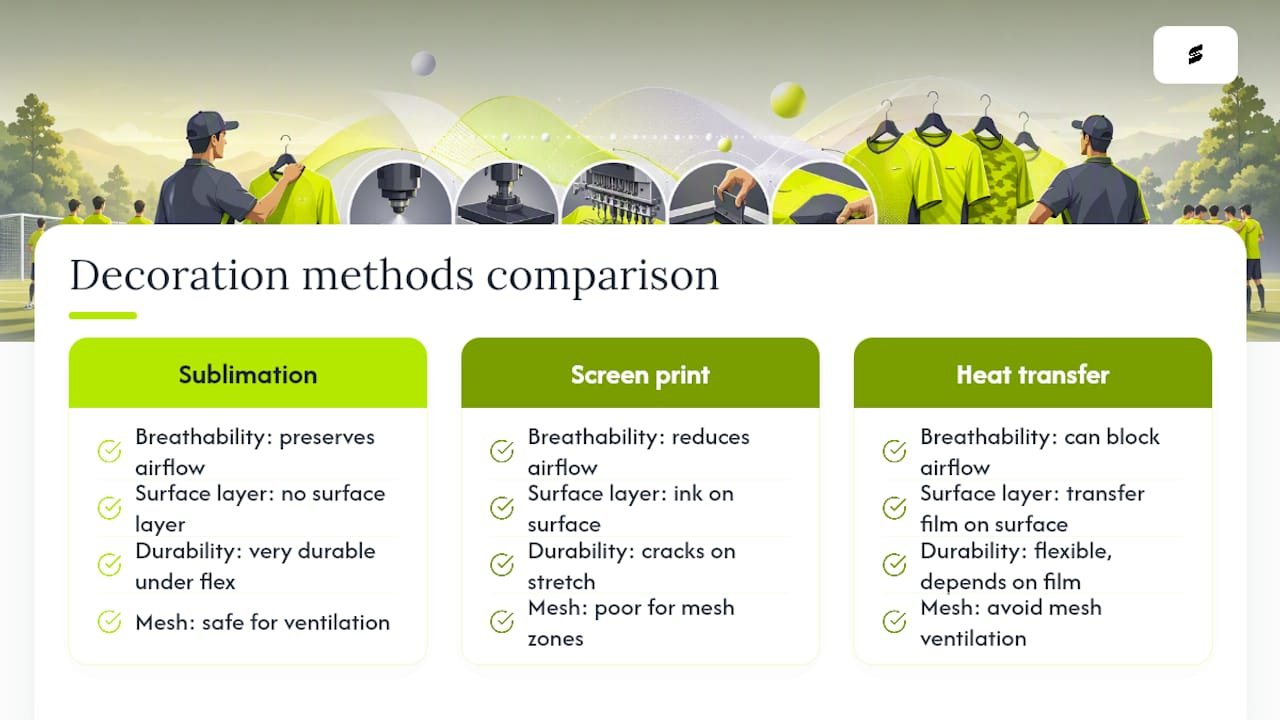
Screen printing applies a physical layer of ink on top of the fabric. On a stretch fabric or a mesh ventilation zone, that ink layer can crack under repeated flexing and reduces the fabric’s ability to breathe exactly where you need it most. It still works fine for small, low-detail graphics on non-stretch panels, but it’s a poor match for full-jersey designs on technical fabric.
Heat transfer sits somewhere in between. It can produce crisp, detailed graphics, but the transfer material itself sits on the fabric surface and can block airflow if applied over a mesh panel or a large chest area. If your team goes this route for a specific detail, choose the thinnest, most flexible transfer material available and keep it away from ventilation zones.
Pro Tip: If your design includes gradients, photo-realistic logos, or full-jersey color blocking, sublimation is the only method that won’t compromise the fabric’s ventilation. Save screen printing for small, one-color accents on non-mesh areas only.
What Should Be On Your Jersey-Buying Checklist?
Picking the right jersey for a specific sport or climate comes down to matching a handful of variables, not chasing the most expensive fabric on the rack.
Run through this checklist before you request a quote:
- Activity intensity: high-output sports (soccer, basketball) need more ventilation than lower-intensity sports (baseball, golf-style activewear).
- Climate: hot, humid conditions call for lighter GSM fabric and maximum mesh coverage; cold-weather sports can tolerate heavier, warmer weaves.
- Fabric weight (GSM): match weight to season, not just sport.
- Ventilation placement: confirm mesh sits at underarm, back yoke, and side seam, not just anywhere for visual effect.
- Decoration method: sublimation for full designs, screen printing only for small non-stretch accents.
- Samples and fit testing: never approve a bulk order without physically testing at least one sample garment.
- Budget and lead time: confirm both up front, since rush production sometimes trades away quality control steps.
Before signing off with any supplier, ask these questions directly:
- What’s your sample policy, and is it free or a paid deposit?
- What’s your minimum order quantity?
- Do you wash-test fabric before it ships, and what’s the process?
- Can you guarantee color fastness across the full order run?
Watch for these red flags: a supplier who can’t produce fabric specs on request, marketing copy that says “moisture-wicking” without naming a fiber content or GSM, and any company unwilling to send a physical sample before you commit to volume.
Why Teams Choose Custom Sublimated Jerseys
Every checklist item above points toward the same conclusion: performance depends on fabric, construction, and decoration method working together, not any single feature standing alone. That’s the gap most stock jersey suppliers never close.
Caprasport builds every team order around sublimated materials specifically because dye-integrated printing protects the ventilation and fiber structure you’re paying for. Low minimum order quantities mean a small rec league team doesn’t get priced out the way bulk-only suppliers force them to. Free samples let a coach physically check seam placement and mesh zones before committing an entire team’s budget, which matters given how much construction quality varies between suppliers.
Direct collaboration with professional designers means unlimited revisions instead of a single take-it-or-leave-it template, and factory-direct pricing removes the markup layer that inflates costs at middleman-run uniform shops. Consistent sizing across a full roster order, accurate color reproduction through sublimation, and print permanence that survives a full season of washing are the practical outcomes of that combination, not marketing promises.
Three Lessons From Outfitting Teams
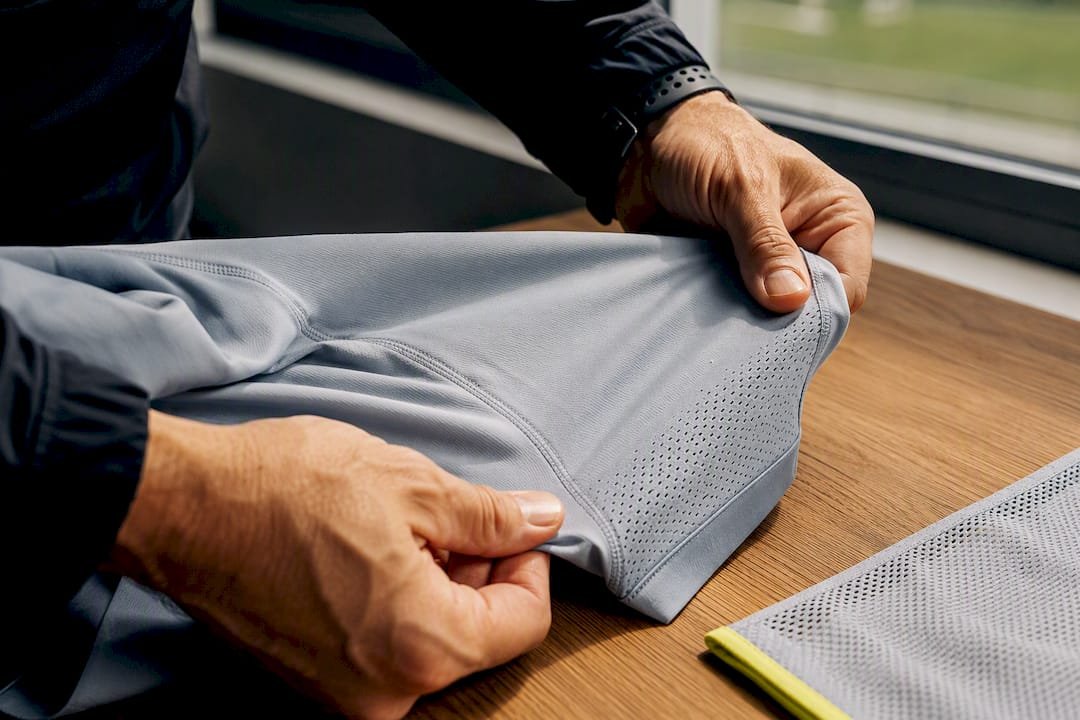
The biggest mistake coaches make isn’t picking the wrong fabric. It’s skipping the sample step entirely and ordering thirty jerseys off a photo. A five-minute stretch test on one sample catches seam and ventilation problems that a spec sheet will never reveal.
The second lesson: cheaper per-unit pricing rarely stays cheap once you count the reorders from jerseys that pill, fade, or crack their print by midseason. Durability is a math problem, not a feel-good phrase.
If you’re a first-time coach ordering team kits, start narrow: request one sample, check the seams at the underarm and collar, and confirm the ventilation actually lines up with where your players sweat.
— Agha
Order Custom Moisture-Wicking Jerseys Built To Last A Season
Caprasport is the direct route to durable, breathable team jerseys, without the markup a middleman-run uniform shop adds to every order. You get sublimated graphics that won’t crack or fade, mesh panels placed where your athletes actually need airflow, and no minimum order quantity forcing a small team to overbuy just to get a fair price.
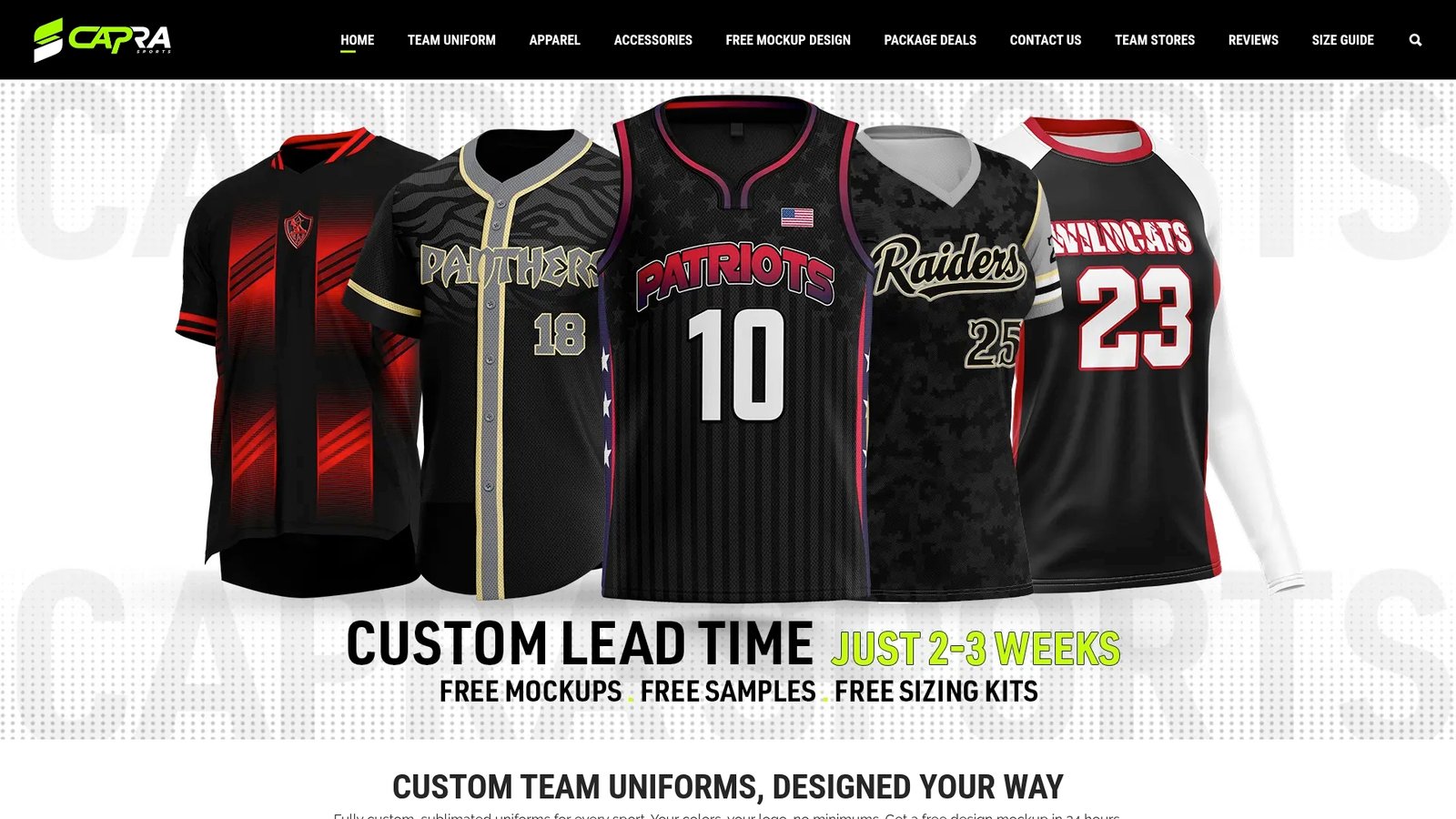
Every order includes free design mockups and direct collaboration with a professional designer for unlimited revisions, so the jersey you approve is the jersey your team actually gets. Whether you’re outfitting a soccer program or building out a football roster from scratch, the process starts the same way: request a free sample or design mockup and check the fabric, seams, and ventilation for yourself before committing to a full team order.
Sources
- Moisture-wicking fabric explained — the science of performance thermoregulation | 2XU
- What is Nike Dri-FIT? | Finish Line blog
- Breathable mesh fabric for activewear | Spandex By Yard
FAQ
Is Moisture-Wicking The Same As Dri-FIT?
No. Moisture-wicking is the general fabric technology; Dri-FIT is one specific branded polyester microfiber system built on the same wicking principle.
Do Moisture-Wicking Shirts Actually Work?
Yes, when the fabric and construction are done right. Polyester microfibers genuinely pull sweat to the fabric’s outer surface for faster evaporation, though results vary depending on ventilation placement and fiber quality.
What Is The Best Moisture-Control Fabric For Team Jerseys?
For most team sports, polyester microfiber with strategic mesh ventilation panels offers the best balance of durability, cost, and moisture control, especially when paired with sublimated graphics that don’t block airflow.
What Fabric Is Most Moisture-Wicking?
Synthetic microfibers, particularly polyester, wick fastest because their fiber structure moves liquid to the surface efficiently. Merino wool and engineered nanopore yarns offer strong alternatives for endurance sports and odor control, though each performs differently depending on climate and exertion level.
How Do I Know If A Jersey’s Ventilation Placement Is Actually Effective?
Check that mesh panels sit at the underarm, upper back, and side seams, the body’s primary heat-dumping zones, rather than scattered decoratively across the front of the shirt.