
NFHS Basketball Uniform Rules 2026-27: A Coach’s Checklist
For the 2026-27 season, an NFHS basketball jersey must be white at home and a dark, contrasting color on the road. The numbers must be a single solid color, at least 4 inches high on the front and 6 inches high on the back. The jersey must be worn the way it was designed, tucked in if it was made to be tucked in. Get these right before you order, because a player in an illegal uniform has to leave the game until it is fixed. At Capra Sports we build custom sublimated basketball uniforms around these specs, so the legal checks happen at the design stage, not at the scorer’s table.
TL;DR
- Home jerseys are white. Visitors wear a dark color that clearly contrasts with white. Gray is allowed only as an away color, and only if it is dark enough.
- Numbers use the digits 0-5 in each position (0 to 5, 00, 10 to 15 and so on), at least 4 inches tall on the front and 6 inches on the back, in one solid color that contrasts with the jersey.
- Side inserts, trim and patches are allowed within set widths and sizes, and every jersey on the team must match.
- Jerseys must be worn as intended. A jersey designed to be tucked in stays tucked in, front and back.
- Head coaches are responsible for legal uniforms before players enter the game. Your state association may add its own rules on top of NFHS.
Table of Contents
- Who sets the rules, and what that means for your order
- Jersey colors: white at home, dark on the road
- Numbers: the rule most teams get wrong
- Trim, side inserts and patches
- Wearing the uniform: tucking and fit
- A pre-order checklist for coaches and athletic directors
- What the checklist looks like on a real order
- How we help you stay on the right side of the rules
- Our perspective
- FAQ
- Sources
Who sets the rules, and what that means for your order
The NFHS (National Federation of State High School Associations) writes the national basketball rulebook that nearly every state high school association adopts. Each state association can then add or adjust a few items, such as patch approvals or when a rule takes effect. So the NFHS rules are your baseline, and your state association’s uniform page is the final word for your league.
The NFHS 2026-27 Basketball Rules Interpretations say a jersey is legal when it meets the uniform requirements for color, numbers, number size, number contrast and permitted design elements. The same document says a player in a noncompliant uniform must leave the game until the problem is corrected, and that head coaches are responsible for making sure players are properly and legally equipped before they enter.
In practice, that is a reason to settle the legal details before artwork is approved. A reorder in January costs more than a ten-minute check in October.
This article covers high school (NFHS) play. Club and AAU events often run their own uniform rules. If your team plays both, see our guide to AAU basketball uniform rules.
Jersey colors: white at home, dark on the road
The NFHS 2026-27 Points of Emphasis reaffirm that home teams wear white and visiting teams wear dark jerseys. NFHS explains that the designation exists to support game administration, giving officials, scorers and spectators a quick, accurate way to tell the teams apart.
The NFHS basketball uniform guidance adds that the torso of the jersey must be a single solid color with no fabric designs. That has a direct design consequence: a sublimated jersey with a fade, camouflage, pattern or graphic across the torso is not a legal NFHS jersey, even if it looks great. Put the creativity into the permitted areas covered below.
What counts as dark, and the gray rule
The visiting jersey must be a dark color that clearly contrasts with white. If you want gray, it can only be your away color, and it has to be closer to black by at least 70 percent. Light gray and silver do not qualify. A gray that looks fine on a screen can look washed out under gym lights, so judge it against a white jersey, not on its own.
If gray and white is your team look, our gray and white basketball jersey design shows how to build it, and the gray rule above is the thing to check before you lock the shade.
Matching uniforms
All players on a team wear matching jerseys. That includes the same side insert width on every jersey and the same number style and color. Shorts (bottoms) must be like-colored across teammates, though different styles are fine under NFHS rule language adopted by some states.
Undershirts and accessories follow a similar logic. Many state associations spell out that compression shorts, tights and sleeves must be black, white, beige or the predominant jersey color, and that teammates match. One change worth knowing: NFHS’s 2023-24 rules changes (Rule 3-5-6) allow black undershirts under visiting jerseys to help schools whose colors are hard to find, as long as all team members match. Confirm your state’s exact wording for headbands and wristbands before you order matching accessories.
Numbers: the rule most teams get wrong
Numbers are where most uniform problems start, because they are small, specific and easy to get wrong when you are rushing a roster. If you want a deeper walkthrough on sizing numbers, our jersey number size guide covers it, but here is the NFHS standard in full.
Legal digits
According to the NFHS uniform guidance:
- The front number is at least 4 inches high and the back number at least 6 inches high.
- Each number stroke is at least 3/4 inch wide, not counting the border.
- Numbers are centered vertically and horizontally.
- They are plain Arabic numerals, in the same style and color on the front and back.
- Legal numbers are 0 to 5, 00, 10 to 15, 20 to 25, 30 to 35, 40 to 45 and 50 to 55.
- A team may not list both 0 and 00 on its roster.
The digit rule exists so officials can signal fouls with their hands. Referees report a number using fingers, and the limited digits make that possible. That is why a 6, 7, 8 or 9 never appears. If a player asks for 69 or 7, the answer is no, and it is far easier to hear that at roster time than after the jerseys arrive.
Contrast, and a rule that changed
Numbers must be a solid, contrasting color. They can use no more than three colors in total, with up to two 1/4-inch borders, or with a shadow trim up to 1/2 inch plus one 1/4-inch border. Because borders count toward the color total, a flashy outlined number can become illegal quickly.
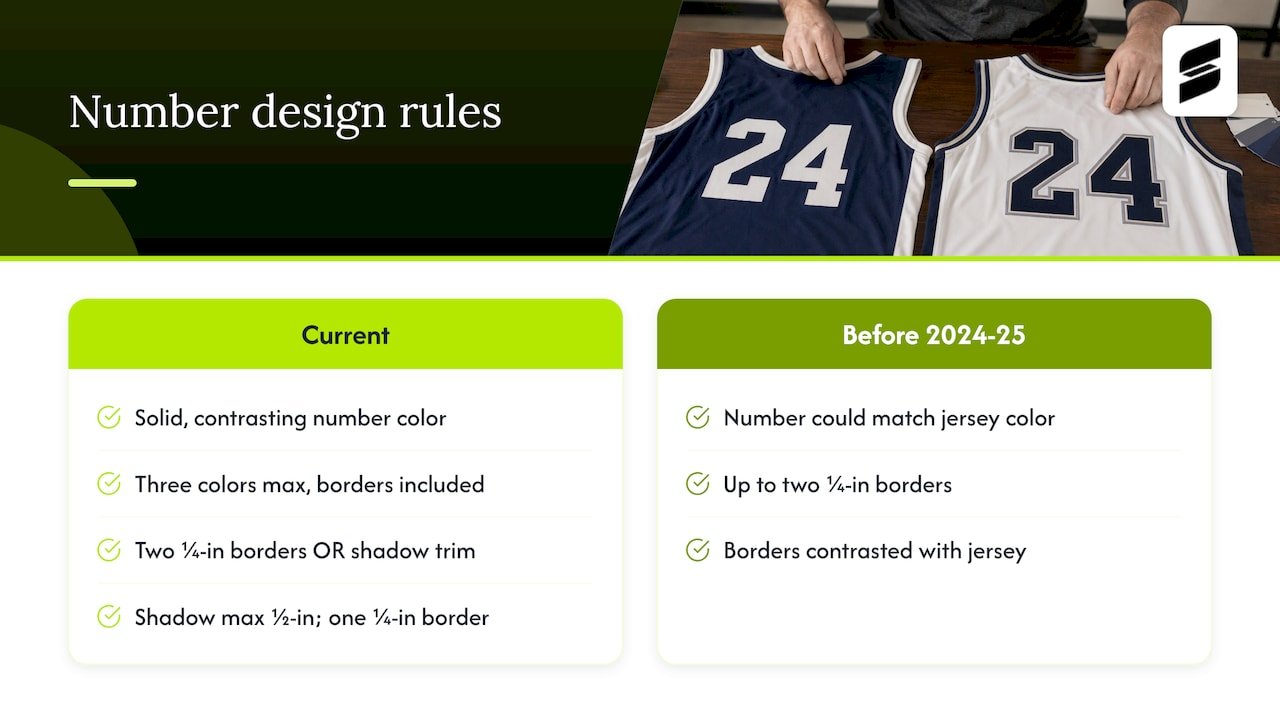
There was also a change that catches teams reusing old designs. Per NFHS’s future year rule changes document, Rule 3-4-3e(2) was removed effective 2024-25. Before that, a number could match the jersey color itself if it had up to two 1/4-inch solid borders contrasting with the jersey. That option is gone, so any design saved from an earlier year needs a fresh look.
Trim, side inserts and patches
This is where you can add personality, and the rules leave real room. From the NFHS uniform guidance:
- Side inserts can be any color or design, centered vertically below the armpit.
- The maximum width is 4 inches in total, which is 2 inches on each side of the seam.
- The width must be the same on all team jerseys.
- Armhole trim that differs from the torso color may not exceed 1 inch.
- If your state association adopts it, one commemorative or memorial patch of no more than 4 square inches may be worn in the side insert or above the neckline.
A state may also allow a school logo or mascot image above the number in place of a name on the front. That is a state-level choice, so check before you add one. In fact, at least one state’s advisory committee has discussed giving schools time to replace jerseys with a mascot placed improperly on the front, which shows how easy this one is to get wrong.
A practical way to use the freedom: keep the torso solid, then spend your design effort on side inserts, collar and armhole trim, and shorts. Our basketball uniform design ideas walk through six styles that stay inside this framework.
Wearing the uniform: tucking and fit
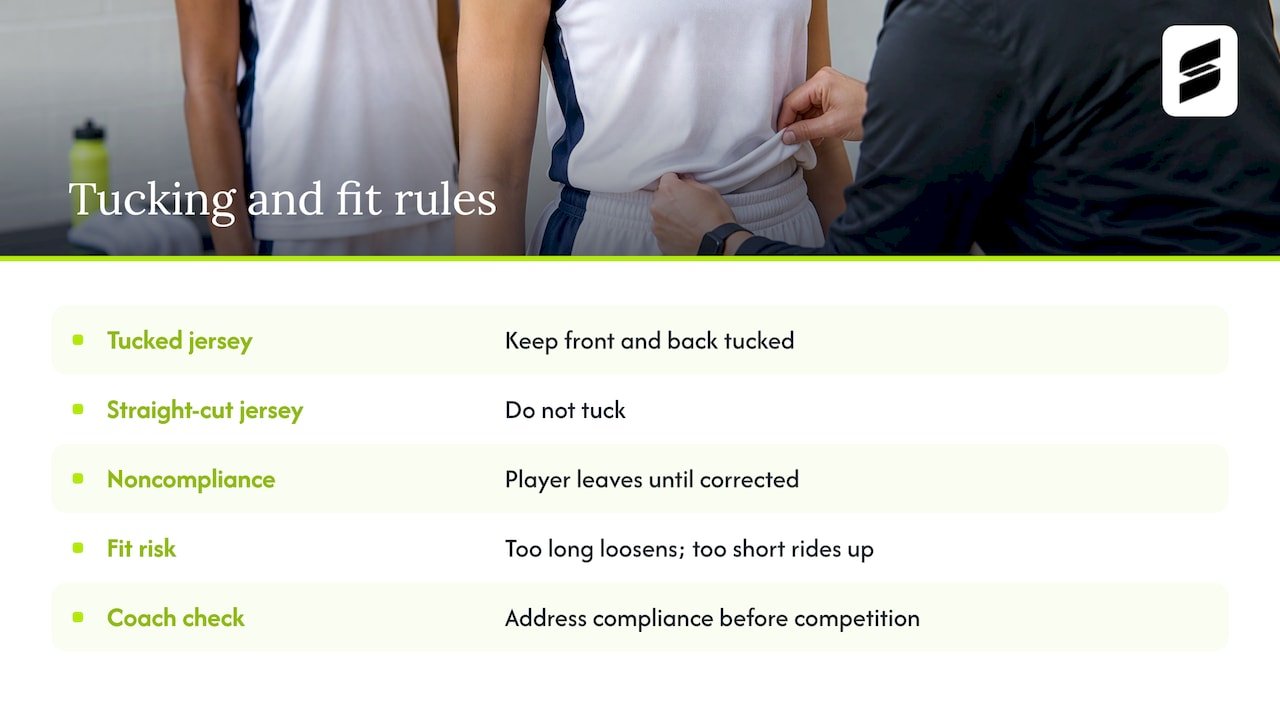
The 2026-27 Points of Emphasis say uniforms must be worn as intended by rule at all times. Jerseys designed to be tucked in must remain properly tucked, front and back. Players who do not comply leave the game until corrected, and coaches are expected to address compliance before competition starts.
That creates a fit question for you as the buyer. If a jersey is cut long and meant to be tucked, players will have to keep it tucked for 32 minutes of hard movement. If a jersey is cut as a straight, untucked style, it should not be tucked. Either way, the right size matters: too long and it comes loose, too short and it rides up.
Other fit rules that commonly appear in state interpretations include a minimum jersey length and shorts worn above the hips, so check your state page. Sizing is a team decision, not a guess. That is the reason we offer one sizing sample at no extra charge on every team order, so you can put a real garment on a real player before the whole set is produced.
A pre-order checklist for coaches and athletic directors
Run this list before you approve any design:
- Home jersey is white and the away jersey is dark. If the away color is gray, it is at least 70 percent toward black.
- The torso is a single solid color, with no fade, pattern or graphic.
- Front numbers are at least 4 inches and back numbers at least 6 inches, with 3/4-inch minimum stroke.
- Numbers use only legal digits, and no roster has both 0 and 00.
- Numbers are one solid color that contrasts with the jersey, with no more than three colors including borders.
- Side inserts are no more than 4 inches wide in total, the same on every jersey.
- Armhole trim that differs from the torso is no wider than 1 inch.
- Any patch is no larger than 4 square inches and approved by your state association.
- Any logo or mascot placement matches your state’s rule.
- Shorts are like-colored across the team.
- You know whether the jersey is a tuck-in cut or an untucked cut, and the players know too.
- You checked your state association’s current uniform page for anything stricter.
Athletic directors ordering for several teams in one school can use the same list as a sign-off form. One shared list keeps boys’ and girls’ programs, and varsity and JV, on the same standard.
What the checklist looks like on a real order
Say a school wants a navy away jersey with white numbers and a gold side insert. Walk through it: navy is dark and contrasts with white, so the color is fine. White numbers on navy contrast clearly. If the numbers carry a gold border, that is two colors, within the three-color limit, as long as the border is no wider than 1/4 inch. The gold insert is allowed because inserts can be any color, provided the width is the same on every jersey and sits at 4 inches or less in total.
Now change one thing: the designer adds a faint tonal stripe pattern across the torso. That one detail breaks the solid-torso rule and puts the entire set in doubt. It is the kind of mistake that is easy to miss on a flat screen and obvious to an official.
How we help you stay on the right side of the rules
When you order custom basketball uniforms from Capra Sports, you work directly with professional designers, and every order includes free design mockups with unlimited revisions. We turn mockups around in 24 hours, so you can review numbers, colors and trim against the list above, ask for changes and approve only when everything checks out. Our uniforms are sublimated, which means the design is printed into the fabric rather than applied on top of it.
Team orders start at 10 sets, and you get one sizing sample at no extra charge, so you can confirm fit and tuck before the full order is made. Browse our custom basketball uniforms for teams, see the pricing page for the product lines, or start from the custom basketball uniform page. Prices: [PRICE TBD].
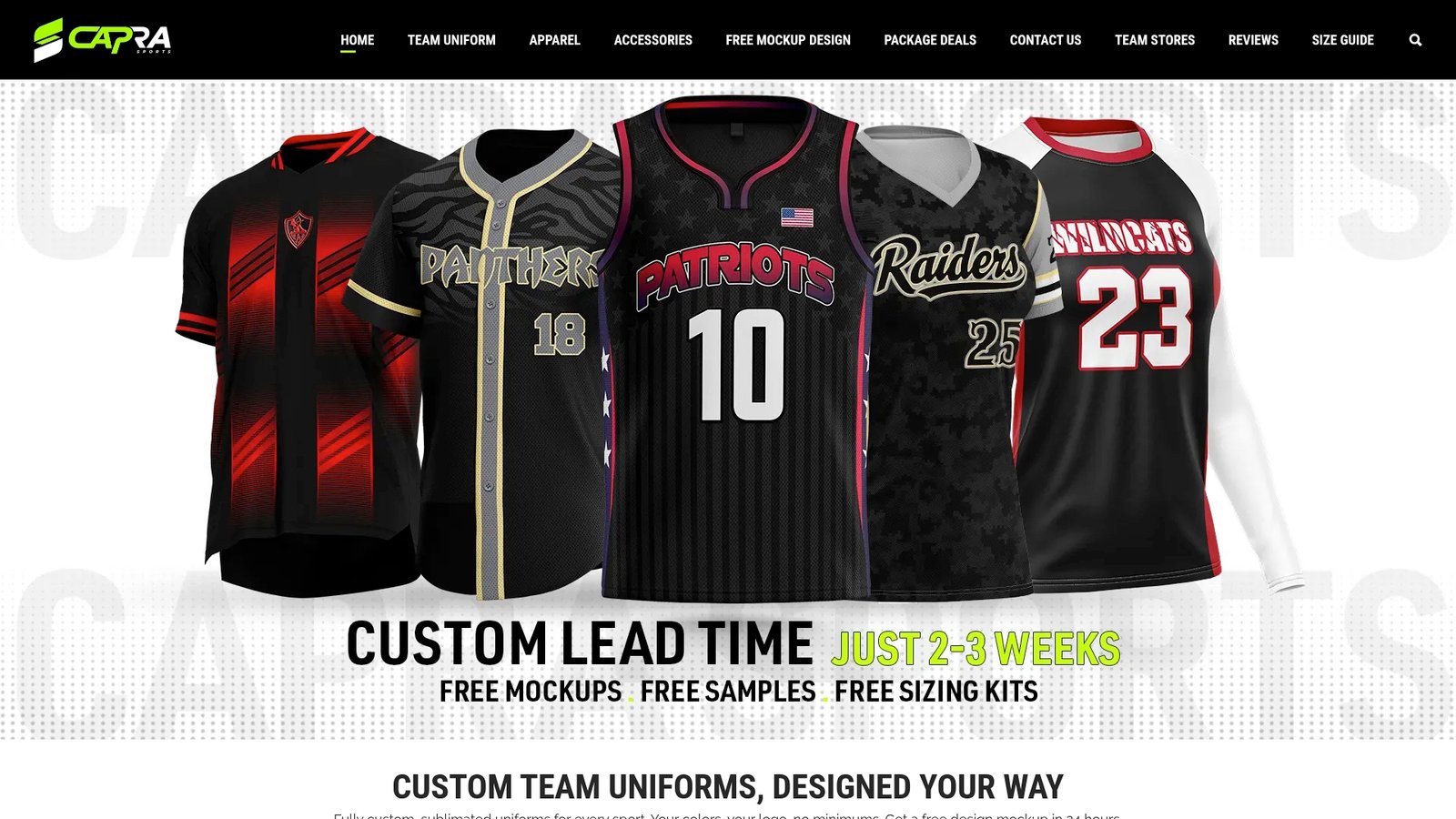
If you tell the designer you need an NFHS-legal set and give the state you play in, the mockup can be built around the rules from the first draft.
Our perspective
Most uniform trouble we hear about is not a bad design. It is a good design that was approved before anyone read the rulebook. A coach falls for a look, the order goes in, and then someone notices the numbers are too small or the torso has a pattern.
We think the fix is simple: treat the rules as part of the design brief. Colors, number sizes, trim widths and digits are all known in advance, so a designer can work inside them from the first mockup. That is why we give every team direct access to professional designers and unlimited revisions. You should be able to keep asking for changes until the uniform is both something your players are proud of and something your officials will pass.
Fit deserves the same attention. A jersey that is legal on paper still causes problems if it does not stay tucked or rides up in the fourth quarter. A sizing sample at no extra charge lets you test that before the whole team is committed.
Agha
FAQ
What are the NFHS rules for basketball jersey numbers?
Front numbers must be at least 4 inches high and back numbers at least 6 inches, centered, in plain Arabic numerals of one solid contrasting color. Legal digits are 0 to 5 in each position, such as 00, 14, 25 and 55. A team may not list both 0 and 00. See the NFHS uniform guidance for the full detail.
What color is the home jersey in NFHS basketball?
The home team wears white and the visiting team wears a dark color that clearly contrasts with white. NFHS reaffirmed this in its 2026-27 Points of Emphasis. Gray is allowed only as an away color and must be at least 70 percent toward black.
Can a player leave the jersey untucked?
It depends on how the jersey is designed. NFHS says uniforms must be worn as intended, so a jersey made to be tucked in must stay tucked front and back, while a jersey cut to be worn out is fine untucked. A noncompliant player must leave the game until it is corrected, per the 2026-27 Rules Interpretations.
Do the rules differ by state?
Yes, in places. Most states adopt the NFHS rulebook, then add items such as patch approvals, logo placement or accessory details. Treat NFHS as the baseline and check your state association’s uniform page before you finalize an order.
Who is responsible if a player’s uniform is illegal?
The head coach. NFHS expects coaches to make sure players are properly and legally equipped before entering the game, and to address compliance before competition. Checking the uniform at the design stage is the easiest way to avoid it.
Sources
- Basketball Rules Interpretations 2026-27, NFHS
- Basketball Points of Emphasis 2026-27, NFHS
- NFHS Basketball Uniforms guidance
- NFHS Future Year Rule Changes
- NFHS 2023-24 Basketball Rules Changes with rationale