
Coaches: Soccer Jersey Numbering, FIFA Sizes 25–35 cm and Mockups
Back numbers must be 25 to 35 centimeters tall for men’s shirts or 20 to 35 centimeters for women’s, with a stroke width of 3 to 5 centimeters, while front and shorts numbers run 10 to 15 centimeters, according to FIFA equipment regulations. Before you order, reserve number 1 for your goalkeeper where required; choose a permanent attachment method like sewing or heat transfer, and confirm your specific competition’s kit submission rules.
TL;DR:
- Confirm your competition’s number range, roster matching rules, and reassignment process; FIFA and IFAB do not set every league’s registration policy.
- Fixed season numbers suit clubs selling merchandise, while assignments that change each match suit recreational leagues with high roster turnover and little merchandise interest.
- Club and school teams should finalize designs 6 to 8 weeks before opening day, allowing time for a sample, revisions, and full production.
- Test confusing digit pairs, including 5 and 6 or 3 and 8, at full size from 20 to 30 meters and review photos.
- Youth and amateur leagues may relax sizing or registration requirements, but federation affiliation can still require full compliance, so verify the current handbook.
Table of Contents
- What FIFA, IFAB and NCAA rules require for jersey numbers
- How to choose a numbering policy without registration conflicts
- Where numbers go on the back, front and shorts
- Picking number heights, stroke widths and fonts that read clearly
- Which production methods actually hold up to match wear
- A pre-order checklist and timeline that keeps you on schedule
- How soccer jersey numbers went from fixed positions to free choice
- How numbering habits differ across leagues and regions
- Why certain jersey numbers carry outsized meaning
- What the rules say about combining names and numbers
- Why legible numbers matter beyond the field
- Common exceptions for youth and amateur teams
- Where sample approval saves teams from reprint costs
- Get your numbers right before you order
- FAQ
- Sources
What FIFA, IFAB and NCAA rules require for jersey numbers
Three sets of rules govern how a soccer number can look and where it has to sit, and knowing which one applies to your team saves you from a reprint.
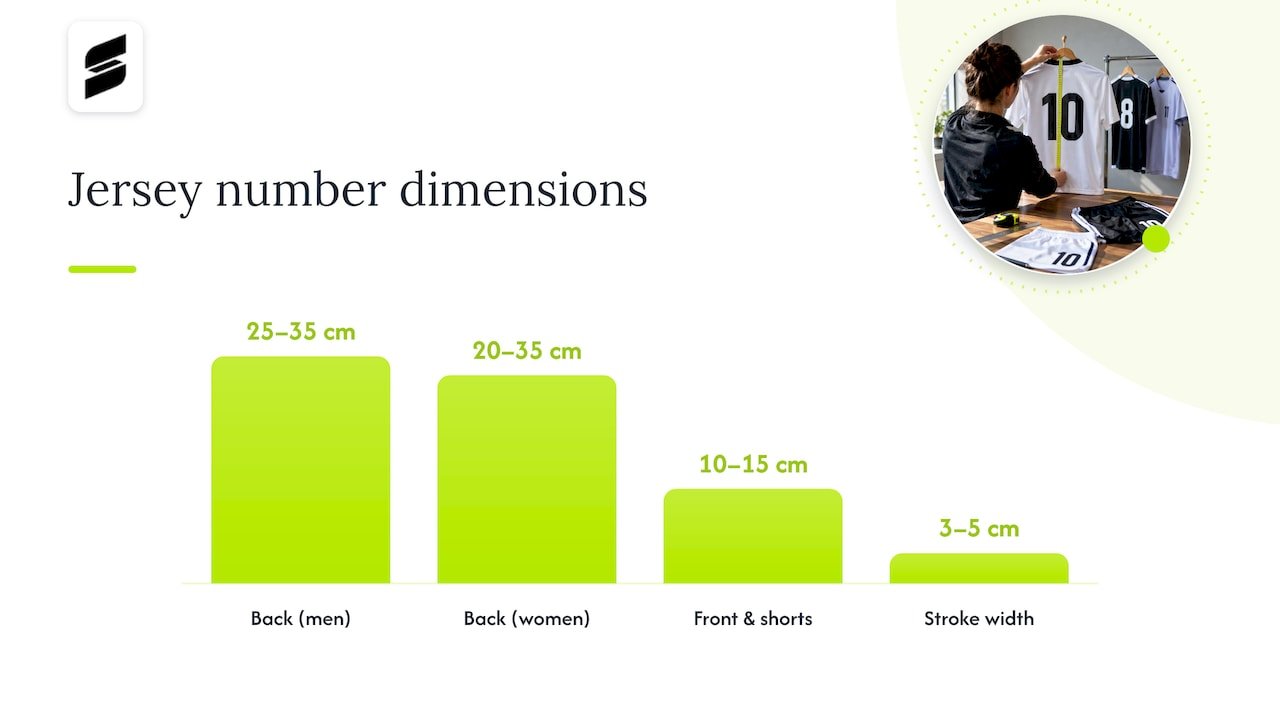
FIFA Equipment Regulations set the baseline most leagues borrow from: back numbers at 25 to 35 centimeters (20 to 35 centimeters for women’s kits), front and shorts numbers at 10 to 15 centimeters, and a stroke width of 3 to 5 centimeters. Numbers must sit centered on the back and stay legible against the shirt color. The same regulations state that number sizing has to stay consistent across every shirt and short in the squad, so a size that works for your tallest forward needs to work for your smallest midfielder too.
IFAB’s Laws of the Game take a lighter touch: numbers, names and logos are permitted as long as they comply with whatever the competition decides, and goalkeeper equipment must clearly set that player apart from everyone else on the field, officials included.
NCAA soccer playing rules add roster and kit submission requirements specific to collegiate competition, layered on top of the baseline sizing standards.
- FIFA sets the numeric specs: height, stroke width and centering.
- IFAB sets the permission structure: what’s allowed and the goalkeeper distinction rule.
- NCAA and most leagues add their own roster and registration steps on top.
Stroke width must fall between 3 and 5 centimeters according to FIFA’s equipment rules, a detail that trips up teams ordering from templates built for other sports. When rules conflict, apply the specific competition’s regulations first and treat FIFA’s numbers as the fallback standard.
How to choose a numbering policy without registration conflicts
Most competitions allow numbers 1 through 99, with number 1 commonly reserved for a goalkeeper under tournament-level regulations. Beyond that baseline, your team has real choices to make before numbers go into production.
- Check whether your league or tournament restricts the number range or requires numbers to match a registered roster before kickoff.
- Decide between season-long fixed numbers, which simplify merchandise and fan recognition, and per-game assignment, which gives coaches more tactical flexibility.
- Reserve low numbers for goalkeepers if your competition requires it, since officials will flag a mismatch at check-in.
- Build a roster spreadsheet listing each player’s confirmed number alongside the date you locked it in, so you have a paper trail if a late dispute comes up.
- Submit that roster to your competition’s registration system as early as the rules allow, since many tournaments lock numbers well before the first match.
Fixed numbers tend to work better for club and school teams that sell fan gear or want consistent identification across a season. Rotating numbers suit smaller recreational leagues where roster turnover is high and merchandise isn’t a factor.
Where numbers go on the back, front and shorts
A compliant number zone is as much about what you leave out as what you print. Keep the zone free of decorative elements, logos or patterns that could blur the digit’s edges, and treat the number as a single, clean color impression unless your competition explicitly allows an outline.
- Center the back number both vertically and horizontally, with enough clearance on all sides that a two-digit number never touches the collar, side seams or hem.
- Place the front number at chest level, sized between 10 and 15 centimeters as specified by FIFA’s regulations.
- Put the shorts number on either leg, matched to the same 10 to 15 centimeter height range.
- Reserve borders or shadow effects for situations where they genuinely improve contrast, never as a design flourish.
Pro Tip: Print a full-size paper proof of your number and tape it to a shirt before committing to production: flaws in spacing or clearance show up instantly at full scale that never appear on a screen.
Picking number heights, stroke widths and fonts that read clearly
Staying inside FIFA’s ranges, back numbers at 25 to 35 centimeters, front and shorts numbers at 10 to 15 centimeters, stroke width at 3 to 5 centimeters, is the starting point, but the font you choose inside those dimensions decides whether a number actually reads from the sideline or a broadcast camera. Adjust toward the lower end of each range for youth cuts and the higher end for adult sizing so proportions stay natural on the shirt.
- Choose fonts with open counters (the enclosed space inside a 6, 8 or 9) so the digit doesn’t fill in at a distance.
- Keep stroke width uniform across every digit rather than letting a font taper thin strokes on curves.
- Pick simple geometric shapes over scripts or condensed athletic fonts that compress digits together.
- Test digit pairs that get confused easily, like 5 and 6 or 3 and 8, side by side before finalizing.
A stroke width locked between 3 and 5 centimeters, per FIFA’s equipment specs, is the single easiest spec to get wrong when scaling a font from a digital mockup to fabric, since most design software defaults to proportional stroke weights that shift outside that range as you resize.
Once you’ve settled on a font, print it life size, hold it at the distance a referee or spectator would actually view it from, roughly 20 to 30 meters, and take a few photos under normal lighting. If the number still reads clearly in a photo, it will read on broadcast footage too.
Which production methods actually hold up to match wear
Numbers have to be permanent. FIFA’s equipment regulations specify that numbers must be sewn on or applied by heat transfer or a similar permanent technique, and rule out Velcro or any other temporary fastener outright.
- Sublimation embeds the number directly into the fabric during printing, which holds up well to repeated washing and contact.
- Heat-applied transfers and sew-on numbers both satisfy permanence rules when the application is done correctly and doesn’t peel at the edges.
- Specify exact height, stroke width, color and whether an outline or shadow is included directly in your production notes, since verbal descriptions get lost between design and print.
- Request a sample or mockup before committing to a full team order, and check how the number holds up after a wash cycle if you have time before the season starts.
Teams that skip the sample step are the ones most likely to discover a legibility or placement problem only after fifteen jerseys arrive at once.
A pre-order checklist and timeline that keeps you on schedule
Confirm your competition’s specific numbering rules the moment you start planning, then work backward from your season opener. For most club and school teams, finalizing designs 6 to 8 weeks before the season starts leaves enough room for a sample, a revision round and full production. Major tournaments operate on a longer runway: kit planning for events like the FIFA World Cup often begins 12 to 18 months ahead, a useful reminder that legibility and color decisions take longer to lock in than most coaches expect.
- Assign numbers and confirm them against your league’s allowed range.
- Build a gang sheet grouping numbers by size and color to reduce production errors.
- Choose your font, color and any outline treatment, then test it at full size.
- Request a sample or full mockup and check it against the FIFA size ranges before approving.
- Submit your roster and kit details to your competition if registration is required.
Pro Tip: Keep one blank jersey and a spare number set on hand during the season. A last-minute roster change is far easier to handle with a quick heat-applied fix than with a full reorder.
How soccer jersey numbers went from fixed positions to free choice
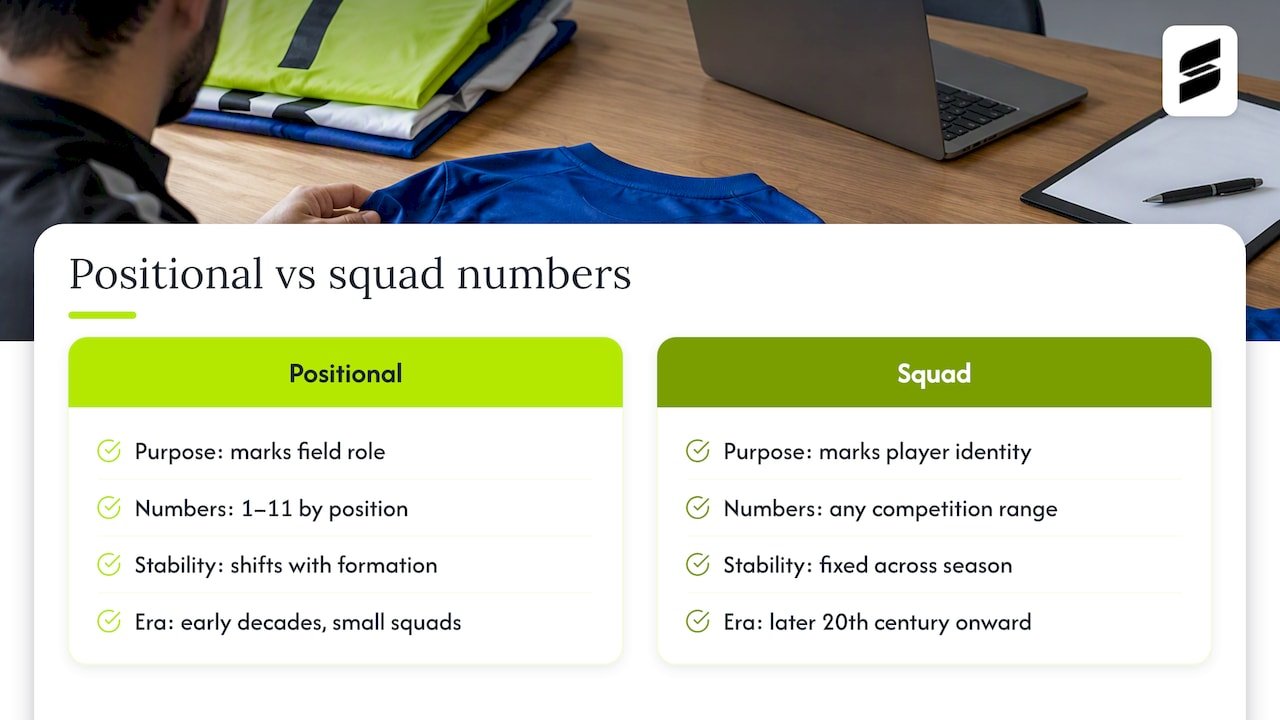
Jersey numbers started as position markers, not personal identifiers. Early organized soccer assigned numbers 1 through 11 according to where a player lined up on the field: the goalkeeper wore 1, full backs wore 2 and 3, and so on through the forward line. A spectator with a program could tell a player’s role from the number alone, long before names appeared on shirts at all.
That system held for decades because squads were small and substitutions were rare. As rosters grew and tactical formations diversified, fixed positional numbering stopped matching reality. A team running a formation without a traditional winger still had a player wearing the winger’s traditional number, and the numbers lost their descriptive power even as they stayed on the shirt.
The shift toward squad numbering, where a player keeps the same number across a season regardless of position, took hold gradually through the later twentieth century. It let clubs build recognition around a specific number and player rather than a tactical slot, and it opened the door to the number as a piece of personal identity rather than a formation diagram.
Today’s rules reflect that history loosely rather than strictly. IFAB’s Laws of the Game permit squads to assign numbers largely as they choose, within whatever range the competition sets, with the goalkeeper distinction as the one structural holdover from the original positional system. For teams ordering kits now, the practical lesson is that number choice is a squad decision, not a formation requirement, though plenty of clubs still nod to tradition by keeping 1 on the goalkeeper and low single digits on defenders.
How numbering habits differ across leagues and regions
Numbering conventions vary more by competition and country than most coaches expect, even though the size and placement rules stay consistent under FIFA’s baseline. Some leagues strictly enforce the traditional 1 through 11 starting lineup convention for official documentation even when substitutes wear numbers well into the double digits or higher. Others let clubs assign any number in the allowed range to any player from day one of registration.
Domestic leagues in different countries also differ in how tightly they police number changes mid-season. Some require a formal transfer-window-style process to reassign a number once registered, while others allow adjustments between matches as long as the roster filing stays current. These differences rarely come from FIFA or IFAB directly. They come from each competition layering its own administrative rules on top of the shared equipment standards.
Retired numbers are another regional variation. Some clubs retire a number permanently to honor a player, a practice far more common in some leagues than others, while many competitions have no retirement mechanism at all and simply reassign numbers as rosters change.
For coaches and team managers, the practical takeaway is to never assume your number policy from a previous league carries over to a new one. Always check your specific competition’s current handbook or registration portal before assuming a number range, a goalkeeper rule or a reassignment process applies. The equipment sizing and stroke width specs from FIFA stay constant everywhere; the administrative rules around who gets which number do not.
Why certain jersey numbers carry outsized meaning
Certain numbers accumulate meaning well beyond their function as a roster identifier. A number worn by a widely recognized player for years becomes shorthand for a role, a style of play or a moment fans associate with that shirt, and new players who inherit the number often feel the weight of that association whether or not they asked for it.
This matters for team ordering in a practical way: players, especially older youth and adult amateur athletes, frequently have a number preference tied to a player they grew up watching or a number they’ve worn since childhood. Coaches who build in a simple preference request process during registration, rather than assigning numbers purely by position or alphabet, tend to see fewer complaints and more buy-in once jerseys arrive.
At the same time, number significance shouldn’t override the practical constraints that actually matter for ordering: goalkeeper reservation rules, league-specific ranges and the sizing consistency FIFA requires across the whole squad. A player’s sentimental attachment to a number is worth accommodating when it fits inside your competition’s rules, not a reason to bend the rules themselves.
Teams ordering custom kits can resolve most of this at the roster stage: collect number preferences early, resolve duplicates before you finalize your gang sheet builder, and treat the emotional weight of a number as one input among several rather than the deciding factor.
What the rules say about combining names and numbers
IFAB’s Laws of the Game permit player names on shirts alongside numbers, provided both comply with whatever rules the specific competition sets. Names are not universally required. Plenty of league and school competitions skip names entirely and rely on numbers alone for identification, while others, particularly at higher levels of play, require both as a condition of registration.
Where names are used, the practical rule most competitions apply is straightforward: the name sits above the back number, doesn’t interfere with the number’s required clearance zone, and stays legible at the same kind of viewing distance you’d test a number against. A name crammed too tightly above an oversized number creates exactly the kind of crowded number zone that FIFA’s equipment guidance warns against, since decorative or competing elements near the number can compromise its legibility.
Font consistency matters here too. A name set in a heavily stylized script above a number set in a clean geometric font reads as mismatched and can make both harder to parse quickly from a distance. Keeping the name and number in the same font family, even at different sizes, gives the whole back panel a cleaner, more legible result.
Before finalizing name-and-number artwork, confirm two things with your specific league or school athletic department: whether names are required or optional, and whether there’s a character limit or approved spelling format, since some competitions require names to match official roster documentation exactly.
Why legible numbers matter beyond the field
A number’s job doesn’t end with the referee’s roster check. Parents in the stands, broadcast cameras at higher levels of play, and even teammates calling for a pass all rely on being able to read a number instantly, at a distance, often in motion. A number that technically meets FIFA’s size specs but uses a poor font choice can still fail at that actual job.
This is where the legibility testing described earlier in this guide pays off in a way that’s easy to underestimate. A number that reads clearly in a studio photo but blurs at game speed under stadium lighting creates real identification problems: a confused call from the sideline, a referee who has to jog closer to confirm a number before carding the right player, a broadcast graphic that mislabels a player because the number was ambiguous on camera.
For teams without broadcast exposure, the stakes are lower but not absent. Parents filming youth games from the sideline, league websites posting match photos, and local news coverage of school and club matches all depend on the same basic legibility that broadcast cameras need. A number that’s hard to read in a sideline photo is hard to read for the same reasons it would be hard to read on television: poor contrast, a cramped stroke width or a font with closed counters.
Getting size, stroke width and font right isn’t just a compliance box to check. It’s the difference between a number that does its actual job, letting anyone watching identify a player instantly, and one that technically passes inspection but fails everyone trying to use it.
Common exceptions for youth and amateur teams
Strict FIFA sizing and IFAB equipment rules apply most rigidly at higher levels of organized play, and plenty of youth and recreational leagues apply a lighter version of the same framework. Many youth leagues don’t enforce the full 25 to 35 centimeter back number range, since younger players wear smaller shirts where a full-size number would look disproportionate or simply not fit the available space.
Amateur and recreational adult leagues often relax requirements around permanent attachment, number registration timelines or the goalkeeper-specific number 1 rule, particularly in lower-stakes or pickup-style competitions where roster turnover is constant and formal registration is minimal.
That said, exceptions are competition-specific, not universal. A youth league affiliated with a national federation may still require full compliance with federation standards, while an informal recreational league may have no written numbering policy at all beyond what the team itself decides. The safest approach for any coach or team manager is the same one that applies at every level: check your specific league’s current handbook before assuming an exception applies, rather than assuming a youth or amateur designation automatically means relaxed rules.
When no formal rule applies, defaulting to FIFA’s baseline specs anyway is still good practice. It keeps your team consistent if you move up to a more regulated league later, and it avoids the scramble of reordering numbers mid-season because a tournament you didn’t expect to qualify for suddenly requires registered, size-compliant numbers.
Where sample approval saves teams from reprint costs
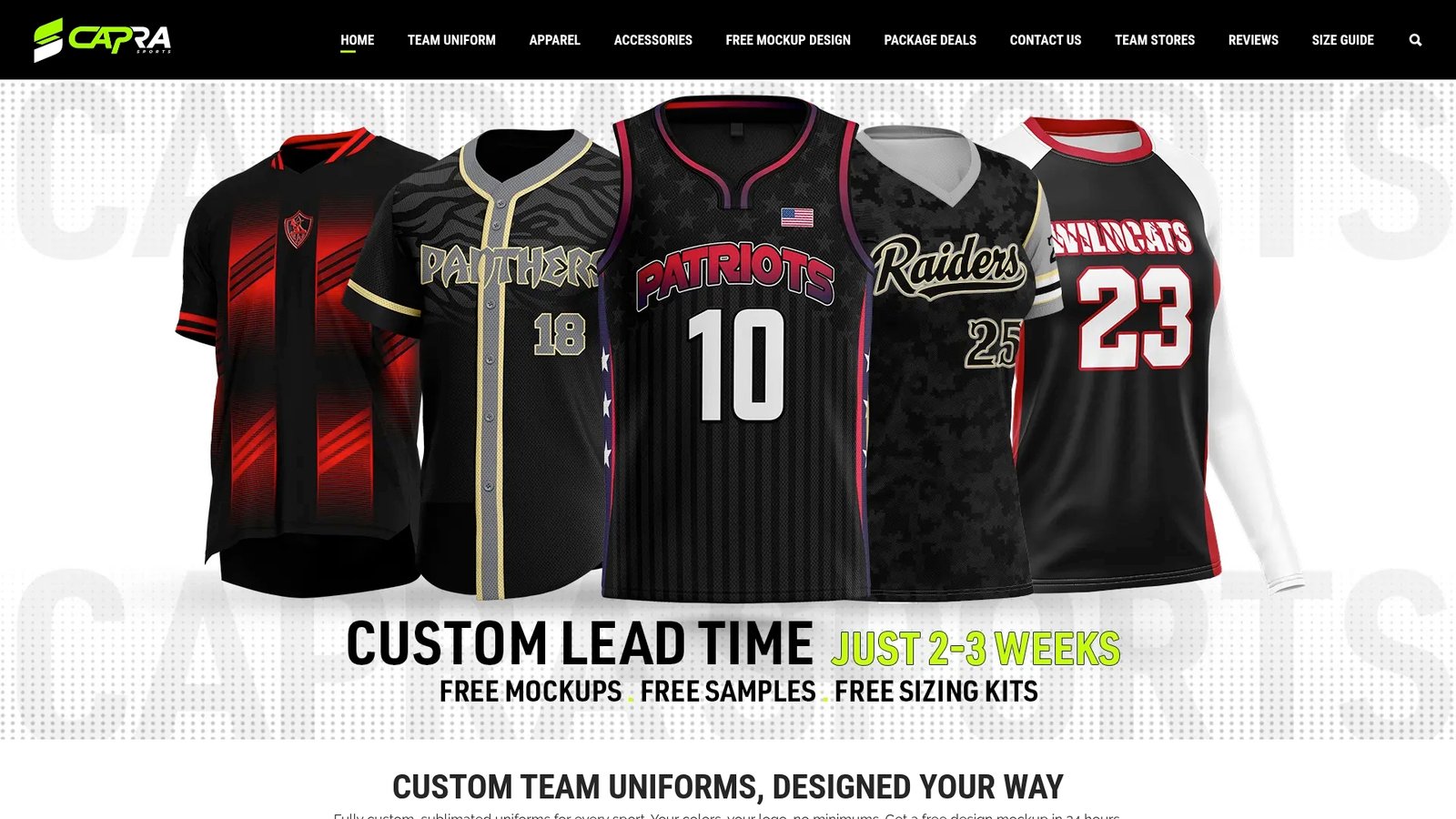
Getting a number’s size, font and placement right on paper is one thing. Seeing it on an actual shirt, in the actual color, is what catches the errors that specs alone miss. At Capra Sports, we specialize in custom-designed sublimated uniforms across soccer and several other team sports, and we work directly with teams through a mockup and sample step before full production begins. That collaboration with our design team gives coaches a chance to check stroke width, contrast and legibility against the actual fabric and color, not a screen rendering, before committing to a full squad order.
— Agha
Get your numbers right before you order
We make it straightforward to confirm your numbering is compliant before a single jersey goes into production. Every custom soccer uniform order includes a collaborative mockup process with our design team, so you can check number size, font and placement against your league’s rules before approving anything for print.
- Request a mockup showing your chosen numbers, font and placement on your actual kit colors.
- Submit your roster with assigned numbers once your design is approved.
- Check current soccer uniform pricing and get a quote for your squad size.
If you’re still finalizing sizing across a mixed-age roster, our soccer size chart gives you a practical reference to pair with the mockup before you submit a final order.
FAQ
What size should soccer jersey numbers be?
Back numbers should measure 25 to 35 centimeters tall for men’s shirts or 20 to 35 centimeters for women’s, with front and shorts numbers at 10 to 15 centimeters, per FIFA’s equipment regulations. Stroke width should fall between 3 and 5 centimeters across all number sizes.
Can a soccer player wear any number from 1 to 99?
Most competitions allow numbers across that full range, but number 1 is commonly reserved for the goalkeeper under tournament regulations. Always check your specific league or tournament’s rules, since some restrict ranges further or require numbers to match a registered roster.
Does a soccer jersey need both a name and a number?
Not universally. IFAB’s Laws of the Game permit both names and numbers on shirts, but whether a name is required depends entirely on the specific competition’s own rules.
Is Velcro an acceptable way to attach jersey numbers?
No. FIFA’s equipment regulations require numbers to be permanently attached by sewing or heat transfer, and specifically rule out Velcro and other temporary fasteners.
How far in advance should a team order custom numbered jerseys?
For a standard club or school season, finalizing your number and font choices 6 to 8 weeks before the season starts leaves enough time for a sample and revisions. Major tournament kits often involve planning that starts 12 to 18 months ahead, a useful benchmark even for smaller teams planning around a big event.
Sources
- FIFA equipment regulations (number sizing and number zone guidance)
- Law 4 – The Players’ Equipment | IFAB
- Regulations for the FIFA Club World Cup 2025 (numbers, registration and kit submission)