
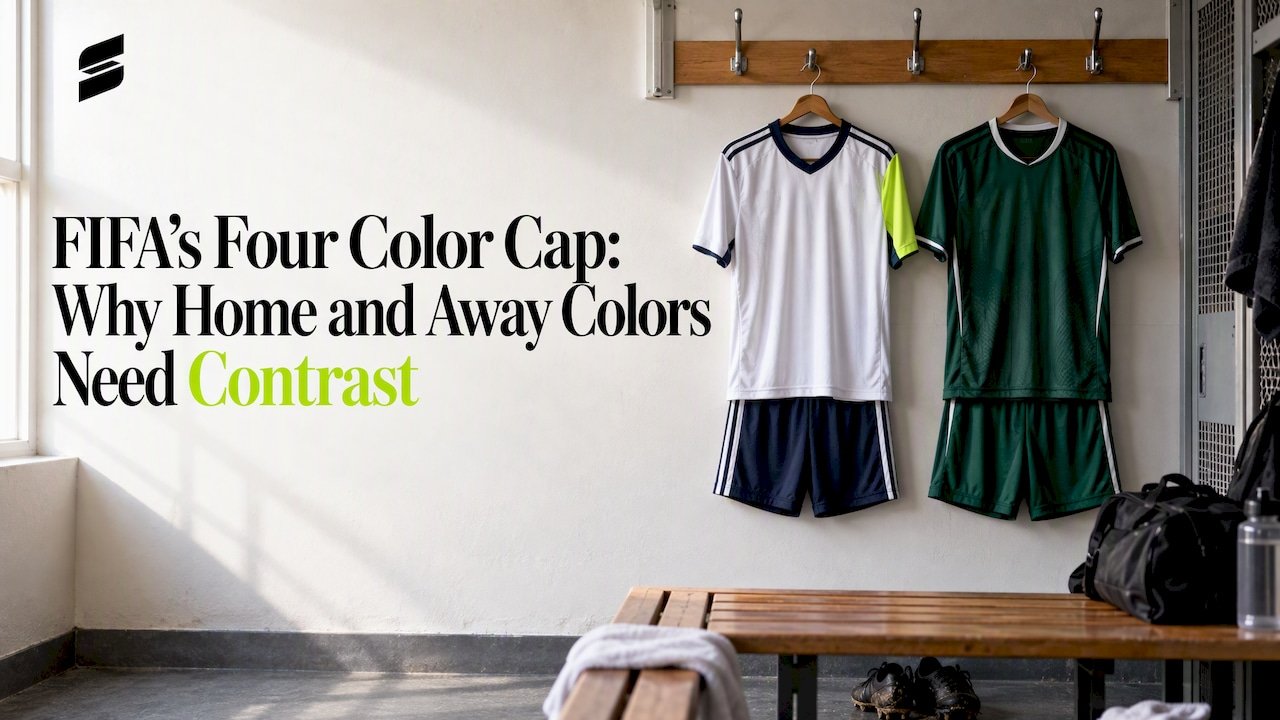
FIFA’s Four Color Cap: Why Home and Away Colors Need Contrast
Home is the team playing at its own venue; away is the visiting team. In practice, the deciding factor is not a fixed light-or-dark rule but contrast and visibility: can officials, players and spectators tell the two sides apart under the day’s lighting? That is why many competitions ask every team to register both a clearly light and a clearly dark option, not because tradition demands it, but because contrast is the standard being tested.
TL;DR:
- MLB and NBA traditionally put home teams in white, while NFL and NHL often assign white to visitors; NCAA basketball permits different combinations by mutual consent.
- FIFA caps most kit items at four colors and requires one predominant shirt color; World Cup teams register an alternate and at least three goalkeeper options.
- Test full kits side by side from 30 to 40 yards under stadium lighting, checking names, numbers, and goalkeeper colors before approving production.
- If home and away kits still clash, the away team switches to an alternate; both sides may change, while goalkeepers can switch independently.
Table of Contents
- How home and away conventions differ by league and sport
- What FIFA’s equipment rules actually require
- Designing for contrast and visibility: a practical checklist
- Third kits, alternates, and how clashes get resolved
- Checklist and designer perspective for teams ordering kits
- Why visibility, not tradition, should drive kit choices
- How we help teams design kits that pass the contrast test
- FAQ
- Sources
How home and away conventions differ by league and sport
Every major league has its own habits, and none of them are universal law. In Major League Baseball, home teams have traditionally worn white while visitors wear gray or a colored alternate, a pattern rooted in laundry logistics from the days before teams traveled with full uniform sets. The NBA followed a similar white-at-home pattern for decades before shifting toward city-edition and association-edition jerseys that loosen the old rule. The NFL and NHL often send the visiting team into white instead, flipping the baseball and basketball logic entirely.
- MLB and NBA: home teams traditionally wear white, away teams wear gray or color.
- NFL and NHL: visiting teams frequently wear white, with home teams in color.
- MLS and international soccer: the home team usually gets first choice of kit, and the away side adjusts to avoid a clash.
- NCAA basketball: light and dark designations are set by rule, with mutual-consent exceptions.
The NCAA’s 2008 clarification on light and dark jerseys shows how a governing body can formalize what fans already expect: predictable color assignments, with room for both teams to agree on a different combination when it suits them. That mutual-consent option matters. It is why you will occasionally see a college team in dark jerseys at home, and it is a reminder that these are league decisions, not fixed physics.
What FIFA’s equipment rules actually require
International soccer runs on written standards, not convention alone. FIFA’s equipment regulations require that playing kits let officials, opponents and spectators clearly distinguish one team from another, from goalkeepers, and from the referee, under real match conditions.
One rule stands out: FIFA’s equipment regulations cap most items at four colors and require one predominant color when a shirt combines several, which keeps patterned or multicolor kits from becoming indistinguishable on the field.
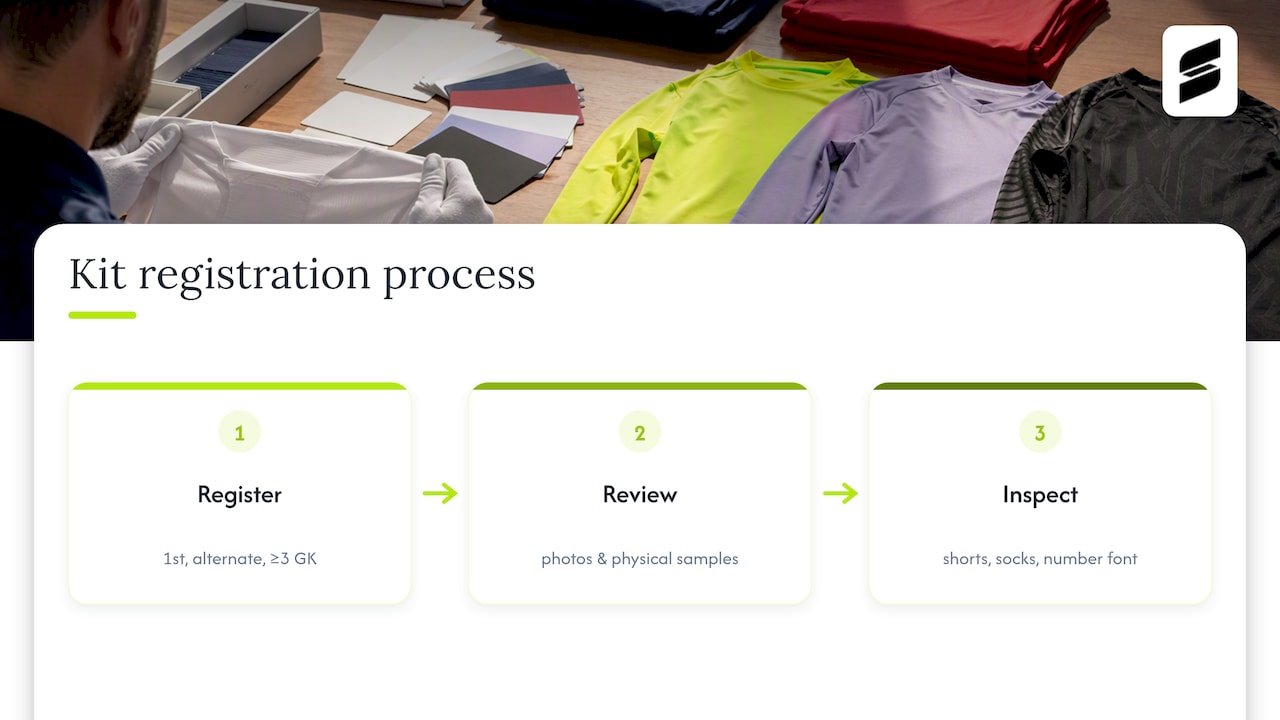
For a tournament like the World Cup, this plays out as a formal process. According to Inside FIFA’s coverage of World Cup kit selection, teams register a first-choice kit, an alternate, and at least three goalkeeper options well before the tournament begins. Reviewers then inspect physical samples and photographs, checking shorts, socks, and number fonts for readability, not just the shirt color on a screen. A kit that reads as “red” in a studio photo can look different once shorts and socks are factored into the whole silhouette, which is exactly why the registration process exists.
Designing for contrast and visibility: a practical checklist
Predominant color matters more than the swatch on a design sheet; for tips on creating effective color pairings, see our guide to golf clothing colour combinations. A shirt with a fine checkerboard or marbled pattern can read as a completely different shade at match distance than it does up close, which is precisely the kind of shift kit reviewers watch for. Our guide to choosing team colors walks through how to think about palettes before you commit to a print run.
A few checks catch most problems before a kit ever reaches the field:
- Photograph both kits side by side from 30 to 40 yards to simulate how fans and officials actually see them.
- Test the combination under stadium or gym lighting, not just daylight or a phone screen.
- Confirm that numbers and names stay legible against the shirt color from a distance.
- Check that the goalkeeper’s kit is distinguishable from both outfield sets and the referee.
FIFA’s color-count limit and predominant-color rule, discussed above, apply directly here: a shirt with too many competing colors fails the readability test before it ever reaches a stadium.
Pro Tip: Stand at the farthest seat in your home venue and look at both jerseys together. If you have to squint to tell the teams apart, the kits need more contrast, not more detail.
Third kits, alternates, and how clashes get resolved
A third or alternate kit exists for one reason: to solve a clash that the primary home and away sets cannot. Teams keep a third option in reserve so a scheduling conflict never forces a match to be played in confusing colors.
When two primary kits clash, a few outcomes are common:
- The designated away team switches to its alternate or third kit.
- Both teams wear alternates when colors still conflict after one switch.
- The goalkeeper changes jerseys independently of the outfield players, since goalkeeper distinction is its own requirement.
These resolutions happen often enough in international tournaments that organizers plan for them during kit registration rather than scrambling on match day, which is part of why the review process described earlier exists in the first place.
Checklist and designer perspective for teams ordering kits
Teams placing a uniform order can borrow the same logic governing bodies use, just scaled down to a league or school level.
- Pick a primary color and confirm it reads clearly against your most common opponents’ colors.
- Choose a genuinely contrasting away set, not a slightly darker shade of the same hue.
- Decide on a goalkeeper or alternate option early if your sport requires one.
- Confirm number and name contrast against both jersey colors before placing a full order.
- Check with league officials if your sport has specific light/dark or color-count rules.
We work directly with teams on this process to provide custom sublimated uniforms built with direct input from our design team so a coach can flag a contrast problem before production starts. Our step-by-step uniform design guide covers the same checks in more detail, including how mockups get reviewed before approval.
Pro Tip: Email your league office before finalizing art. A five-minute check against written rules is faster than a reprint after the season starts.
Why visibility, not tradition, should drive kit choices
Treating home and away colors as a visibility problem rather than a nostalgia exercise changes how you judge a kit. Broadcast cameras, stadium lighting, and even weather all affect how a color reads, which is why the same jersey can look sharp on a sunny afternoon and muddy under floodlights. Good kit design plans for the worst lighting, not the best.
— Agha
How we help teams design kits that pass the contrast test
We build custom sublimated uniforms in various sports, with direct collaboration from our design team so home and away contrast gets checked before anything goes to print. Every order includes a free sample for sizing, and mockups turn around in 24 hours, so a coach can confirm readability against real lighting before committing to a full team run.
If your current home and away sets are too close in tone, or your goalkeeper or alternate kit needs a refresh, start with our custom uniform pricing page to see options across sports and request a mockup for your team’s colors.
FAQ
What colors are home and away?
There is no single fixed color for either side. Home teams often wear a lighter or brand-primary color while away teams wear a contrasting or darker option, but the exact assignment depends on the sport and league, as explained in Wikipedia’s overview of away colours.
What color are home and away jerseys?
It depends on the league: MLB and NBA teams traditionally wear white at home, while NFL and NHL teams often put the visiting team in white instead. The deciding factor in most rulebooks is contrast between the two teams, not a universal color standard.
What color is the away team?
The away team typically wears whatever contrasting kit avoids a clash with the home team’s chosen colors that day. In leagues with first-choice privileges, the home team picks its preferred kit first, and the visiting team adjusts to stay visually distinct, per common conventions described on Wikipedia.
What’s the difference between home and away jerseys?
Home jerseys represent the team’s primary identity at its own venue, while away jerseys exist specifically to avoid confusion when the two teams’ usual colors would clash. The practical difference is contrast: away kits are designed and often approved based on how clearly they read against the home side’s colors.
Sources
- EQUIPMENT REGULATIONS
- How World Cup 26 teams choose kits, jerseys & colours — Nick Thurston
- Away colours
- NCAA 2008 clarification