
NFHS Soccer and Football Uniform Rules for 2026
For 2026, NFHS soccer rules require home teams to wear dark jerseys and dark socks, and visiting teams to wear solid white jerseys and socks. In football, jerseys and pants follow NFHS numbering, color and logo-size rules, and a change on contact-enhancing jerseys arrives in 2027. Your state association has the final say on all of it, so treat this guide as a checklist to take to your athletic director before you order anything.
This page is for coaches, athletic directors and parents who need to get a set of uniforms right the first time. It covers soccer in the most detail because that is what most readers ask about, then football, then how to check your state’s version.
TL;DR
- Soccer: home teams wear dark jerseys and dark socks, visitors wear solid white jerseys and white socks.
- A home jersey with white side panels, white sleeves or white stripes can be ruled illegal under the dark jersey requirement, so check the design before you print.
- Football: visible logos and trademarks on jerseys and pants are limited to 2¼ square inches, and jerseys or pads made to enhance contact become illegal in 2027.
- NFHS writes the rules, but each state association is the only source of binding interpretations. Confirm locally before you order.
- Get a mockup reviewed by your athletic director or state interpreter, then order.
Table of Contents
- What “NFHS uniform rules” actually means
- NFHS soccer uniform rules for 2026
- NFHS football jersey and pants rules for 2026
- How the rules differ by sport and level
- How to confirm your state’s rules
- What officials check, and what happens if a uniform fails
- A pre-order checklist for coaches
- Our perspective: design for the rule, not around it
- Getting a rule-ready design from Capra Sports
- FAQ
- Sources
What “NFHS uniform rules” actually means
The National Federation of State High School Associations (NFHS) writes the playing rules that most U.S. high school sports use. It does not enforce them. Each state high school association decides whether to adopt a rule, and the NFHS says that the state associations that adopt its rules are the sole source of binding interpretations. If you have a question about a specific uniform, contact the rules interpreter your state association designates.
That has three practical consequences for a coach:
- The NFHS rule book is your starting point, not your final answer.
- A state can add its own requirements, such as how sponsor patches are handled, so read your state’s handbook too.
- An answer from a rules interpreter in another state does not settle your question. Interpretations published by one state are useful guidance, but your own state’s interpreter decides for your games.
The rules also change on a yearly cycle. Soccer and football both have committee-driven updates for the 2026 season, and the 2026-27 soccer guide is the current reference for the soccer year that began this fall.
NFHS soccer uniform rules for 2026
The core of the soccer rule is color. The 2026-27 NFHS soccer guide states that home teams wear dark jerseys and socks, and visiting teams wear solid white jerseys and socks. That one sentence drives most of the design decisions a team makes.
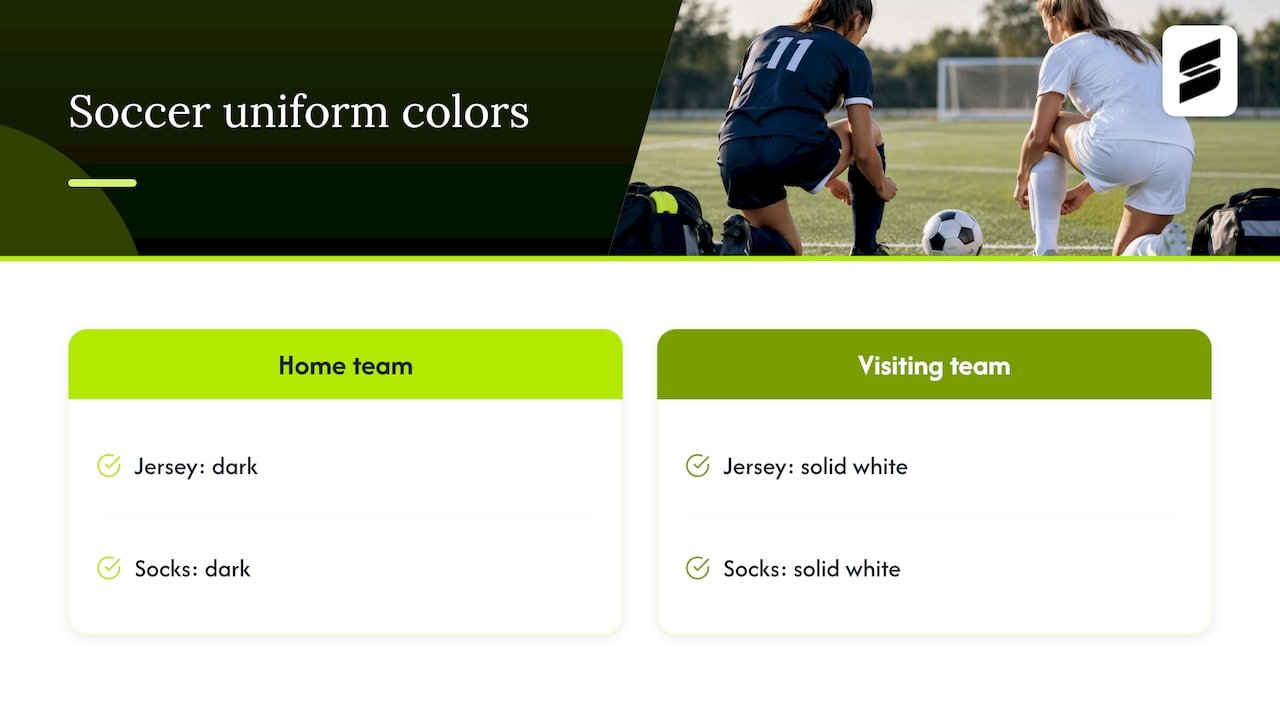
Home jerseys: dark means dark
The 2026 wording leaves less room for creative color blocking than many teams assume. According to the August 2026 weekly rule interpretations published by the Michigan High School Athletic Association (MHSAA), a home jersey that includes white components such as side panels or sleeves is considered illegal. The same interpretation says white stripes, side panels, sleeves and light gray sleeves are illegal, while thin white piping that outlines the collar or hem is legal.
This is one state’s interpretation, so confirm it with yours. But it is a good signal of how officials are likely to read the rule. A few design implications:
- A dark body with a bright accent color (gold, orange, red) is a safer choice than a dark body with white accents.
- If your school colors are white and a bright color, your home jersey needs to be built around the darker of your colors or a true dark alternative, such as navy or black.
- Light gray or silver sleeves can read as light to an official, so test the shade with your athletic director.
- Thin white trim at the collar or hem is the kind of detail the MHSAA says is legal, but ask before you rely on it.
Visiting jerseys: solid white
The visiting jersey is the simpler half. It is solid white. If your team travels, you need a white jersey that is actually solid, not a white jersey with a large colored sleeve or a heavy graphic wash. Keep any design elements small and within what your state allows for numbers and marks.
Socks
Socks were the subject of a 2026 clarification. Rule 4-1-4c requires home team socks to be a single dominant dark color. The Oregon School Activities Association (OSAA) describes this as a clarification of existing practice, meant to prevent confusion between the white socks that visitors must wear and the options available to home teams.
What to do with that:
- Order home socks in one dominant dark color that matches or complements the home jersey.
- Order visiting socks in white.
- Do not assume that a sock with a school-color stripe at the top will pass as the dominant color. Ask your interpreter if the stripe is wide.
Shin guards and other equipment
Uniform legality in soccer is not only about the jersey. The NFHS soccer guide calls for NOCSAE-standard shin guards, and the MHSAA interpretation adds that guards must display the seal and the approved height range. Before the first match, have each player show you the label on the guard. Players who bought guards online or inherited them from an older sibling are the ones most likely to have a guard without a seal.
The guide also states that players may not wear audio or video devices on the field. That matters for teams that use wearable trackers or cameras in practice and forget to take them off for games.
Numbers and goalkeeper kits
The research I could verify for this guide does not cover every detail of soccer numbering, such as size, contrast and placement, or the goalkeeper color requirements, so I will not guess at them here. Pull those lines directly from the 2026-27 soccer guide or your state’s handbook, and have your athletic director initial them on the order sheet. For general numbering practice, including how FIFA-style sizes work for clubs, see our guide to soccer jersey numbering.
NFHS football jersey and pants rules for 2026
Football rules are more detailed than soccer rules because they cover numbering, color and the interaction of uniform pieces with protective equipment. The official NFHS football jersey and pants rules summary for 2026 is the document to keep in your coaching binder.
Logos and visible marks
The summary limits visible logos, trademarks or references on jerseys and pants to 2¼ square inches, and 2¼ inches in any dimension. That is small. A full-size team mascot printed across the chest is a team graphic, not a manufacturer mark, so the limit is aimed at brand and reference marks. Even so, ask your state how it treats sponsor marks and school marks before you put either on a jersey.
Home and visiting colors, and numbering
The same document sets the home and visiting jersey color requirements and the numbering rules for football. Position-based numbering is its own topic, and we cover it in detail in our football numbers by position rulebook. If you are choosing a design, our football uniform design ideas show how to build a look that stays inside the color and numbering rules.
Jerseys and pads that enhance contact
The 2026 summary states that football jerseys, undershirts and exterior arm covers or pads manufactured to enhance contact are illegal through 2026, and that jerseys or pads manufactured to enhance contact are illegal effective 2027. If you are buying a multi-year set now, read the product description for any feature meant to increase contact, such as hard or textured exterior elements, and ask your athletic director to approve it.
The NFHS summary also lists protective equipment that football players must wear. Equipment is usually purchased separately from uniforms, but a coach who orders jerseys should still check that the jersey cut fits over shoulder pads.
How the rules differ by sport and level
A rule that is legal in one setting can be illegal in another. The NFHS soccer guide notes that NCAA and IFA-USSF requirements differ from the high school rules, and the same pattern holds across sports.
| Setting | What to check | Where to look |
|---|---|---|
| High school soccer | Dark home jersey and socks, solid white visitor jersey and socks, NOCSAE shin guards | NFHS soccer guide and your state handbook |
| High school football | Numbering, logo size, home and visiting colors, protective equipment | NFHS football jersey and pants rules and your state handbook |
| Youth baseball leagues | League-specific rules on jerseys, pants and sizing | Your league’s rules, such as our Little League uniform rules guide |
| Travel and club baseball | Tournament body rules | Our USSSA baseball uniform rules checklist |
| Club and AAU basketball | Tournament and governing body rules on uniforms | Our AAU basketball uniform rules guide |
If your school plays high school games and also enters a club tournament, you may need two uniform sets or at least two sets of socks and jerseys. Plan this before you order, not after the first tournament email arrives.
How to confirm your state’s rules
A short process keeps you out of trouble:
- Find your state high school association’s handbook or its sport-specific uniform page for the current season.
- Read the NFHS rule for your sport next to the state’s additions.
- Write your questions down: sleeves, piping, sponsor marks, number sizes, goalkeeper color.
- Send them to the rules interpreter your state association designates, and keep the reply.
- Attach that reply to your order file so a future coach or athletic director knows why the design was chosen.
This is the route the NFHS itself points to, because state associations are the binding authority.
What officials check, and what happens if a uniform fails
Officials look at uniforms before the game. Typical checks include jersey color against the home and visitor designation, sock color, numbers, and required equipment such as shin guards. The MHSAA interpretation frames shin guard checks around student-athlete safety, which is why the seal and height range matter.
The consequences of a failed check depend on your state’s rule book and on the official’s judgment. I will not state a penalty here, because it varies by state and sport. What you can control is the preparation:
- Bring both jersey colors to every game, even if you expect to be the home team.
- Keep a spare set of socks in each color in the equipment bag.
- Check shin guard labels at the start of the season, not on game day.
- Keep your interpreter’s written answer on your phone.
A pre-order checklist for coaches
Before you approve a design, run through this list:
- Which sport and which governing body: high school, club, league or tournament?
- Home and visitor colors: is the home jersey dark with no white panels, sleeves or stripes (soccer), and is the visitor jersey solid white?
- Socks: one dominant dark color for home, white for visitors.
- Logos and marks: within the football size limit, and approved by your athletic director.
- Numbers: sized and placed to your sport’s rule and readable against the jersey color.
- Shorts and pants: match your state’s requirements for color and trim.
- Sizing: have players try a sample before you commit to the full order.
- Multi-year use: any 2027 football change on contact-enhancing jerseys or pads.
Our perspective: design for the rule, not around it
We see the same pattern each season. A team falls in love with a design, orders it, and finds out in the first week that the home jersey has a white sleeve panel or the logo is too large. The fix is almost never complicated, but by then the uniforms are printed.
At Capra Sports we build uniforms with sublimated printing, which means color blocking, panels and graphics are part of the fabric design rather than something added on top. That gives a coach real freedom, and it is also why the rules matter so much: a design can look great and still be illegal for your league. So we recommend reviewing the rules first, then working with a designer to make the legal version look as good as possible.
Three things we tell coaches:
- Start from the rule. Write down the home and visitor color requirements before you open the design tool.
- Ask for a mockup, share it with your athletic director, and revise it before you order. Our professional designers work with you on revisions, and mockups come back within 24 hours.
- Try the fit. We include one sizing sample at no extra charge, so you can check sizing before the team order. Our team minimum is 10 sets.
A uniform that passes the pre-game check, fits every player and looks sharp is not a matter of luck. It is a matter of doing the rules homework first.
— Agha
Getting a rule-ready design from Capra Sports
If you are ready to turn the rules above into a real set, start with a mockup. Tell us your sport, your home and visitor colors and the rules you need to meet, and our designers will build a design around them. You can see our custom soccer uniforms and kits and our custom football uniforms, or check current pricing for each sport. Pricing: [PRICE TBD].
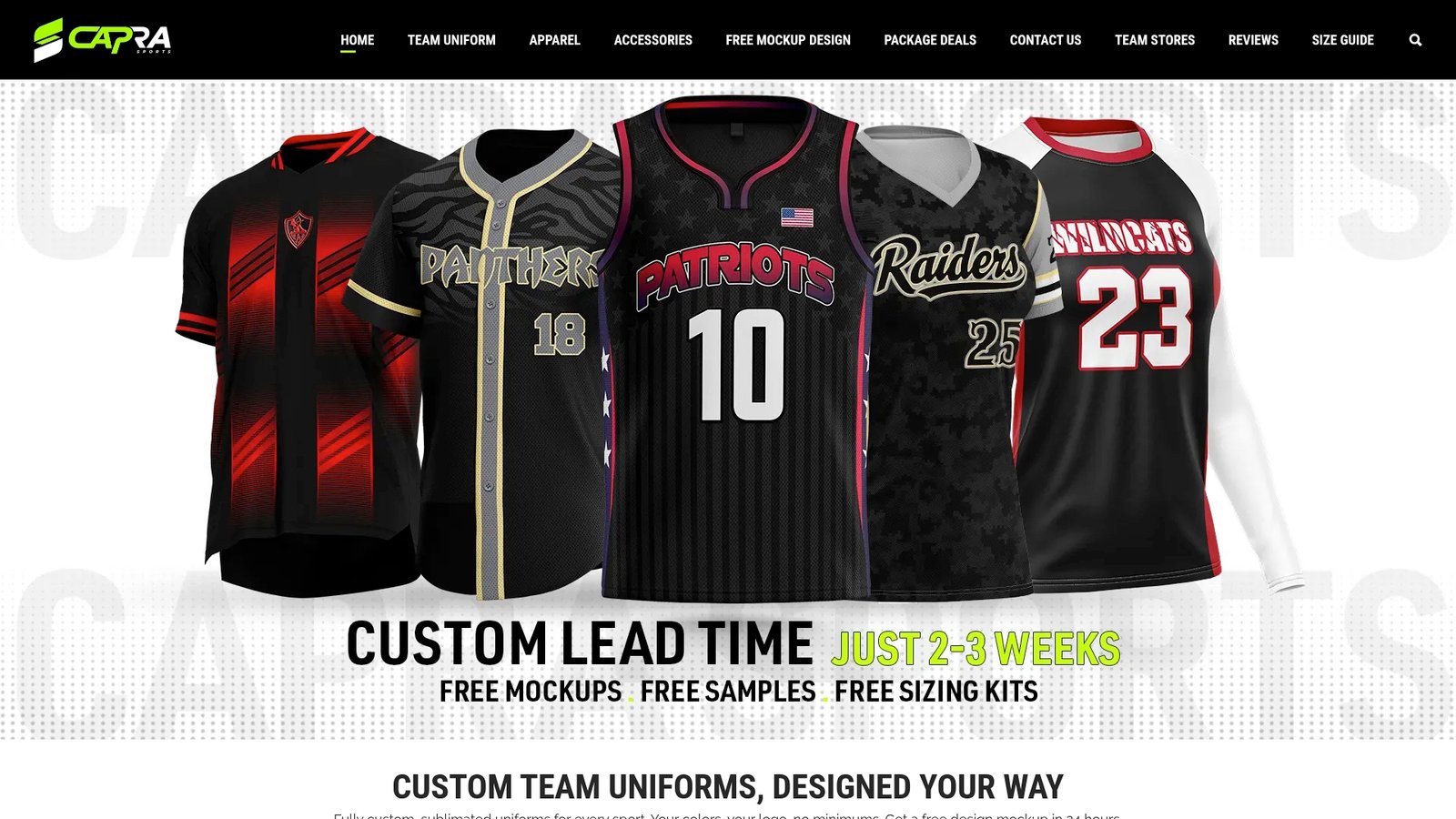
For soccer teams, a quick tip: ask for the home design in a dark base with accent colors and the visitor design in solid white, and request matching socks in each color. For football teams, ask the designer to keep any marks within the logo size limit and to avoid contact-enhancing features. Our football uniform design ideas are a good place to start if you want to see what legal and good-looking can mean.
FAQ
What color must home soccer jerseys be under the 2026 NFHS rules?
Home teams wear dark jerseys and dark socks, and visiting teams wear solid white jerseys and socks. The MHSAA interpretation treats white side panels, sleeves and stripes on a home jersey as illegal. Thin white piping on the collar or hem is described as legal, but confirm with your state.
Do NFHS rules apply to club or youth leagues?
Not automatically. NFHS rules govern high school sports through the state associations that adopt them. Club, league and tournament bodies set their own requirements, and the NFHS soccer guide notes that NCAA and club requirements differ. Check the rules of the body that runs your games.
Who has the final word on a uniform question?
Your state high school association. The NFHS says adopting associations are the sole source of binding interpretations, and it directs questions to the rules interpreter designated by the state. Keep the written answer with your order records.
What is the logo size limit for football jerseys?
The 2026 NFHS football jersey and pants summary limits visible logos, trademarks or references to 2¼ square inches and 2¼ inches in any dimension. Ask your athletic director how your state treats school marks and sponsor marks before you finalize artwork.
Are shin guards part of the uniform check?
Yes, in practice. NFHS soccer requires NOCSAE-standard shin guards, and the MHSAA interpretation says they must show the seal and approved height range. Check every player’s guards at the start of the season so there are no surprises before kickoff.
Sources
- NFHS 2026-27 Soccer Guide
- 2026 NFHS Football Jersey and Pants Rules
- OSAA 2026 Soccer Rules Changes and Points of Emphasis
- MHSAA NFHS Soccer Weekly Rule Interpretations, August 26, 2026
- NFHS Rules Interpretation Requests