
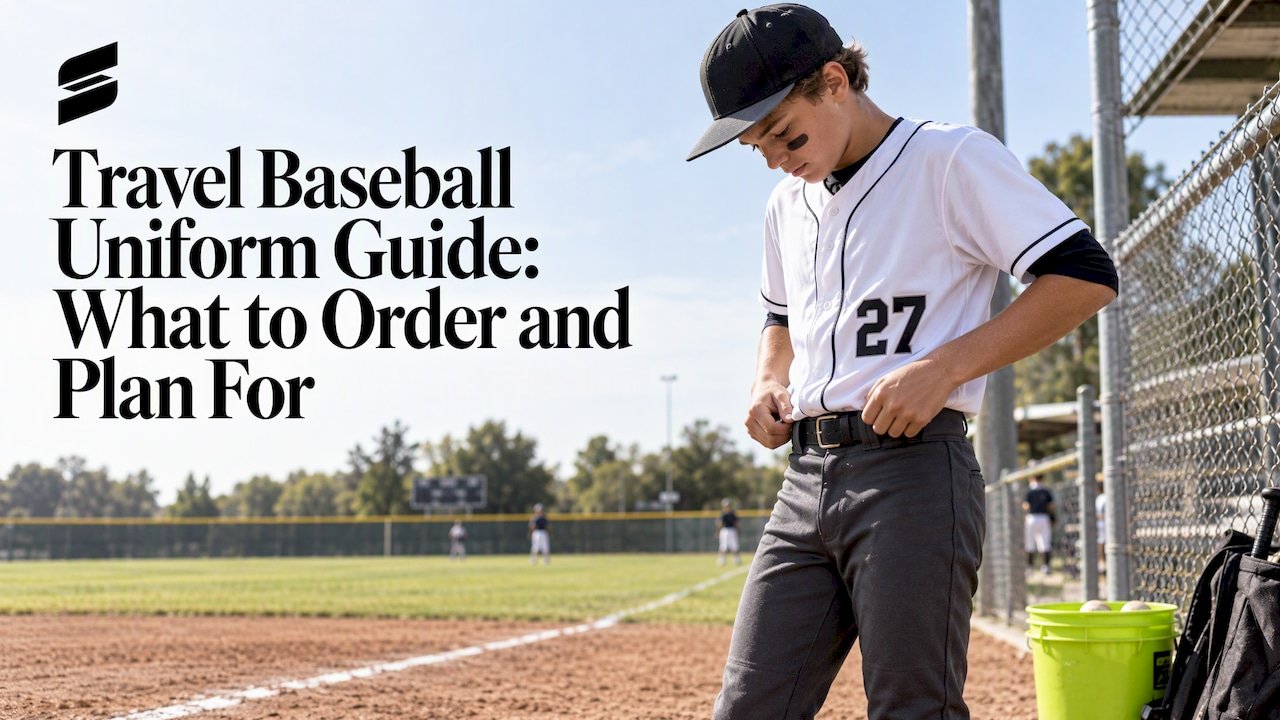
Travel Baseball Uniform Guide: What to Order and Plan For
A travel baseball uniform is a matched set: jersey, pants, belt, socks and cap, with a number on the back and your team identity on the front. Ordering it well comes down to five decisions: which pieces you need, how the team will look, how you size the roster, which fabric you want, and how you budget and schedule the order. This guide walks through each one so a coach or team parent can order once and get it right.
TL;DR
- A full travel uniform is a jersey, pants, belt, socks and cap. Check your league or tournament rules for number size and color requirements before you design anything.
- Pick one primary color, one accent and one clear logo. Add a second set (home and away, or a pullover alternate) only after the first set is settled.
- Measure every player and compare against a size chart. Our policy is one sizing sample at no extra charge, so use it before the full order.
- Sublimated uniforms print the design into the fabric, so graphics and numbers do not crack or peel the way applied lettering can.
- Our team minimum is 10 sets, and design mockups come back within 24 hours. Pricing is [PRICE TBD] until you request a quote.
Table of Contents
- What a travel baseball uniform includes
- Travel baseball jersey ideas that look distinct
- Coordinating jerseys, pants, socks and caps
- Sizing the roster
- Fabric and construction
- Budgeting, personalizing and scheduling the order
- Our perspective: order the look, not the pieces
- Ready to see your team’s look
- FAQ
- Sources
What a travel baseball uniform includes
Start with the pieces, because that is where most budgets get confused. A uniform is not the same thing as a player’s full equipment bag, and teams often assume the club covers items that families actually buy.
Little League’s guidance on equipping players separates the uniform from equipment. It describes a typical team-provided uniform as a jersey or T-shirt, a team hat or visor, and any required league patch. Families commonly supply baseball pants, a belt and socks in the colors the team or league selects. Travel teams usually go further than a recreational league and order the whole look as one package, which is what keeps a roster from showing up in six shades of gray pants.
Here is how the pieces break down for a travel roster:
| Piece | What to decide | Common mistake |
|---|---|---|
| Jersey | Button-front or pullover, sleeve length, color, numbers | Choosing a number too small to read from the stands |
| Pants | Full-length or piped, color, fit by age | Ordering by jersey size instead of waist and inseam |
| Belt | Color matched to the pants or an accent color | Forgetting it until the first tournament |
| Socks | Solid or striped, how they pair with the pant length | Buying a color that does not match the jersey trim |
| Cap | Logo placement, crown color, bill color | Designing the cap last, after the colors are locked |
| Optional layers | Warmup shirt, hoodie, backpack | Letting each family buy a different one |
We build the core set around the jersey and the pants, then add the optional layers once the main look is approved. You can see the pants options on our custom baseball pants page.
Rules that shape the design
Before you pick colors, find out which rules govern your games. Travel teams often play under several sanctioning bodies in one season, and each can have its own requirements for numbers, colors and equipment. Number size is the one that catches teams most often: a small, thin number on the back may look fine in a mockup and still fail a check at the field.
Two more details from Little League’s rule updates are worth knowing if your players also play in that system. The 2025 rulebook update permits pitchers to wear exposed neoprene sleeves if they are solid-colored and not white or gray. If you have pitchers who wear sleeves, plan the color of the sleeve alongside the uniform, not after it.
We cover the details in more depth in our guides to Little League uniform rules and USSSA uniform checks. Whatever your sanctioning body, ask the tournament director for the written uniform requirements before you finalize the design.
Travel baseball jersey ideas that look distinct
Travel teams compete for attention in a way recreational teams do not. You are in a park with twenty other programs, and a clean, recognizable look helps players feel like a unit and helps parents find the right dugout.
Start with color
The simplest approach is one primary color, one accent and a neutral. Navy with red, black with gold, forest green with white, and royal blue with orange are all familiar combinations because the contrast holds up in bright sun and under lights. Heavily saturated or very light colors can be harder to read from a distance, so check how the number looks against the jersey in the mockup before you approve it.
Some questions that settle color quickly:
- Does the primary color match your club logo or your school or town colors?
- Will the number contrast clearly with the jersey at a distance?
- Do the pants and socks make the team look matched without making the set look flat?
- Can a second set in a different base color still look like the same team?
Choose a jersey style
The main style choice is between a full-button jersey and a pullover. Full-button jerseys read as traditional and are popular with older age groups. Pullovers are easy to get on and off, which parents of younger players tend to appreciate. Both can carry the same color blocking, piping and lettering, so the choice is more about feel than design. See our custom baseball pullover jerseys for one option, or browse 30 custom baseball jersey designs for layouts to adapt.
Personalization details that work
- Team wordmark across the chest. Script or block lettering is the usual choice. Keep it to one line so it stays legible.
- Sleeve details. A small logo, a stripe or a number on the sleeve adds identity without crowding the front.
- Player names on the back. They help scorekeepers and parents, but they add a step to the order, so collect spellings once and confirm them in writing.
- Side panels or piping. Contrast panels give the jersey shape and set it apart from stock designs.
- Alternate set. A home and away pairing, or a darker alternate, gives you flexibility for tournaments where two teams show up in similar colors.
If you want a starting point built around rules compliance, our baseball jersey design ideas page walks through layouts that coaches can take to a free mockup.
Coordinating jerseys, pants, socks and caps
A uniform looks sharp when every piece has a job. The jersey carries the identity, the pants and socks ground it, and the cap ties it together from the top.
A few practical coordination rules:
- Pick the pants color first if you can. Gray, white and solid team colors are the common choices. Darker pants hide dirt, lighter pants look cleaner at the start of a tournament weekend and show every slide.
- Match the belt and socks to an accent. One accent color repeated in belt, socks and jersey trim makes the whole set look planned.
- Keep the cap simple. One logo on the front, on a crown color that already appears in the jersey.
- Do not use more than three colors across the full set. Beyond that, the look gets busy and the logo gets lost.
- Test the set on a dark and a bright day. Check the mockup on a phone screen in sunlight, since that is how most parents will see it first.
If you want a layered look for cooler tournaments, plan the warmup shirt and hoodie from the same palette. A team that arrives in matching layers looks organized before the first pitch.
Sizing the roster
Sizing is where most reorders come from. A jersey that is too tight restricts the swing, and pants that are too long are a tripping problem in the field. Because travel rosters often include players of the same age with very different builds, do not size by age group alone.
How to measure
- Measure chest, waist and height for every player, with the player standing and wearing a thin shirt.
- For pants, take the waist and the inseam. Do not guess from the jersey size.
- Write the measurements on a team sheet and keep it; you will need it for reorders and for replacements when a player joins midseason.
- Compare each player’s numbers against the size chart on the page you are ordering from. Our baseball uniform size chart lists the dimensions from youth sizes up through adult sizes.
When a player is between sizes
Growing players are the hard case. If a player falls between two sizes, most coaches size up for youth players who are still growing and size to fit for older players who have finished growing. If you are unsure, ask the parent for a recent measurement on the day of the order, not from last season.
To avoid a full roster of wrong sizes, we offer one sizing sample at no extra charge. Have a few players try the sample, and adjust the order before it is produced. That one step has saved teams from the most common order mistake, which is discovering a size problem after the whole set has arrived.
Fabric and construction
Fabric decides how the uniform feels in July heat and how it looks in September. Travel schedules are long: multiple games a day, often in direct sun, with uniforms that get washed in hotel sinks and family washing machines.
Our team uniforms are sublimated. That means the design is printed into the fabric rather than layered on top of it. For a baseball team, that has practical effects:
- Colors and gradients can run edge to edge without seams between color blocks.
- Numbers and logos are part of the fabric, so there is no lettering to lift or crack.
- Because the design is not a separate layer, the jersey stays lighter and more flexible than one covered in applied twill.
Some details are worth asking about before you order:
- Weight and stretch. Lighter fabrics breathe better, while heavier fabrics tolerate more abuse. Younger players often prefer lighter, older players slide more and may want more durability in the pants.
- Pant construction. Look for reinforced areas where players slide and kneel, and a waistband that stays comfortable through a long day.
- Collar and cuffs. These take the most wear in a jersey, so check how they hold their shape.
- Color and fade. Dark colors can show chalk and dirt, light colors can show grass stains, so decide which tradeoff suits your fields.
Care is simple. Turn jerseys inside out, wash in cold water, and hang dry or tumble dry on low. Follow the care label that comes with the order, because it reflects the specific fabric you chose.
For practice, Little League recommends baseball pants or sweatpants rather than shorts, since players slide and field on the ground. The same page recommends molded cleats for younger levels and says metal cleats are not permitted there. If your team practices more than it plays, a second pair of pants for practice is a good use of budget.
Budgeting, personalizing and scheduling the order
A travel uniform order has more moving parts than a recreational one, and the money questions come up quickly. Here is how we suggest a coach walks through them.
Set the budget per player
Start with the full set per player, not per piece. Add the jersey, pants, belt, socks and cap, then decide whether warmup layers or a backpack are in or out. Per-piece prices on our pricing page are listed as [PRICE TBD] in this guide, so request a quote for your roster to get exact figures. If families pay individually, give them one total and a deadline instead of a list of options.
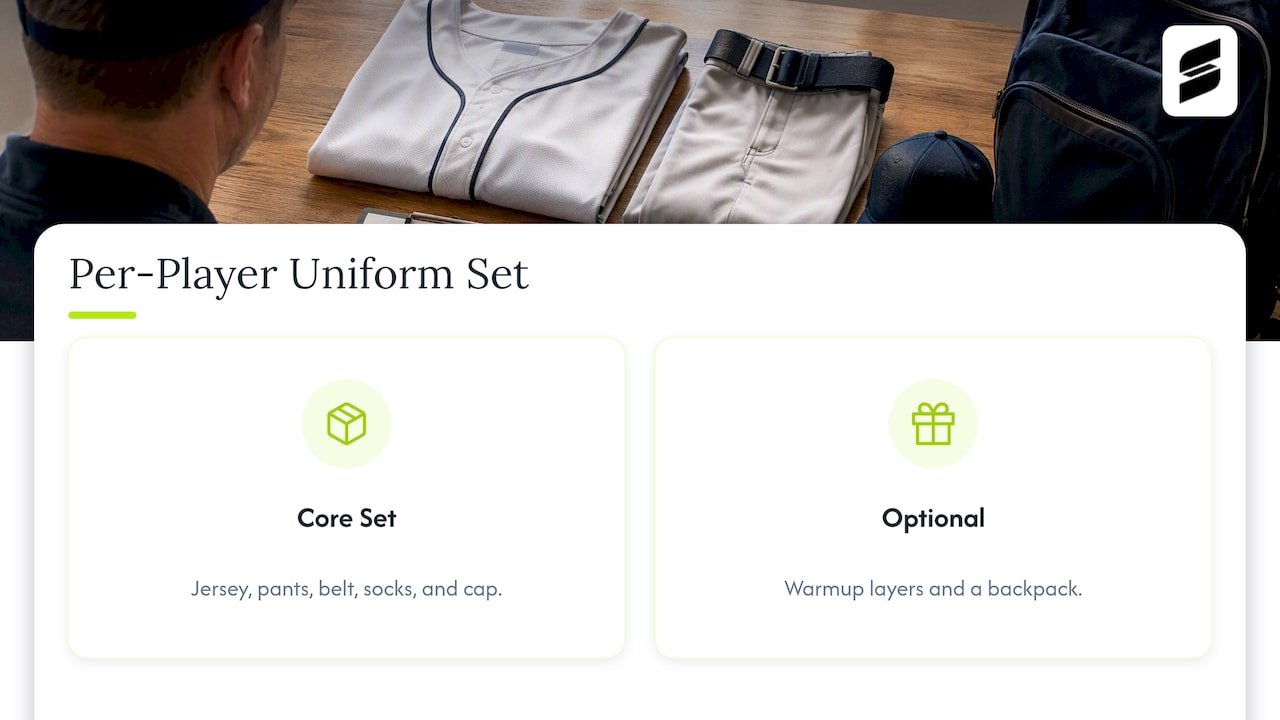
You can also look at a bundled option. Our youth baseball uniform packages group the pieces into one set per player, which keeps the order simple when you want a matched look across the roster.
Understand the minimum
Our policy is a 10-set team minimum. Most travel rosters are at or above that, but if your team is smaller, talk to us about options before you design.
Build a realistic timeline
Work backward from your first tournament:
- Design. Share your colors, logo and ideas. Our designers return a free mockup within 24 hours, and you can request revisions until the look is right.
- Approval. Collect sign-off from the coach and the parent coordinator in one place. Changes after approval are the biggest source of delay.
- Names and numbers. Lock the roster, spelling and number assignments before production begins.
- Sizing. Use the sample and the size chart, then confirm every player’s size.
- Production and shipping. Ask for the current schedule when you place the order, and leave a buffer before your first event.
Because timelines depend on the season and order size, ask for the current schedule when you request your quote instead of assuming one from a past order. Order earlier than you think you need to, since spring tournaments and fall ball both create busy periods for every team.
Pack the uniform for the road
Once the uniforms arrive, a packing routine matters. Pack every piece for each game, with a spare pair of socks, and keep the cap and belt in the same bag as the jersey so they do not get separated. Our tournament packing list covers what players, parents and coaches should carry.
Our perspective: order the look, not the pieces
We talk with coaches and team parents about uniforms constantly, and the same pattern repeats. Teams that struggle with an order usually decided the colors first and the rules last. Teams that do well start with the rules, then the sizes, then the design, because the last two are easier to change than the first.
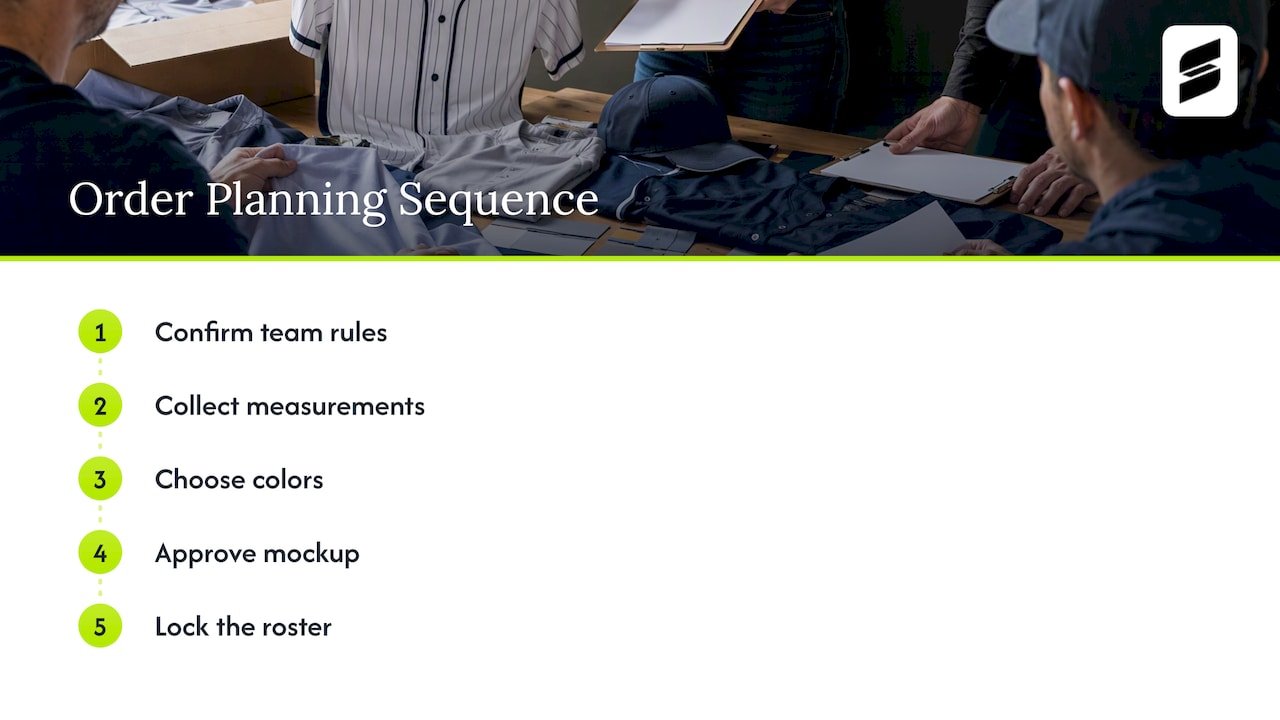
Our advice is to build the order in this sequence: confirm the rules your team plays under, collect measurements, choose your colors, approve a mockup, and only then lock the roster. If a sizing question comes up, use the free sample before the full run. If a design question comes up, ask for another revision, since unlimited revisions are part of working with our designers.
We also suggest that teams think of the uniform as a two-season asset. Choose a design that still looks right next year, so new players can join without the team needing to change its identity. A simple, strong look ages better than a trendy one.
— Agha
Ready to see your team’s look
If you are ready to move from ideas to a real design, we can help. Capra Sports makes custom sublimated baseball uniforms for travel teams, with free design mockups returned within 24 hours and direct work with professional designers.
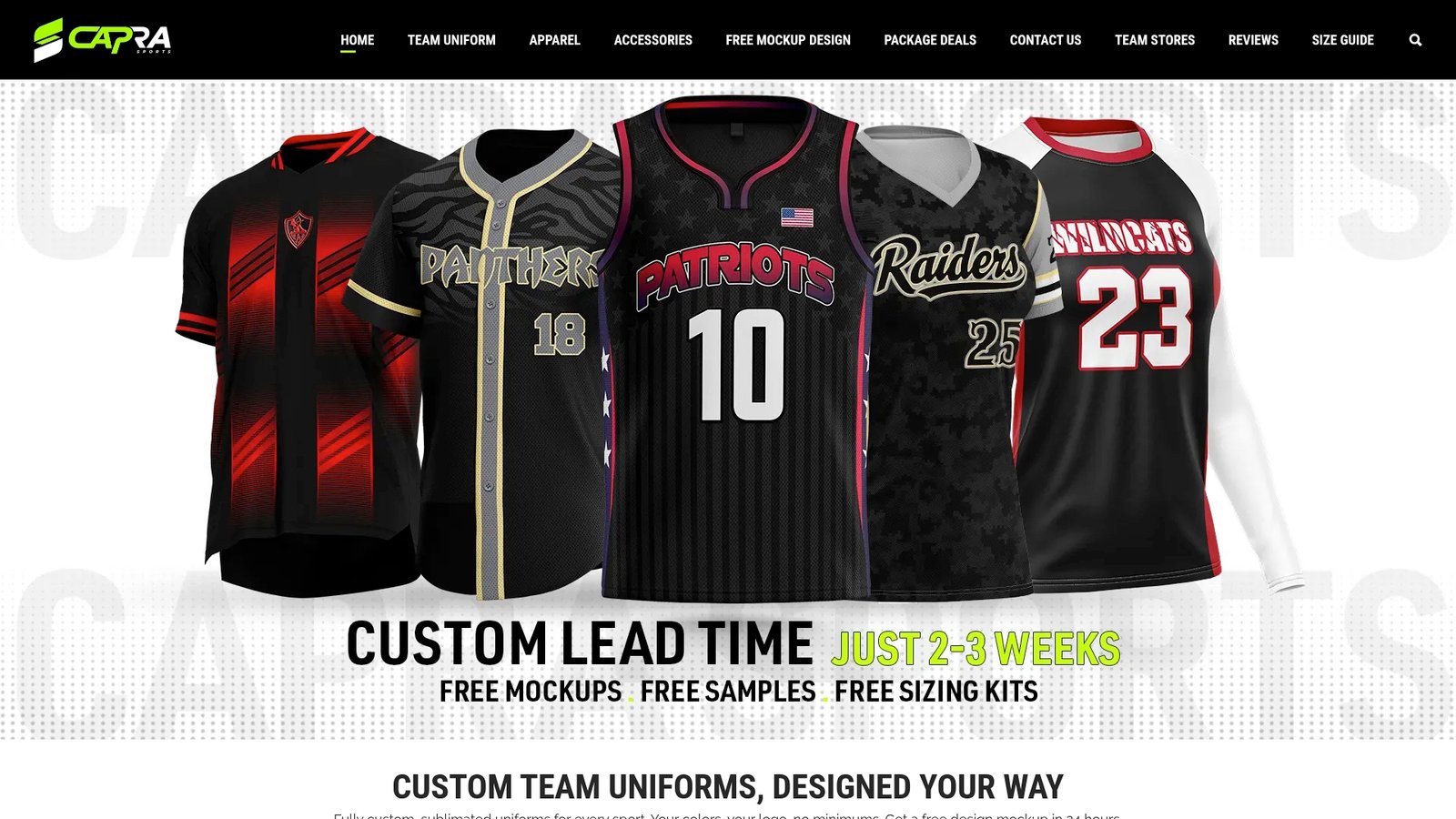
You can start with our custom baseball uniforms for teams page, try the custom baseball uniform builder to sketch colors and layouts yourself, or read how to choose custom baseball and softball uniforms for a coach’s walkthrough. For more articles, visit our sportswear blog.
FAQ
What pieces should a travel baseball uniform include?
At minimum, a jersey, pants, belt, socks and a team cap. Little League’s guidance treats the jersey and hat as the core of a team-provided uniform, with pants, belt and socks commonly bought by families in team-selected colors. Most travel teams order all of them together so everything matches.
How big should the jersey number be?
It depends on the sanctioning body, so check the written rules for each league or tournament you play in. Make the number large and high contrast against the jersey color either way. Confirm the requirement before approving a mockup, because changing it after production is costly.
How do I size a youth travel team?
Measure every player for chest, waist, height and pant inseam, then compare the numbers to the size chart. Do not size by age alone. Try the free sizing sample on a few players of different builds before you place the full order.
How many uniforms do I have to order?
Our team minimum is 10 sets. If your roster is smaller than that, contact us before you design so we can talk through your options.
How long does it take to get a design?
We return free design mockups within 24 hours. Production and shipping timelines vary by season and order size, so ask for the current schedule when you request your quote.
Sources
- Little League: What Parents and Local Leagues Need to Know About Equipping a Little Leaguer
- Little League: 2025 Rulebook Significant Updates
- Little League: Get the Gear and What to Wear for Little League Practices