
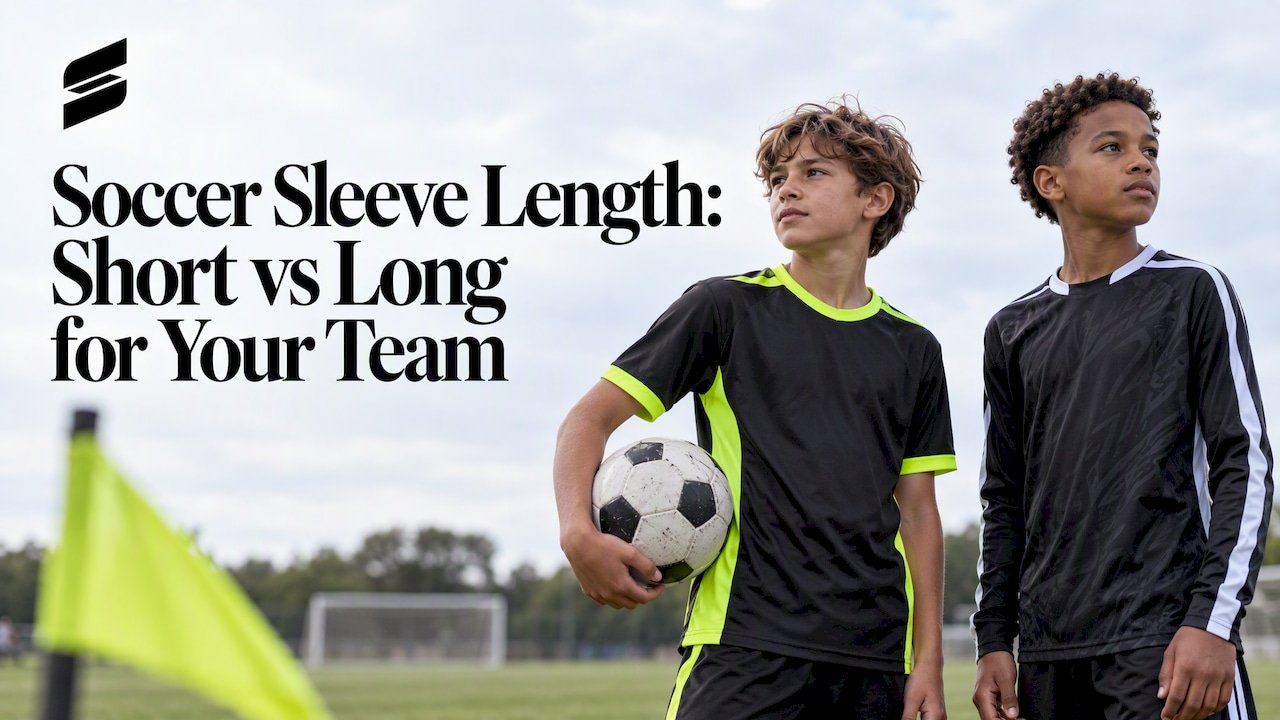
Soccer Sleeve Length: Short vs Long for Your Team
For most youth and adult teams, short sleeves ending around mid-bicep are the right default. Long sleeves that reach the wrist suit cold-weather schedules, goalkeepers and teams that simply like the full-sleeve look. The rest of this guide covers how each length should fit, what the rules say, how layering changes the call, and how to settle it for a whole roster before you order.
One note on terms: “sleeve length” also gets searched by players looking for leg or calf sleeves. This article is about the sleeves on the jersey itself, which is the decision a coach or league coordinator makes for the full team.
TL;DR
- Short sleeves should end around mid-bicep. Long sleeves should reach the wrist without bunching at the cuff.
- Sleeve length is not a warmth switch. Fabric, breathability and layers do most of the work.
- A jersey must have sleeves under the FIFA equipment rules, and high school play follows NFHS uniform requirements, so check your league before you pick.
- Choose one style for the whole team, then confirm sizes with a sample before the full order.
Table of Contents
- Short sleeve or long sleeve: the quick decision
- How each sleeve length should fit
- Does sleeve length change how warm a player is?
- Goalkeepers: a different case
- What the rules say about sleeves
- A sleeve-length decision for every kind of team
- How to test sleeve length on a real roster
- Common sleeve problems and how to fix them
- Our perspective at Capra Sports
- Ordering your team’s jerseys with Capra Sports
- FAQ
- Sources
Short sleeve or long sleeve: the quick decision
Start with three questions.
- What are your game conditions? A fall league that starts in warm September afternoons and ends in November is a different order from a spring league that begins in March.
- Who is on the roster? Field players, goalkeepers and any player who wears a base layer all have different needs.
- What does your league require? Some leagues and schools specify one uniform style for everyone.
If the answer to the first question is “mostly warm” and the second is “mostly field players,” short sleeves win on simplicity. If your season runs into cold weather, or players want covered arms against turf contact, long sleeves are worth a look. Many teams do the practical thing: order short-sleeve game jerseys and let players add their own fitted layer underneath when it gets cold.
| Factor | Short sleeve | Long sleeve |
|---|---|---|
| Typical fit | Ends around mid-bicep | Reaches the wrist |
| Best for | Warm and mild matches, most field players | Cool matches, turf contact, goalkeepers, the full-sleeve look |
| Layering | Easy to wear over a base layer | Can feel tight if a thermal layer goes underneath |
| Sizing risk | Sleeve opening too tight on the bicep | Cuff too short at the wrist or too baggy |
| Roster flexibility | One style fits almost everyone | Players with long arms need extra attention |
How each sleeve length should fit
A good sleeve is invisible during play. The player forgets it is there. These are the checks we recommend running with any player trying a sample.
Short sleeves: the mid-bicep rule
The hem of a short sleeve should land around the middle of the bicep. A common pairing guide from soccer retailers puts it the same way: short sleeves end mid-bicep and long sleeves reach the wrist without bunching. Nothing here is complicated, but the details matter:
- Too short and the sleeve rides up toward the shoulder when the player raises an arm, which looks sloppy and can pinch.
- Too long and the hem flaps near the elbow, catching on opponents’ hands and looking oversized.
- Too tight at the opening and the sleeve cuts into the bicep, especially on older players who lift weights.
Have the player raise both arms overhead, throw an imaginary throw-in, and swing a kicking motion. The jersey body should not ride up, and the sleeve opening should not dig in.
Long sleeves: wrist to wrist without bunching
A long sleeve should finish at the wrist bone when the arm hangs straight. When the player bends the elbow to sprint, a little fabric gathering is normal. A lot of bunching means the sleeve is too long, and a cuff that jumps up the forearm means it is too short.
Long sleeves also add more fabric to the shoulder and upper arm, so mobility matters more. A poorly fitted long-sleeve jersey can restrict the arms more than a correctly sized short-sleeve shirt, which is why we tell coaches to check range of motion before they check style.
The jersey body counts as much as the sleeve
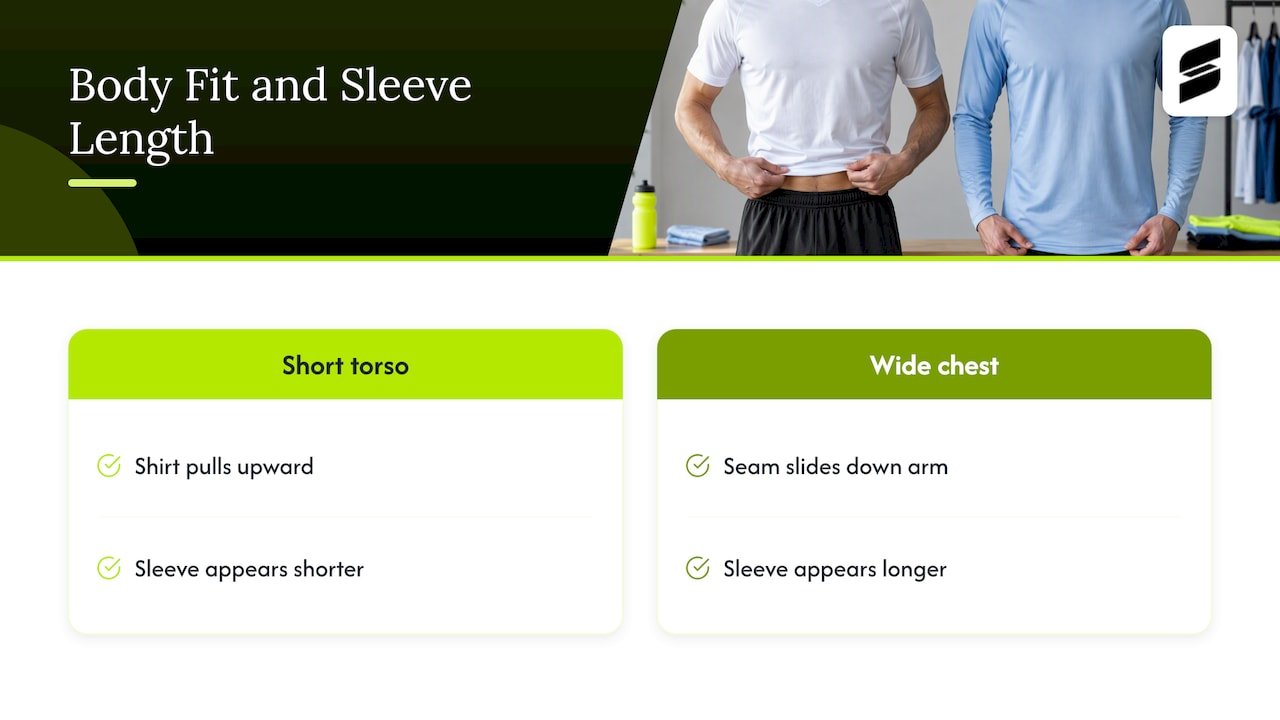
Players often blame the sleeve for what is really a body-length or chest-width problem. If the torso is short, the whole shirt pulls up and shortens the sleeve with it. If the chest runs wide, the shoulder seam slides down the arm and the sleeve looks too long. Always judge sleeve length together with chest width and body length. Our soccer size chart lists measurements for each size so you can compare them against your players.
Does sleeve length change how warm a player is?
Less than most people expect. Modern sublimated jerseys are lightweight, moisture-wicking knits, and they do not hold much heat whether the sleeves are short or long. A long sleeve covers more skin, so it takes the edge off a breeze, but it will not turn a game-day shirt into a winter jacket.
If warmth is the goal, think in layers:
- A short-sleeve jersey over a fitted long-sleeve base layer gives the most flexibility. Players can add or drop the layer based on the forecast.
- A long-sleeve jersey over a thermal undershirt can feel restrictive, because two layers of sleeve compete for the same space.
- A warmup top or hoodie covers the sideline time, when players actually get cold.
That last point is the cheap fix. Most players are cold while waiting to enter the match, not while running. Matching warmup shirts, pants or hoodies often solve the problem that people try to solve with sleeve length.
Goalkeepers: a different case
Goalkeepers dive on turf and hard ground, so long sleeves are the usual choice. Coverage on the forearm and elbow reduces scrapes, and some keepers add padding that field jerseys do not carry. The goalkeeper jersey also needs to look clearly different from both teams. Under NFHS soccer uniform guidance, the keeper’s jersey must be distinctly different in color from teammates and opponents.
Practical advice for a team order: plan the keeper jersey as its own design from the start, in a long sleeve if the keeper prefers it, with a color that no one on either bench will wear.
What the rules say about sleeves
The basic position is simple. Under the FIFA equipment list, the compulsory gear includes a shirt with sleeves, shorts, socks, shin guards and footwear. The rule asks for sleeves, not a particular length, so both short and long are valid.
What can complicate the picture is the league above your team:
- High school: The NFHS soccer uniform summary says all team members wear the same color and style of uniform, and that jerseys are worn as the maker intended. Athletic directors should treat sleeve style as part of that uniform standard.
- Club and rec leagues: Many leagues publish their own uniform rules. Ask your league coordinator if sleeve style must match across the roster, and whether undershirts must match the sleeve color.
- Numbers and names: Sleeve choice does not change number requirements. If you are also planning numbers, see our soccer jersey number rules page.
When in doubt, email the league contact and keep the answer on file. It takes two minutes and prevents a re-order.
A sleeve-length decision for every kind of team
Youth recreational teams
Go short sleeve for almost everyone. Kids grow, and a sleeve that ends at mid-bicep this season will still be acceptable half a size later, while a long sleeve that runs past the wrist quickly looks wrong. Parents also prefer to buy a single jersey for warm and cool days and add a base layer as needed. For measuring tips by age, our youth jersey sizing guide explains what to record.
Competitive club and travel teams
Travel teams play in more climates, so the uniform must work across seasons. Short-sleeve game jerseys with a long-sleeve option for keepers or a cold-weather tournament give you range without doubling every order.
High school and school athletic programs
Uniform consistency is the point. Pick one sleeve style for the roster, confirm the state association rules, and order a keeper jersey that is clearly different. Athletic directors who manage several programs can use the same sleeve decisions across teams to keep orders consistent.
Adult rec leagues
Adult leagues often run in the evening, in all weather, and on tight timelines. Players are free to wear their own base layers, so short sleeves are the flexible pick. Players with a strong preference for covered arms can wear a fitted layer.
How to test sleeve length on a real roster
No chart replaces holding a jersey up to a player. Here is a process that works for a team of 10 to 20 players.
- Measure each player. Record chest, body length and sleeve length. Our team uniform sizing guide for coaches walks through the steps and the common mistakes.
- Check the arm. For a short sleeve, mark the mid-bicep. For a long sleeve, measure from the center of the back of the neck or shoulder to the wrist, as the size chart indicates.
- Decide on layers. Ask which players will wear a base layer. If many do, short sleeves leave more room.
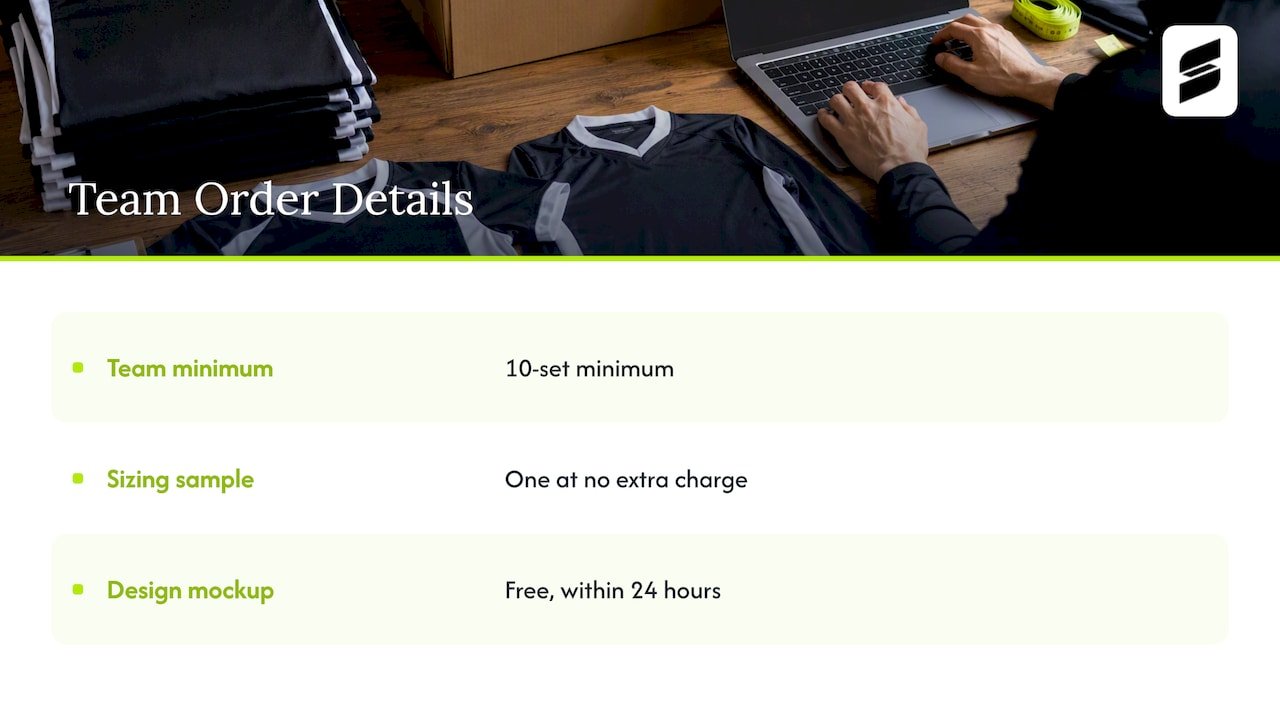
- Order a sample. We include one sizing sample at no extra charge, so a coach can try the cut on a typical player before committing the team.
- Run the movement test. Arms overhead, throw-in motion, a sprint stride. Look for riding up, pinching and bunching.
- Lock the roster. Collect final sizes in a single spreadsheet and double-check the odd ones: the tallest, the broadest and the youngest.
A frequent mistake is sizing by age label alone. A 12-year-old can be a small youth or an adult small, and sleeve length goes with them. Measure first.
Common sleeve problems and how to fix them
- Sleeve hem rolls or curls. The opening is probably too tight for the bicep. Go up a size or choose a roomier cut.
- Cuff hits mid-forearm on a long sleeve. The player has longer arms than the size assumes. Move up a size and check body length too.
- Fabric bunches at the wrist. The sleeve is too long, or the player is between sizes. Try the next size down only if the chest still fits.
- Jersey rides up when the arms rise. This is a body-length issue. A longer torso fixes it better than any sleeve change.
- Players complain of overheating in long sleeves. Fabric breathability matters more than length. Consider short sleeves with a removable layer for the next order.
Our perspective at Capra Sports
We talk to coaches about sleeves more than you might think, and the pattern is consistent. Teams start by asking which sleeve is better, and they end up asking which sleeve is easier to manage across fifteen different bodies. Our answer is usually short sleeves for the roster, long sleeves where there is a specific reason, and a sample before anything else.
Sleeve length is a small detail that reveals whether the whole fit is right. If the sleeve looks wrong, check the shoulder, chest and body length first. We build sublimated jerseys around your team’s design, and our designers work with you on the mockup. Revisions are unlimited, and a mockup arrives within 24 hours, so you can look at the sleeve design, panels and colors on screen before anyone cuts into fabric. That is also the best time to decide whether the keeper gets a long sleeve in a contrasting color.
One principle guides how we advise teams: do not let sleeve style fight your schedule. If most of your matches are warm, do not pay in comfort for a look. If you play in November, plan layers or warmups too.
— Agha
Ordering your team’s jerseys with Capra Sports
When you know the sleeve style, the next step is the order. We make custom sublimated soccer jerseys and full soccer uniforms and kits for youth teams, schools, parks and recreation programs and adult leagues. Team orders start at a 10-set minimum, with one sizing sample at no extra charge. You get a free design mockup in 24 hours, and the price for your configuration is [PRICE TBD]. Our pricing page shows the current lineup, and you can add warmup shirts, pants, hoodies or backpacks so the whole team looks matched on the sideline.
If you need numbers on the shirts, check our soccer jersey numbering guide for sizes and mockup tips before you finalize the design.
FAQ
Are long sleeve or short sleeve soccer jerseys better?
Neither is better overall. Short sleeves suit most field players and warm or mild weather, and they are easy to pair with a base layer. Long sleeves suit cool weather, goalkeepers and teams who prefer the full-sleeve look.
How long should a soccer jersey sleeve be?
A short sleeve should end around mid-bicep. A long sleeve should reach the wrist without bunching up. In both cases, the player should be able to raise both arms without the jersey riding up or the sleeve pinching.
Do soccer rules require a specific sleeve length?
The FIFA equipment list calls for a shirt with sleeves but does not name a length, so short and long are both acceptable at that level. High school and local leagues can add their own uniform rules, such as one style for the whole team. Ask your league or state association before you order.
Does a long sleeve jersey keep a player warmer?
A little, mostly by blocking wind on the arms. Lightweight sublimated fabric holds little heat either way. For real warmth, use a fitted base layer or a warmup top for the sideline.
Can one team mix short and long sleeves?
Often yes for goalkeepers, who need a different color anyway. For field players, many leagues expect a uniform style across the roster, and NFHS guidance asks for the same color and style. Check your league rules first, and plan the mix in the mockup so the team looks intentional.
Sources
- FIFA equipment rules: compulsory items for players
- NFHS soccer uniform requirements
- Soccer uniform fit guidance on sleeves (Soccer.com guide)