
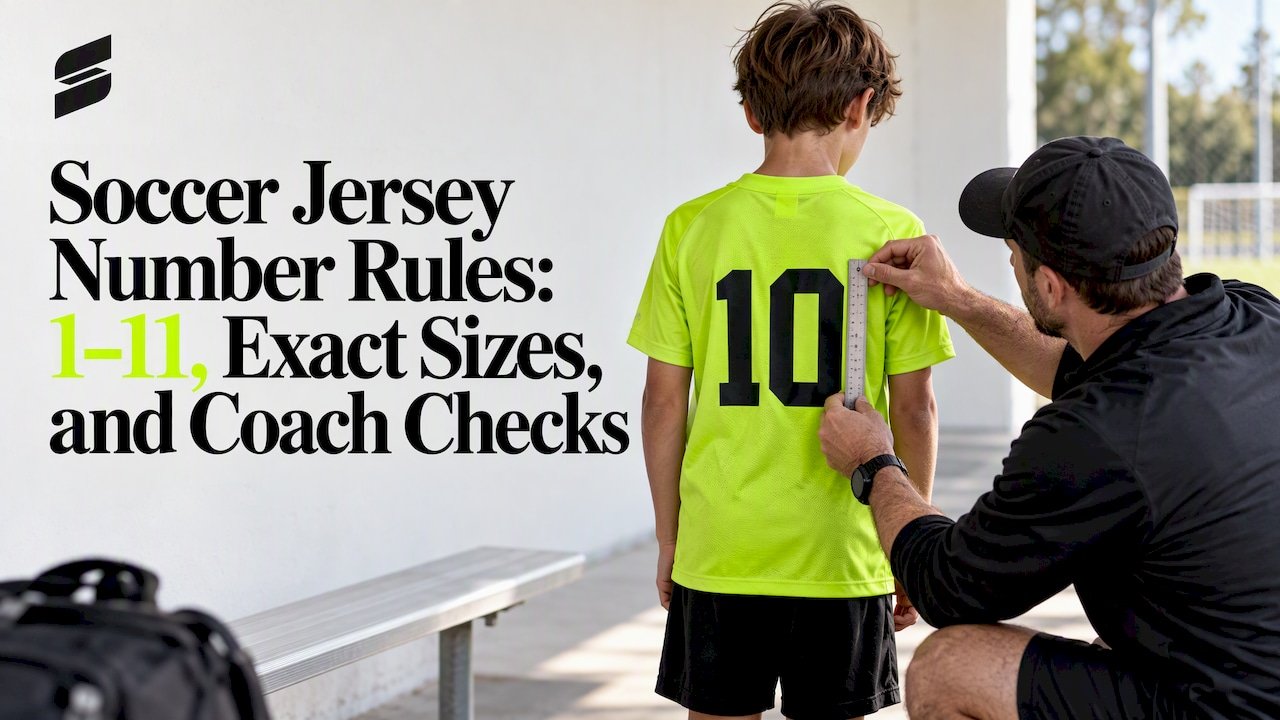
Soccer Jersey Number Rules: 1–11, Exact Sizes, and Coach Checks
In regulated matches, every field player needs a unique, permanently affixed number that meets the competition’s minimum size, and goalkeepers must wear a color that sets them apart from both teams. Those three rules (uniqueness, size, goalkeeper contrast) come from the governing body running your competition, whether that’s US Youth Soccer, NFHS, or IFAB through UEFA and FIFA at the professional level.
TL;DR:
- US Youth Soccer and NFHS require back numbers at least 6 inches tall; UEFA sets ranges of 25 to 35 centimeters for men and 20 to 35 for women.
- Traditional numbers 1 through 11 can help youth players learn positions, but they are conventions, not requirements, and modern tactics often blur their meanings.
- Confirm whether your competition accepts 0 or 00 and check its roster range before printing; tournament numbers are usually fixed after registration closes.
- Pack light and dark kits, give officials a current roster linking names and numbers, and check whether temporary taped numbers are allowed.
- Officials check substitute numbers against the submitted roster, so an unlisted number can delay a restart or draw a caution in stricter competitions.
Table of Contents
- How jersey numbering started and why positions still matter
- What each soccer number usually means and how to choose
- Exact measurement rules by governing body
- Match-day and ordering checklist for coaches
- Special cases: 0, retired numbers, and tournament ranges
- How substitutions work with jersey numbers
- Where numbers go on the jersey
- Recent trends in jersey numbering rules
- Youth leagues versus adult and professional number rules
- How we help coaches get compliant kit right
- Ordering regulation-compliant soccer jerseys made simple
- FAQ
- Sources
How jersey numbering started and why positions still matter
Numbered shirts trace back to formations built around fixed positions on the field. When teams lined up in the old 2-3-5 shape, the goalkeeper wore 1, defenders took 2 and 3, and the numbers climbed forward through the midfield into the attack. Referees and spectators could identify a player’s role at a glance, which is the entire reason numbering exists in the first place.
That system held for decades until squads moved to permanent, player-specific numbers in the 1990s. Once a number belonged to a player rather than a position, numbering became personal. A winger could wear 23 instead of 7, and a veteran defender could keep a number from a previous club. According to Wikipedia’s overview of squad numbering), modern players frequently choose numbers from 1 to 99 for personal or superstition-driven reasons rather than strict positional logic.
Even so, plenty of coaches still default to the old pattern, and for good reason:
- Parents and spectators at youth games can follow the action more easily when a number maps to a familiar role.
- New players learn team structure faster when the numbering reinforces where they’re expected to play.
- Scouts, referees, and opposing coaches read a traditional lineup sheet more quickly when 1 through 11 sits where they expect it.
Neither NFHS nor US Youth Soccer requires 1-11 positional numbering today. The only hard rule is that each player’s number is unique and legible. Tradition is a coaching tool now, not a legal requirement.
What each soccer number usually means and how to choose
Number meanings are conventions, not regulations, but they still shape how rosters get built and how new players get assigned a digit.
Number 1 almost always goes to a starting goalkeeper. Teams carrying two or three keepers typically give the backups numbers like 12, 13, or 25, mirroring how senior national teams handle multiple goalkeepers at major tournaments. Avoid handing out 1 to an outfield player at competitive levels since referees and opponents expect to find the goalkeeper there.
Defenders traditionally wear 2 through 5: right back, center backs, and left back, in roughly that order under the old 2-3-5 and later 4-4-2 lineages. Central midfielders take 6 through 8, with 6 often marking a holding midfielder and 8 a box-to-box or attacking presence. Wide players, especially wingers, commonly wear 7 and 11, while the central striker and the most advanced creative player take 9 and 10. Modern tactics blur these lines constantly. A false nine might wear 10, and a wing-back might carry a defender’s traditional number, so treat the 1-11 pattern as a loose guide rather than a rulebook.
Numbers 12 and higher belong to the rest of the squad and carry far less consistent meaning. Many leagues and tournaments cap rosters at a fixed range (commonly 1-99, though some competitions restrict squads to a 1-26 or similar band for the event). Players picking high numbers like 99 or 88 are usually making a personal statement rather than signaling a position.
For assigning numbers across a full roster, three approaches work well:
- First-come, first-served by sign-up or tryout date, which is simple and fair for recreational teams.
- Position-first, reserving 1-11 for likely starters and filling the rest sequentially, which helps youth teams teach structure.
- Player preference with coordinator oversight, letting players request a number while a single person checks for duplicates before anything gets printed.
Pro Tip: Lock your roster and numbers before ordering jerseys. A mid-season swap means paying for a reprint instead of a simple correction.
Exact measurement rules by governing body
The specific digit height, stroke width, and placement you need depends entirely on which competition you’re playing in. Youth and high school rules are more forgiving than the specs used in UEFA and FIFA competitions, but every level enforces uniqueness and legibility.
US Youth Soccer’s national competition rules require a permanently affixed back number at least 6 inches tall on every field player, plus two full kits (light and dark) so teams can change colors at a referee’s request. NFHS uniform rules set the same 6-inch minimum for back numbers and require that every jersey, including the goalkeeper’s, carry a number that contrasts clearly against the shirt color. Neither body mandates a specific front number, but both require that duplicate numbers never appear on the same roster.
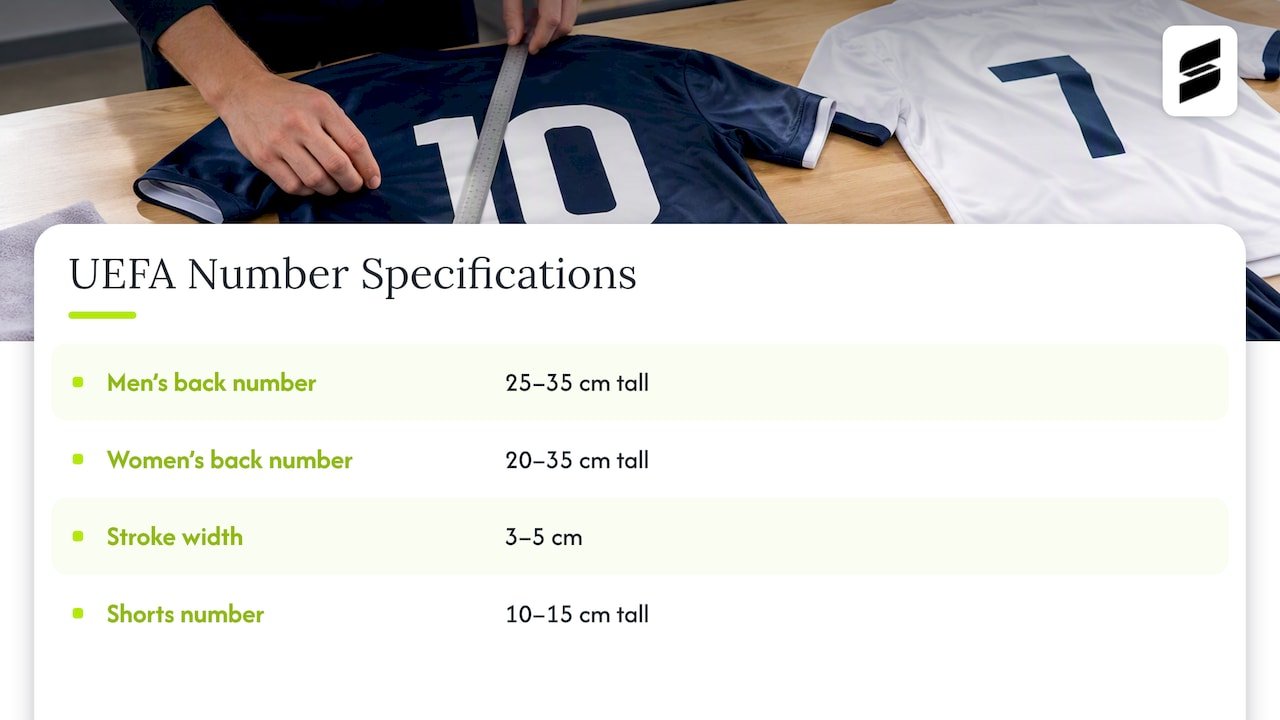
UEFA’s equipment regulations go further, specifying back numbers between 25 and 35 centimeters tall for men’s competitions and 20 to 35 centimeters for women’s, with a stroke width of 3 to 5 centimeters and front-of-shorts numbers between 10 and 15 centimeters tall. Number 1 is typically reserved for a goalkeeper in squad list contexts under these rules.
IFAB’s Laws of the Game add one more wrinkle: the organizer of any given competition can set additional requirements for numbers, names, and crests beyond the baseline Laws. That means your league or tournament handbook is always the final word, even when it departs slightly from NFHS or UEFA defaults. Youth, high school, and local club teams should design to their own competition’s handbook first and only match the stricter UEFA or FIFA spec if they expect to play in tournaments that enforce it.
Match-day and ordering checklist for coaches
A little preparation prevents the most common check-in problems: duplicate numbers, missing kits, and goalkeeper color clashes.
- Build a roster sheet that pairs every player’s name with a single, unique number, and keep it ready to hand to officials before kickoff.
- Pack two full kits, light and dark, since referees can require a color change if the two teams clash, per US Youth Soccer rules.
- Confirm your goalkeeper’s jersey color is distinct from both outfield kits and from the opposing goalkeeper.
- Check your competition handbook for rules on taped or temporary numbers before assuming a quick fix will pass inspection; some competitions reject tape-over numbers outright.
- Carry one or two spare numbered shirts for late roster additions, if your league permits mid-season changes.
- Review your club’s roster management process regularly. Services built for this, like Sidekick’s roster management tools, can help clubs track registrations and catch duplicate numbers before game day rather than after.
Pro Tip: If a number conflict shows up at check-in, let the referee decide the fix immediately rather than arguing. Most competitions give officials final authority on color and number disputes, and a calm resolution keeps kickoff on schedule.
Special cases: 0, retired numbers, and tournament ranges
Whether 0 or 00 is allowed depends entirely on your competition’s registration system. Some leagues accept any number from 1 to 99, including 0, while others restrict the range or exclude 0 outright. There’s no universal answer, so check your league or tournament’s handbook before printing.
Retired numbers are a club-level tradition, not something governing bodies track or enforce. A club can retire a number to honor a player, but most registration systems still expect every active squad member to carry a publicly listed, unique number for the current season regardless of retired history.
Tournament organizers typically lock a squad’s numbers for the duration of the event once registration closes. Mid-season changes, when they’re permitted at all, usually happen only during formal registration windows between seasons rather than mid-tournament.
- Confirm your competition’s accepted number range (commonly 1-99) before finalizing a roster.
- Treat 0 and 00 as competition-specific exceptions, never a default assumption.
- Expect international and elite tournaments to fix squad numbers once the official squad list is submitted.
How substitutions work with jersey numbers
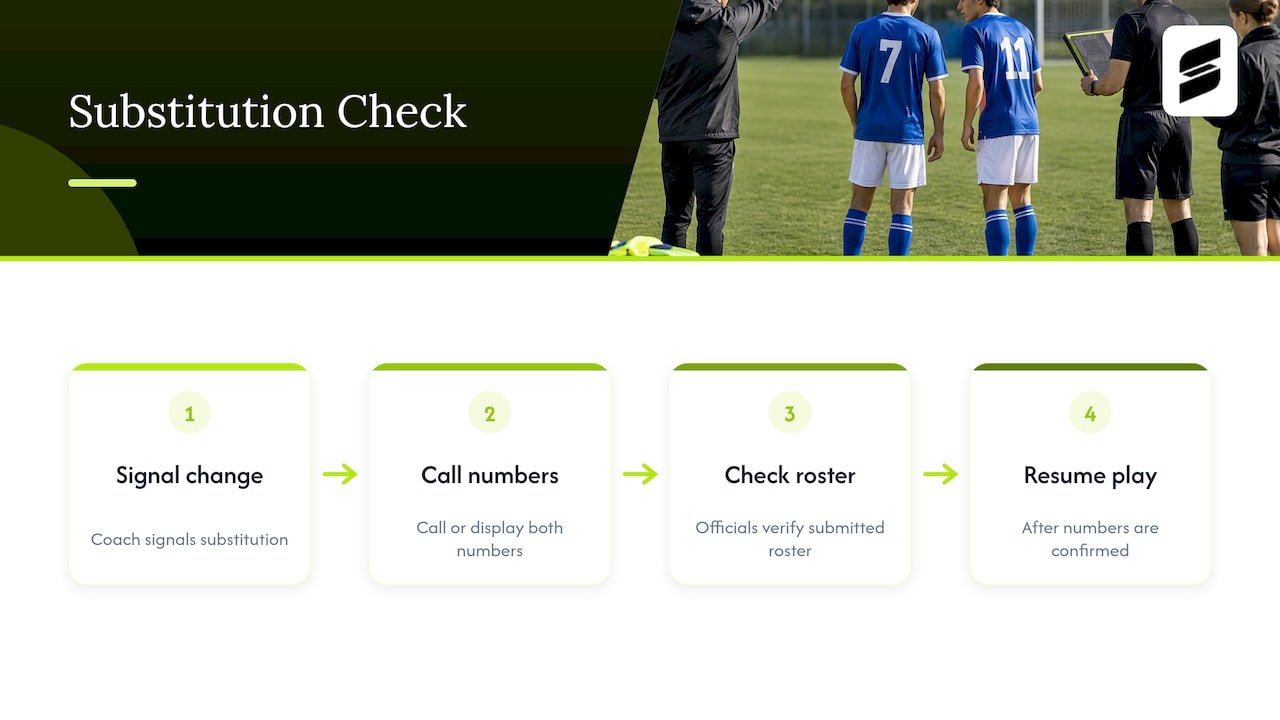
Jersey numbers exist partly to make substitutions clean for referees and the fourth official. When a coach signals a change, the outgoing and incoming players’ numbers get called or displayed on a substitution board, and officials cross-check those numbers against the submitted roster before play resumes. A mismatch, like a substitute wearing a number that wasn’t on the pre-match roster, can delay the restart or draw a caution in stricter competitions.
This is exactly why uniqueness matters so much in practice. If two players shared a number, a referee couldn’t confirm which player actually entered the match, which creates disputes over playing time, eligibility, and even match results in competitive leagues. At the youth level, having an accurate number-to-name roster sheet on hand speeds up every substitution, since officials aren’t stopping to ask which player just came on.
Some competitions also track substitution limits by number on the official match report, which matters for leagues enforcing re-entry rules (allowing a substituted player to return later in certain youth formats). Keeping your roster sheet current throughout the match, not just before kickoff, avoids confusion if a late injury or tactical change forces a quick substitution the bench wasn’t planning for.
Where numbers go on the jersey
Back placement is the universal requirement: every governing body we’ve covered requires a number on the back of the jersey, centered below the collar, sized to meet that competition’s minimum. Front placement is common but not always mandatory. Many leagues ask for a smaller front number on the chest, while UEFA’s regulations specifically call for a number on the front of the shorts, sized between 10 and 15 centimeters, separate from any chest number.
Sleeve numbers are mostly a design choice rather than a rule. Some competitions allow a small sleeve number as a secondary identifier, but it never substitutes for the required back number. Whatever placement your handbook requires, contrast matters as much as position. NFHS rules specifically call for the number color to contrast clearly against the jersey, since an official needs to read it from a distance under game lighting. When you’re designing a kit, treat the back number as fixed and non-negotiable, and treat front and shorts numbers as the places where your handbook’s specific requirements (or your own design preferences, where no rule applies) come into play.
Recent trends in jersey numbering rules
The clearest trend across youth and amateur soccer is flexibility replacing rigid positional numbering. Governing bodies have largely stopped mandating 1-11 by position, focusing their enforcement instead on the things that actually affect officiating: uniqueness, minimum size, and goalkeeper distinction. That shift lets players keep a personal number across age groups and clubs, which many families find easier to manage than renumbering every season.
At the elite level, UEFA and FIFA continue to refine legibility standards, including stroke width and contrast guidance, as broadcast and video review technology makes jersey numbers more important for officiating decisions than ever. Expect competition handbooks to keep tightening contrast and size rules at the top levels even as youth and recreational leagues stay flexible. For now, no major governing body covered here has announced a sweeping change to core numbering requirements, so the safest approach remains building your kit to your own competition’s current handbook rather than anticipating a rule that hasn’t been published yet.
Youth leagues versus adult and professional number rules
Youth leagues like those under US Youth Soccer and high school programs under NFHS keep requirements simple: a unique number, a 6-inch minimum height, and a goalkeeper in a distinguishable color. There’s no requirement to follow traditional positional numbering, and front or shorts numbers are rarely mandated.
Professional and elite international competitions under UEFA and FIFA add precision on top of those basics. Back numbers must fall within a defined centimeter range, stroke width is specified, and shorts numbers are required at a set size. Squad numbers are also typically locked once a tournament’s official squad list is submitted, which rarely happens at the youth level where mid-season roster changes are more common. The practical takeaway is simple: a club fielding both a youth program and an adult or semi-professional side needs two different design checklists, not one, since the adult side is far more likely to face the tighter UEFA-style spec.
How we help coaches get compliant kit right
We provide a jersey number size guide and mockup resources reflecting these specs, so coaches can check digit height, stroke width, and goalkeeper contrast before production. Our soccer jersey numbering resource walks through FIFA’s 25-35 cm range alongside the simpler youth and high school minimums, and our number size guide gives coordinators a visual reference for checking placement before approving a design. Orders include a mockup review step where number size and contrast can be confirmed against the actual jersey color rather than using a generic template.
Ordering regulation-compliant soccer jerseys made simple
Collaboration with coaches and designers helps ensure number sizing, placement, and goalkeeper contrast align with competition handbook requirements before printing jerseys. This collaboration, along with a sizing sample included on team orders, helps catch sizing or placement issues early before a large order is produced.

Getting a compliant kit from us follows a simple sequence:
- Request a free mockup showing your team’s number placement, size, and color contrast.
- Review and approve the mockup, adjusting digit height or stroke width to match your league’s handbook.
- Confirm sizes using our soccer uniform size chart before we move to production.
- Place your order through our custom soccer uniforms page, with a 10-set team minimum and one sizing sample included at no extra charge.
FAQ
Is number 69 allowed in soccer?
Allowance depends on your competition’s registration system rather than any universal soccer rule. Many leagues accept numbers from 1 to 99 as long as each is unique on your roster, but some competitions restrict their number ranges, so check your handbook before registering a player with a particular number.
Do soccer players’ jersey numbers mean anything?
Traditionally yes: numbers 1 through 11 mapped to specific positions under older formations, with 1 for the goalkeeper, 2-5 for defenders, and 9-10 for forwards, according to historical squad numbering conventions. Modern permanent squad numbers, adopted widely since the 1990s, let players choose numbers for personal reasons, so the positional meaning is now a convention rather than a rule.
What does 22 mean in soccer?
There’s no official meaning tied to numbers outside the traditional 1-11 positional range under any governing body’s rules, so a player typically selects a squad number for personal preference rather than as a role indicator.
Is jersey number 0 allowed in soccer?
Whether 0 or 00 is allowed depends entirely on the competition’s own registration rules, since neither NFHS nor US Youth Soccer sets a single universal answer. Some leagues permit it within a 0-99 range while others exclude it, so confirming with your specific league or tournament handbook is the only reliable way to know.
— Agha
Sources
- 2025-2026 National Championships and National Presidents Cup Competition Rules (US Youth Soccer)
- UEFA: Article 10 Numbers – Equipment
- IFAB: The players’ equipment (Laws of the Game)