
Backpack Personalization Ideas for Sports Teams
The best way to personalize a team backpack is to make it easy to spot on a crowded bench and hard for a stranger to read. Think jersey numbers, team colors, position symbols, patches and removable accessories, and keep a child’s full name off the outside. Below you will find specific ideas by team type, the safety and school-policy checks to run first, and a simple process for ordering a matching set.
TL;DR
- Personalize for quick identification. When 15 bags look identical, a number, color code or symbol beats a printed name.
- Child safety groups advise against putting a child’s name where strangers can read it. Use initials, numbers or a name on the inside instead.
- Removable items (zipper pulls, strap wraps, clip-on tags) are easy to swap and rarely collide with school rules.
- Check your school or league handbook before you order, especially for clear-bag rules and logo limits.
- Capra Sports can build a custom team backpack to match your uniforms, with a free design mockup in 24 hours.
Table of Contents
- Start with the job the personalization has to do
- Check safety and school rules before you design
- Ten personalization ideas that work for teams
- Match the bag to the sport
- Our perspective: design the bag as part of the uniform
- How to plan a team backpack order
- Common mistakes to avoid
- Order a matching team set with Capra Sports
- FAQ
- Sources
Start with the job the personalization has to do
Most teams personalize a bag for one of three reasons: to tell identical bags apart, to get a lost bag back, or to make the team look like a team on travel days. Each reason points to a different design choice, so decide which one matters most before you pick a single color.
- Telling bags apart: Dugouts, benches and bus holds are full of near-identical gear. Large, high-contrast markers work better than small text.
- Getting a lost bag back: This needs contact information, but not on the outside of the bag where anyone can read it.
- Team identity: Matching colors, a logo and a number tie the bag to the uniform and make a travel roster look organized.
A useful rule: put the identity on the outside and the recovery details on the inside. That single split solves most of the safety debate below.
Check safety and school rules before you design
Why the name on the outside is a problem
The name-on-the-backpack look is popular, but it comes with a real downside for kids. Reporting on guidance from child safety experts, including the National Center for Missing & Exploited Children, says a visible first name can let a stranger pretend to know a child. The same advice points to alternatives such as initials, team colors, symbols or keychains that mean something mainly to the child and family.
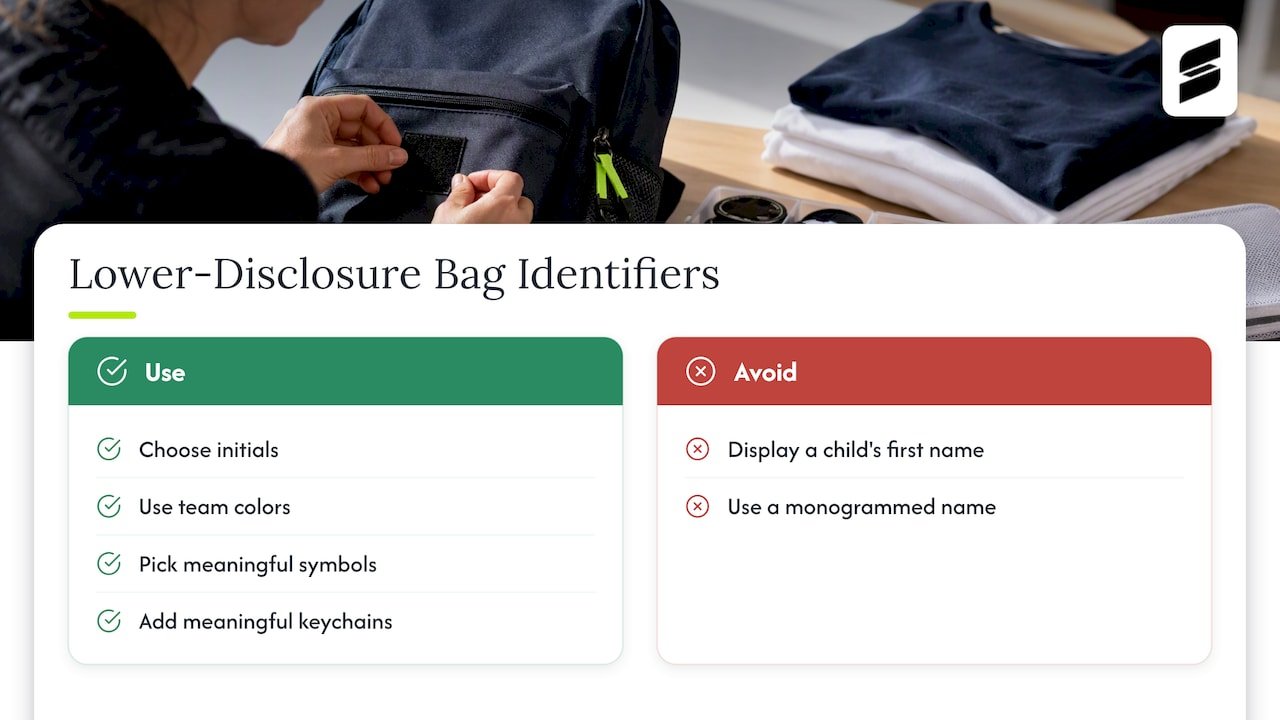
Law enforcement has said the same thing locally. A Chatham County police warning asked parents to think twice about monogrammed names, and a Fox News report on personalized school backpacks covered the same concern from a former detective’s perspective.
For youth teams, this is easy to respect. A jersey number and a team logo identify a bag to teammates and coaches without telling a stranger anything useful. If your roster includes younger players, make that the default. For adult leagues and older athletes, a name is a matter of team preference, but a number still reads faster from across a field.
School clear-bag and logo policies
School rules vary widely. Some districts require clear backpacks, and their guidance often limits what can be added. The Green Bay Area Public School District’s clear backpack FAQ is a good example of the kind of question families ask, including whether name tags are allowed for differentiation. Your own district may answer differently, so read your handbook or ask the athletic director before you order.
Some leagues also regulate logos on team gear, and sponsor marks are a common sticking point. If your program carries sponsors, it helps to see how one youth league handles sponsor logo size limits and approval steps, then ask your own league what it requires before a sponsor mark goes on a bag.
A practical checklist before you finalize a design:
- Does the school or league require a clear or mesh bag for game days?
- Are logos, monograms or names restricted on the exterior?
- Are removable tags and zipper pulls allowed?
- Will sponsor marks need approval?
- Does the bag need to fit under a bus seat or in a locker?
Ten personalization ideas that work for teams
1. Jersey number as the main identifier
The number a player already wears is the most natural bag marker. Everyone on the team knows it, coaches can call it out, and it tells a stranger nothing personal. Put it large on a front panel or side pocket in a high-contrast color. If your uniform numbers use a specific typeface, match it so the bag and the jersey read as a set. Our note on fitting long names and numbers on jerseys covers the same sizing logic, and it carries over to bag panels.
2. Team colors in a distinct pattern
A bag that matches the uniform palette looks intentional. If you want to go further, give each position group a different accent color: pitchers, outfielders and infielders on a baseball team, or setters, hitters and liberos on a volleyball team. A coach can then see at a glance whose bag is whose, with no text at all.
3. Position symbols
Small icons for a position (a ball, a glove, a net, a whistle for captains) give you identity without personal details. They also add some personality, which kids enjoy. Keep them simple enough to recognize at 15 feet.
4. Initials, small and placed with care
Initials are a middle ground. They help a player claim a bag without announcing a full name. For younger kids, consider placing them on the inside panel or a lower corner rather than front and center. This follows the advice from child safety experts to favor discreet identifiers over visible names.
5. Team logo or mascot
A logo is the most reliable way to make a bag read as part of the team. Place it where it will not be covered by a strap or fold. If you use a logo on the uniform, reuse the same artwork so the whole kit is consistent. When you plan the logo placement on the bag, treat it the way you would on a jersey: leave clear space around it. Our sleeve patch placement guide shows the kind of measurement thinking that helps, even though it is written for sleeves.
6. Patches for achievements
Patches let players build up a story over a season: a tournament, a championship, a milestone. Industry practitioners suggest removable, functional accessories such as patches, zipper pulls and strap wraps so players can personalize without permanently altering a bag or running into school rules. Keep patches away from zippers and vents so the bag still opens and breathes.
7. Zipper pulls
A colored or shaped zipper pull is the cheapest, most flexible marker there is. Give every player the same team color and a different shape or number charm. They swap out in seconds, which matters if a school asks you to remove something.
8. Clip-on or loop tags
Tags work well for tournaments, and the hardware matters. Equipment professionals recommend stainless steel loops for teams that fly or ride buses, since they hold up better than clear plastic under rough handling. For daily school-to-practice use, a flexible clear loop is usually enough and easier for kids to manage. This comes from a practical guide to basketball bag tags, so treat it as a durability tip rather than a rule.
9. A QR code on the back of a tag
For recovery, put contact details on the back of a tag, not the front. Practitioners suggest a team or guardian contact method, or a QR code that links to a schedule or recovery form, while the front stays limited to a number or logo, per this hockey bag tag guide. A QR code to a team page keeps a child’s details off the bag entirely.
10. A matching color on the bag’s inside lining or label area
A bold interior color or a labeled inside pocket gives you a safe place for a name and phone number. It is also the first place a coach or a lost-and-found volunteer will look.
Match the bag to the sport
Different sports ask different things of a bag, and the design should follow.
| Sport | Common bag situation | Design idea that fits |
|---|---|---|
| Basketball | Tournaments with many teams and shared benches | Large number panel, bold team color, tag on the zipper |
| Baseball and softball | Dugout rows of identical bags | Position color accent, number, symbol patch |
| Soccer | Sideline piles on grass | High-contrast number, bright zipper pull |
| Football | Bulky equipment, locker rooms | Oversized bag with team logo and number |
| Volleyball | Gym floors, long tournament days | Matching colors to the uniform, number tag |
| Flag football | Rec leagues, quick turnarounds | Team color blocks and a simple logo |
If you want to see the current options, we offer custom backpacks along with sport-specific styles such as the GameTime backpack, the volleyball backpack, the flag football backpack and the XL football backpack. For a wider set of gear, browse our custom sports bags.
Our perspective: design the bag as part of the uniform
We work with teams on uniforms every day, and the pattern we see is simple: the teams that look best on game day treat everything they carry as part of one kit. The bag is the first thing a parent sees walking into the gym, and it either matches the jerseys or it does not.
Here is how we think about it when a coach asks for ideas.
- Start from the uniform. Colors, number style and logo are already decided. Reuse them. A bag built from the same artwork needs fewer decisions and looks better than a bag built separately.
- Keep the front simple. One logo, one number, one color story. Anything more gets lost at a distance.
- Put the personal details inside. A name and contact line inside the bag does the recovery job. The outside does the team job.
- Ask about the rules early. A school clear-bag policy or a league logo limit is far easier to design around than to fix after an order.
- Look at the mockup before anything is made. Seeing the bag next to the uniform is the quickest way to catch a clash.
Our designers work directly with coaches and team managers on this, and we send a free design mockup within 24 hours so you can see the whole set together before you commit.
— Agha
How to plan a team backpack order
A clear process keeps a group decision from dragging on. This is the sequence we suggest to coaches and athletic directors.
- Confirm the rules. Check the school handbook and your league’s gear policy for clear-bag requirements, logo limits and tag rules.
- Pick the one job. Decide whether the main goal is identification, recovery or team identity, and design toward it.
- Choose the identifiers. Number, color code, symbol or initials. Avoid full names on the exterior for younger players.
- Gather artwork. Send your logo and uniform colors so the bag can match the jerseys.
- Review the mockup. Check number size, logo placement and color contrast. Ask for revisions until it is right.
- Plan the extras. Decide on zipper pulls, tags or patches as removable add-ons, and choose hardware that suits how the team travels.
- Place the order for the whole team. Our team order policy is a 10-set minimum, so bundling bags with uniforms is a natural fit.
For teams ordering uniforms and bags together, it helps to keep the same contact person for both, so that numbers and colors do not drift between the two orders.
Common mistakes to avoid
- Too much detail. Fine text and busy graphics disappear at a distance. Go bolder than you think you need.
- Low contrast. A dark number on a dark bag helps nobody. Test the mockup in grayscale if you can.
- Names on the outside for kids. It is the one choice that can create a safety problem. Numbers and symbols do the same job.
- Permanent additions that break rules. If a school bans a logo size or a name tag, a sewn-on element cannot be undone. Removable accessories can.
- Weak hardware for travel teams. A clear plastic loop can snap on a bus or at an airport. Choose sturdier hardware if the bag will be handled roughly.
- Ignoring zippers and vents. Decorations should stay clear of closures and ventilation so the bag still works.
Order a matching team set with Capra Sports
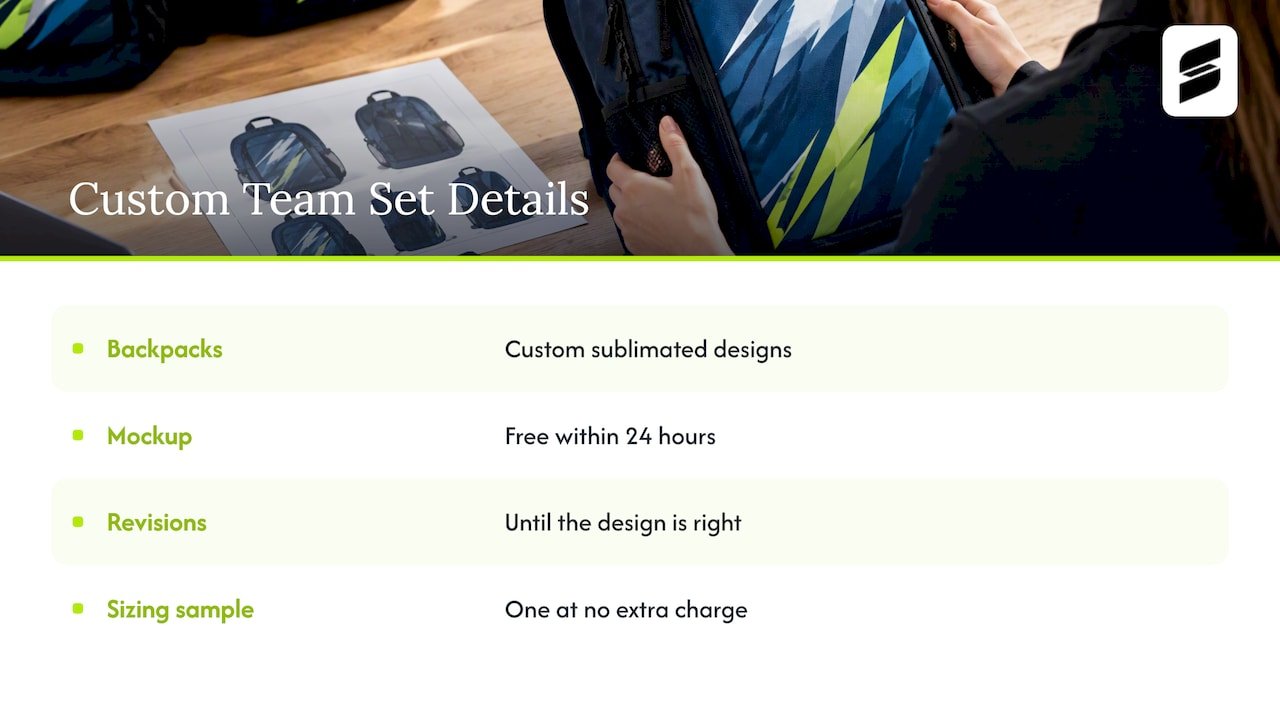
If you want the bag, the uniform and the warmups to look like one program, Capra Sports builds custom team uniforms and personalized apparel, including backpacks, in sublimated designs for basketball, baseball, softball, soccer, football, volleyball and cheer. You work with our designers, get a free mockup within 24 hours, and can ask for revisions until the design is right. Teams can also request one sizing sample at no extra charge.
See the current custom backpack options, check pricing (currently [PRICE TBD]), or start with your sport on our custom basketball uniforms for teams page and add the bag to the same order.
FAQ
Is it safe to put a child’s name on a backpack?
Safety experts generally advise against it. A visible name can let a stranger seem familiar to a child, so child safety guidance suggests initials, symbols, team colors or a name on the inside instead. A jersey number is a good team-friendly alternative.
What is the best way to label a team backpack?
Put the identity on the outside and the contact details on the inside. Use a number, color or logo on the front, and a name and phone number inside the bag or on the back of a tag. A QR code to a team page also works for recovery.
What are good things to attach to a backpack?
Zipper pulls, strap wraps, clip-on tags and patches are the most common. They are removable, cheap and easy to match to team colors. Keep them away from zippers and vents, and check that your school allows them.
Can I personalize a backpack if my school requires a clear bag?
Often yes, but only in limited ways. Districts such as Green Bay’s publish a clear backpack FAQ that addresses tags and other additions. Ask your school or athletic director what is permitted before you order anything.
How many bags can we order at once?
Our team order policy is a 10-set minimum. Many coaches add bags to a uniform order so the whole roster is covered in one go, and we can show the full set in a mockup first.
Sources
- Read This Before You Personalize Your Kid’s Back-to-School Supplies (Yahoo)
- Chatham Co. law enforcement warns against labeling children’s names on backpacks (WTOC)
- Don’t personalize your kids’ school backpacks (Fox News)
- Clear Backpack FAQ (Green Bay Area Public School District)