
Coaches: Sleeve Patch Placement, 1 in set in, 3 in raglan, mockups
For a set-in sleeve, place the patch 1 inch below the left shoulder seam. For a raglan sleeve, move it down to 3 inches below the seam, since the diagonal cut sits differently on the arm, according to Little League. The left sleeve is the standard spot for team or unit insignia, while the right sleeve is typically reserved for flags with reversed artwork. When your league or governing body sets its own rule, that rule overrides general convention.
TL;DR:
- Patches on set-in sleeves should be placed one inch below the shoulder seam, while raglan sleeve patches are positioned three inches below the seam.
- Flag patches typically measure around two by three inches, with the stars facing forward, and should be placed on the right sleeve if they are to be reversed correctly.
- Always measure and mark patch placement before attaching, and avoid placing multiple patches too close or on stressed areas to prevent fabric distortion and patch damage.
- Different sports and organizations may have varying patch placement rules, so follow specific league or governing body guidelines over general conventions.
- Proper patch attachment involves careful preparation, pinning, sewing, or ironing, and testing methods on scrap fabric to ensure durability through washing.
Table of Contents
- Standard placement by sleeve type
- Flag patch placement, orientation, and sleeve etiquette
- How to apply a patch: sewing, ironing, and hook and loop
- Sizing and spacing when a sleeve carries multiple patches
- Caring for garments with sleeve patches
- Placement rules for other sports and work uniforms
- Common placement mistakes and how to avoid them
- What correct sleeve patch placement looks like
- Regional and league differences in patch conventions
- How patch placement affects fit and movement
- Why consistent placement matters on a full roster
- How Capra Sports can help with your team’s patch placement
- Sources
- FAQ
Standard placement by sleeve type
Sleeve construction changes where a patch should sit because it changes how the fabric drapes and moves. A set-in sleeve is stitched into a distinct armhole, giving you a flat, stable panel just below the shoulder. A raglan sleeve runs in one diagonal piece from the collar to the underarm, so the same visual height on the body falls lower relative to the seam itself.
Little League’s patch requirements spell this out precisely: patches go 1 inch below the shoulder seam on a set-in sleeve and 3 inches below the seam on a raglan sleeve, based on official Little League patch guidance. The organization also addresses jerseys with no sleeves at all, along with a distinct rule for umpires.
- Set-in sleeve: patch centered, 1 inch below the shoulder seam.
- Raglan sleeve: patch centered, 3 inches below the shoulder seam.
- Sleeveless jersey: patch centered over the left chest instead of the sleeve.
- Umpire jerseys: patch placed 4 inches below the left shoulder seam.
Long-sleeve jerseys generally follow the same upper-arm measurement as their short-sleeve counterparts, since the placement reference point is the shoulder seam, not the cuff. Cuff-level badges exist in some work and utility uniforms, but they are the exception rather than the rule for team sportswear. If a league publishes its own offset, follow that number over any general guideline, since state associations and individual organizations sometimes adjust standard measurements for their own jerseys.
Flag patch placement, orientation, and sleeve etiquette
American flag patches follow a different logic than team insignia because orientation matters as much as position. Guidance from The Institute of Heraldry states that a flag patch is typically sized around 2 inches by 3 inches, worn with the star field facing forward. When the flag sits on the right sleeve, the artwork is reversed so it reads as though it is flying forward as the wearer moves, a convention borrowed from military uniform practice.
The flag patch’s standard size is generally close to 2 inches by 3 inches, per The Institute of Heraldry, which keeps it proportionate to most sleeve widths without crowding a team patch on the opposite arm.
No federal code mandates which sleeve carries a flag patch on a sports uniform. The reversed-flag convention comes from military heraldry guidance rather than law, so most teams and leagues are free to set their own placement policy.
- Reserve the left sleeve for team or unit insignia when a flag also appears on the uniform.
- Place the flag on the right sleeve and mirror the artwork so the stars face forward on both sides of the body.
- Size the flag patch close to 2 by 3 inches so it does not overpower or clash with a team patch of a different size.
How to apply a patch: sewing, ironing, and hook and loop
Getting placement right on paper does not matter if the patch shifts, puckers, or peels off after one wash. Each attachment method has its own preparation and technique.
- Prepare the garment. Wash and dry it first so any shrinkage happens before you measure, then mark the placement point with tailor’s chalk using the shoulder-seam measurement for your sleeve type.
- Pin or baste. Hold the patch in place with pins or a few loose basting stitches before committing to permanent stitching or heat.
- Sew it on. Tack the corners first, then backstitch around the entire perimeter using thread that matches the patch border; on stretch fabrics like performance jerseys, sew with a slight give in the thread tension to avoid puckering.
- Iron it on. Check the garment’s fabric content for heat tolerance, place a pressing cloth over the patch, and apply the iron using the heat and time the patch manufacturer recommends, then clamp or weight the area until it cools completely.
- Attach hook and loop. Sew the loop side to the garment for a permanent anchor, then apply the hook-backed patch; skip adhesive-only Velcro strips for athletic wear since they tend to fail under repeated washing and movement.
Pro Tip: Test any iron-on patch on a hidden scrap of the same fabric first, since synthetic performance jerseys can scorch or melt at temperatures cotton patches tolerate fine.
Reinforce corners on high-stress areas like the underarm curve, and avoid high-heat dryer cycles on any garment with a heat-applied patch, since repeated heat exposure can loosen the adhesive over time.
Sizing and spacing when a sleeve carries multiple patches
A single patch is straightforward. Multiple patches on the same sleeve, a team crest stacked above a league badge, or a memorial patch next to a sponsor mark, require some proportion and planning to avoid a cluttered look.
- Keep each patch narrower than the sleeve itself, with a small margin of visible fabric on both sides.
- Leave at least half an inch of space between stacked patches so stitching lines do not overlap or strain the fabric.
- Align multiple patches in a single vertical column down the outside of the arm rather than scattering them at odd angles.
- Move secondary patches, like sponsor logos or event badges, to the chest or back when the sleeve is already carrying a team crest and a flag.
Pro Tip: Build a simple placement template, a card marked with the exact seam-to-patch distance, and use it on every jersey in the order so patch height stays identical across every player size.
Checking a printed mockup against that template before production catches sizing drift between youth and adult cuts, where the same inch measurement can look proportionally different on a smaller sleeve.
Caring for garments with sleeve patches
How you wash a patched jersey depends heavily on how the patch got there in the first place.
- Wash iron-on and sewn patches on a gentle cycle in cool or warm water rather than hot, which stresses both the adhesive and the stitching.
- Use cold water for delicate performance fabrics regardless of attachment method, since heat accelerates fading and fabric breakdown.
- Air-dry when possible, or use a low-heat dryer setting; high heat is the most common cause of iron-on patches lifting at the corners.
- Re-sew a lifting edge as soon as you notice it, and add a line of reinforcing stitches around older iron-on patches before they come loose entirely.
Always check the garment’s care tag before washing a batch of team uniforms, and test a new patch type on one jersey before running an entire roster through the same cycle.
Placement rules for other sports and work uniforms
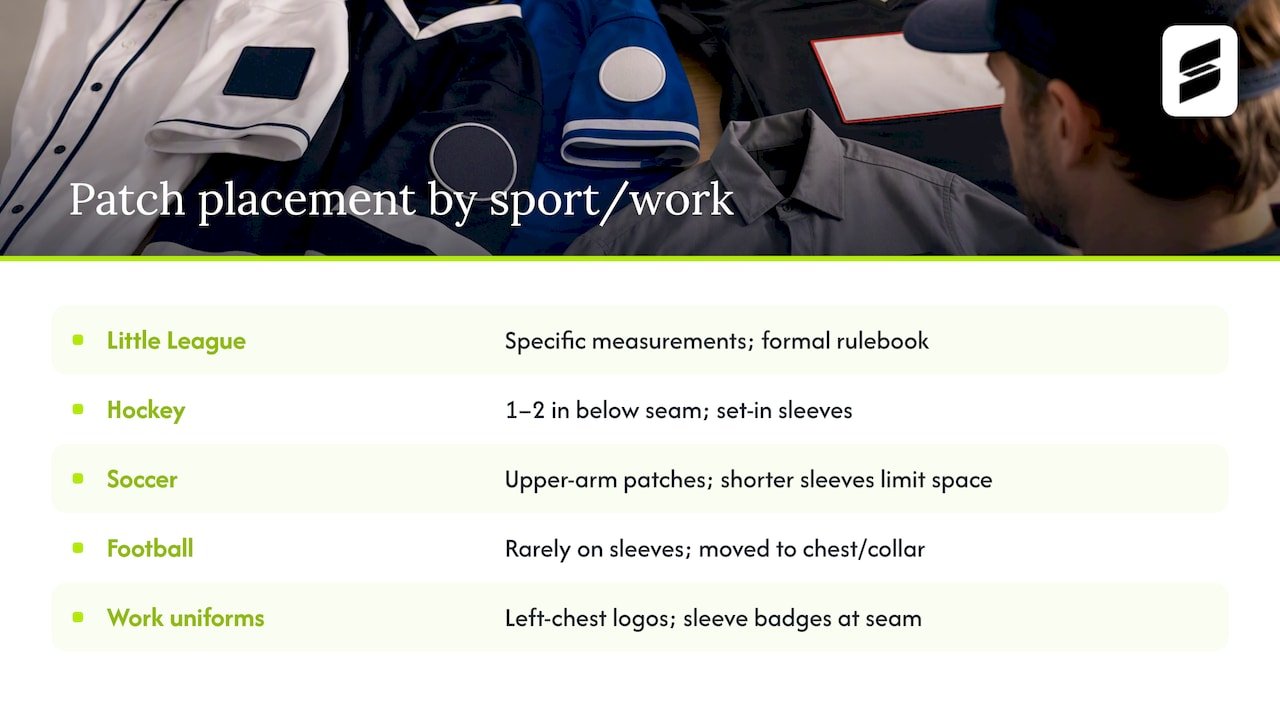
Little League’s measurements are specific to baseball and softball, but the same shoulder-seam logic applies across most team sports. Hockey jerseys, often built with set-in sleeves and heavier fabric, generally carry crests and league patches at a similar 1 to 2 inch offset below the shoulder seam, adjusted for the jersey’s boxier cut. Soccer jerseys, which favor slim raglan or set-in sleeves depending on the brand, typically place sponsor or league patches on the upper arm rather than lower on the sleeve, since soccer sleeves are shorter and space is limited.
Football jerseys rarely carry sleeve patches at all because of pad bulk and sleeve length variation, so commemorative or league patches more often move to the chest or collar area instead. Work uniforms follow a more relaxed convention: company logos commonly sit on the left chest, with name badges or department patches on the sleeve at roughly the same shoulder-seam distance used in athletic wear.
None of these conventions carry the same formal rulebook status as Little League’s patch requirements or high school NFHS uniform guidance, so when a specific rulebook exists for your sport or workplace, treat it as the final word over general practice.
Common placement mistakes and how to avoid them
Most patch problems trace back to skipping the measuring step. Eyeballing “about an inch” below the seam produces visibly uneven results once you compare ten or fifteen jerseys side by side on a bench.
A second common mistake is applying the same measurement to every sleeve type on a mixed order, forgetting that a raglan sleeve needs the patch three times farther from the seam than a set-in sleeve does. Teams that order jerseys with both cuts often end up with patches that sit at different visual heights once the uniforms are on the field.
Reversing flag artwork incorrectly is a subtler error. A flag patch on the right sleeve needs its star field mirrored so it still faces forward, and a patch applied straight from a left-sleeve template will read backward once flipped to the right arm.
Finally, rushing the ironing or sewing step without testing on a scrap can leave scorch marks or crooked stitching. Slowing down at the placement and attachment stage saves far more time than fixing a misaligned patch after the season starts.
What correct sleeve patch placement looks like
Picture a set-in sleeve jersey laid flat on a table. The shoulder seam runs across the top of the arm, and the patch center sits exactly 1 inch straight down from that seam, centered left to right on the sleeve panel. On a raglan-cut jersey, that same patch drops to 3 inches below the diagonal seam, since the seam itself runs at an angle rather than straight across.
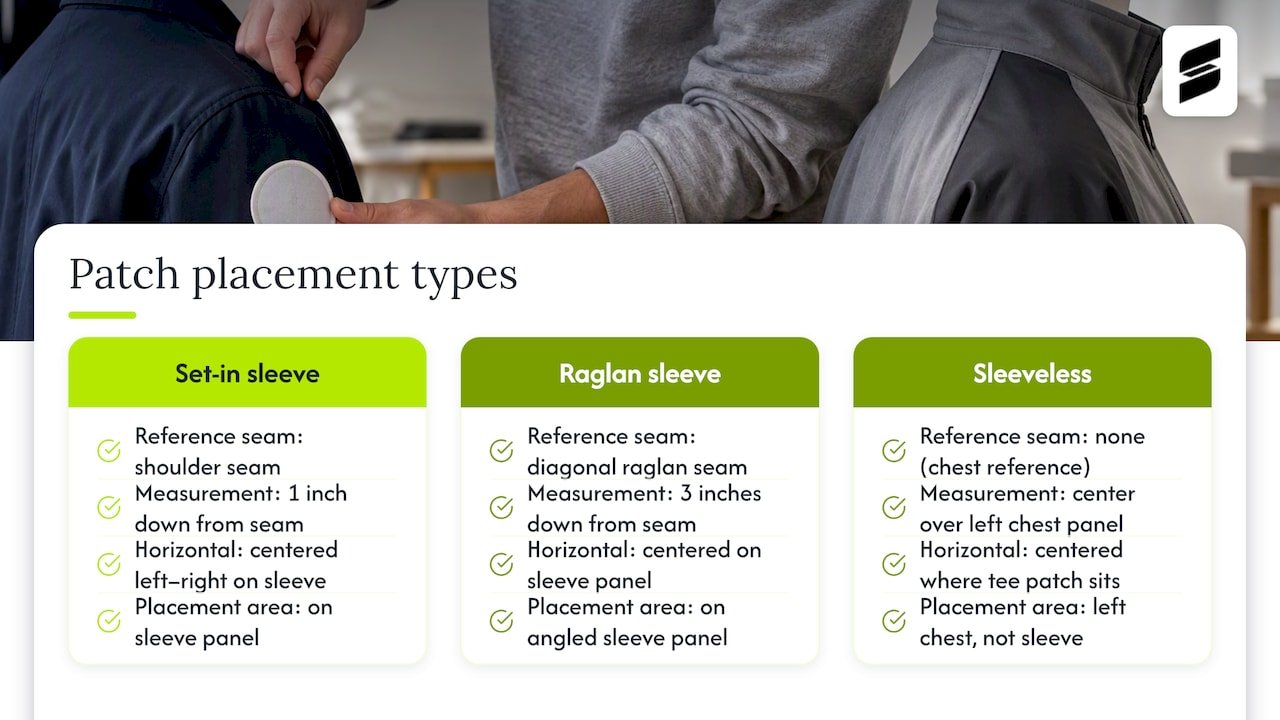
A sleeveless jersey shifts the entire reference point: instead of measuring from a shoulder seam that does not exist, the patch centers directly over the left chest panel, roughly where a sleeveless tee would have a patch positioned. Side by side, a set-in sleeve patch, a raglan sleeve patch, and a sleeveless chest patch will each look correctly placed on their own jersey even though the actual distance from the collar varies between them, because the sleeve construction itself is the variable, not the eye test.
When a flag patch joins a team patch on the same jersey, the visual result should show the team crest on the left arm at its standard offset, and the flag on the right arm, mirrored, at roughly the same height so the two patches read as a matched pair rather than an afterthought.
Regional and league differences in patch conventions
Placement conventions are not identical everywhere, even within the same sport. Little League’s measurements are specific to that organization’s rulebook and apply to its own sanctioned play, while a local recreational league using similar jerseys might set its own offset or skip a formal measurement entirely. High school programs governed by NFHS rules focus more on avoiding distracting uniform elements and keeping logos and patches within reasonable size limits than on prescribing an exact sleeve height.
International sports, particularly soccer, tend to follow whatever convention the kit manufacturer or federation sets rather than a universal inch-based rule, which is part of why club and national team sleeve patches vary so much in position from one league to another. Work uniforms vary by company policy rather than any outside authority, so a delivery service and a hospital system can land on entirely different sleeve conventions for the same type of jacket.
The practical takeaway is the same regardless of region: check whether a governing body or company handbook sets a rule, and default to the standard shoulder-seam measurement only when no such rule exists.
How patch placement affects fit and movement
A patch placed too close to the armhole seam can interfere with the natural stretch of the fabric right where the arm bends and rotates most during play. Stitching through that zone repeatedly, especially with multiple patches stacked too tightly, stiffens a section of fabric that needs to flex, which can create a pull or bunch during a pitching motion, a serve, or a tackle.
Iron-on patches carry a similar risk if applied over a seam rather than a flat panel, since the adhesive does not bond evenly to overlapping fabric layers and tends to separate faster in that spot. Keeping patches centered on a flat section of the sleeve, away from seams and stress points, protects both the look of the jersey and the durability of the patch itself.
Correct placement also keeps sleeve length and hem lines from being pulled out of shape, since a patch anchored near the sleeve opening can distort the cuff over repeated wear and washing.
Why consistent placement matters on a full roster
A single well-placed patch is easy. Keeping that placement identical across fifteen or twenty jerseys, in three different youth sizes and two sleeve cuts, is where most teams run into trouble. Some companies build custom-designed team uniforms around personalization and rapid turnaround, working directly with teams across basketball, baseball, softball, soccer, football, and volleyball using sublimated materials rather than after-the-fact patches wherever a design allows it.
Because placement questions come up most often when a team is choosing between a stock patch and a fully sublimated design, Capra Sports offers direct collaboration with professional designers and free samples to confirm sizing before a full order ships, according to Capra Sports. A simple coach checklist works well here: measure from the shoulder seam on the actual sample, confirm the placement looks right on both the smallest and largest sizes in the order, and approve the mockup only after both checks pass.
How Capra Sports can help with your team’s patch placement
Every measurement and rule in this guide matters most when it shows up correctly on the actual jerseys your team wears. Capra Sports builds custom uniforms across basketball, baseball, softball, soccer, football, and volleyball, with a design process built around getting details like sleeve placement right before production starts.

- Request a free mockup showing your logo, team patch, or flag positioned according to your sleeve type.
- Review the placement on your one included sizing sample before approving a full team order.
- Work directly with a designer to adjust height, spacing, or flag orientation until the layout matches your league’s rules.
Once the mockup looks right, coaches can move straight to ordering: browse custom uniform pricing for basketball, baseball, soccer, football, volleyball, and other sports, and submit your team’s design for review.
Sources
- Patch Requirements & Instructions — Little League
- NFHS — baseball uniform rules
- Shoulder Sleeve Insignia — The Institute of Heraldry
FAQ
Should the flag be placed on the right or left sleeve?
No federal rule requires a specific sleeve for a flag patch on a sports uniform. Many organizations follow military-style convention and place the flag on the right sleeve with reversed artwork, according to The Institute of Heraldry, while reserving the left sleeve for team or unit insignia.
Where should the Little League patch be placed?
Little League requires the patch 1 inch below the left shoulder seam on a set-in sleeve and 3 inches below the seam on a raglan sleeve, per Little League’s patch requirements. Sleeveless jerseys carry the patch centered over the left chest instead.
Should I put the patch on the left or right side of my shirt?
Team, unit, or league insignia conventionally go on the left sleeve or left chest, while flags more often go on the right sleeve with mirrored artwork. Check your specific league’s rulebook first, since organizations like Little League and NFHS-governed programs may specify their own placement requirements.
Where is the best place to put a patch on your body?
For sleeved jerseys, the standard spot is the upper sleeve, measured down from the shoulder seam rather than judged by eye. For sleeveless jerseys, the left chest is the conventional placement, matching the position Little League specifies for its own shoulder patch policy.