

Soccer Captain Armband Rules: What Coaches Need to Know
Every soccer team must have a captain on the field, and that captain must wear an identifying armband. The Laws of the Game say what the band can look like, but they leave the details (which arm, who wears it after a substitution, how much the captain can speak for the team) to competition organizers. That is why a rule that is firm in a pro match can be relaxed in a youth league down the road.
This guide covers what the global Laws require, what changes at the youth and rec level in the U.S., and a short checklist you can run before the first game of the season.
TL;DR
- The Laws of the Game require each team to have a captain on the field who wears an identifying armband.
- The band must be issued or authorized by the competition organizer, or be a single-colored band that can carry “captain,” “C,” or a translation in one color.
- The captain has no special status or privileges, only a degree of responsibility for the team’s behavior.
- If the captain is substituted or sent off, another player must take over the role and wear the band.
- Local leagues write their own rules. Some require the band at all times, and some youth programs do not require it at all, so read your league handbook.
Table of Contents
- What the Laws of the Game require
- Which arm does the captain wear it on?
- What the band must look like
- What a captain does, and what a captain does not get
- “Only the captain” guidelines
- What happens when the captain leaves the field
- Youth and rec leagues: the rules change
- A pre-season checklist for coaches
- Our perspective on captains and kits
- Planning a new soccer kit for your team
- FAQ
- Sources
What the Laws of the Game require
The rule sits in Law 4, the players’ equipment law. According to IFAB Law 4, the captain must wear an armband issued or authorized by the competition organizer, or a single-colored armband that may also carry “captain,” “C,” or a translation of the word in a single color.
The 2025/26 Laws, as summarized in U.S. Soccer’s learning materials, repeat the basic point: each team has a captain on the field of play who wears an identifying armband.
Two practical readings follow from that wording:
- The band is part of the required equipment picture. A captain without any identifying band is a problem for the referee, not just a style choice.
- The band is flexible by design. A plain elastic band in one color is enough. A fancy one is not required.
Why the band exists
The band is there so the referee can find the captain quickly in a crowded penalty area or a heated moment. The Guardian’s history of captains’ armbands describes it as a practical tool for match officials that also carries symbolic weight for a team’s history, values, and hopes. Both are true in a youth game too. The referee needs to know who to talk to, and a nine-year-old wearing the band often feels the responsibility.
Which arm does the captain wear it on?
The convention is the left arm, upper arm, above the elbow. The Bundesliga’s explainer says the captain’s armband is worn on the left, while black mourning armbands are typically worn on the right. That separation is useful: it keeps a tribute band from being mistaken for a captain’s band.
The wording of Law 4 does not name an arm in the text above, so treat left as the strong convention rather than a rule you can cite word for word. If your league handbook says a specific arm, follow the handbook.
Keep it visible
A band that slides down to the wrist, or disappears under a long-sleeve base layer, does not do its job. Some local leagues go further than the Laws. The Rogers Adult Soccer League’s rules, for example, say the captain must wear a clearly visible armband at all times and act as the primary on-field representative of the team. That is a reasonable standard to adopt even if your league is silent.
What the band must look like
Here is how the main options line up for a team deciding what to buy or issue.
| Option | Allowed under Law 4? | Notes for coaches |
|---|---|---|
| Band issued or authorized by the competition | Yes | Use it if your league hands them out, and return it if asked |
| Plain single-colored band | Yes | The simplest and cheapest route for a rec or club team |
| Single-colored band with “C,” “captain,” or a translation | Yes | Lettering must be one color |
| Multi-colored or heavily decorated band | Not described in Law 4 | Check with the league before game day |
| No band | No | Referee and league may require you to fix it |
A contrast tip: pick a band color that stands out against the jersey sleeve. A white band on a white kit is technically a band, but it defeats the purpose. The same logic applies to the kit itself, which is why we wrote about why home and away colors need contrast.
What a captain does, and what a captain does not get
The armband does not make a player the boss. The 2025/26 Laws state that the captain has no special status or privileges but carries a degree of responsibility for the team’s behavior.
In practice, that means:
- The captain is a point of contact for the referee, especially at the coin toss.
- The captain can help calm teammates, but cannot demand a decision or argue with a call.
- A captain who loses control of teammates can still see the team, and sometimes the captain personally, on the receiving end of the referee’s attention.
For a youth coach, this is the lesson to share with your captain on day one: the band is a job, not a prize.
Picking the right player
The best captain is rarely the best scorer. Look for the player who stays calm after a bad call, talks to teammates in a normal tone, and will not argue with an official. Many coaches rotate the role across a season in younger age groups so more kids get the experience. If you rotate, keep a spare band in the bag so the handoff takes seconds, not minutes.
“Only the captain” guidelines
The most important change to how captains talk to referees is IFAB’s “Only the captain” guidance. IFAB encourages competitions to adopt it to improve behavior and the relationship between players and referees.
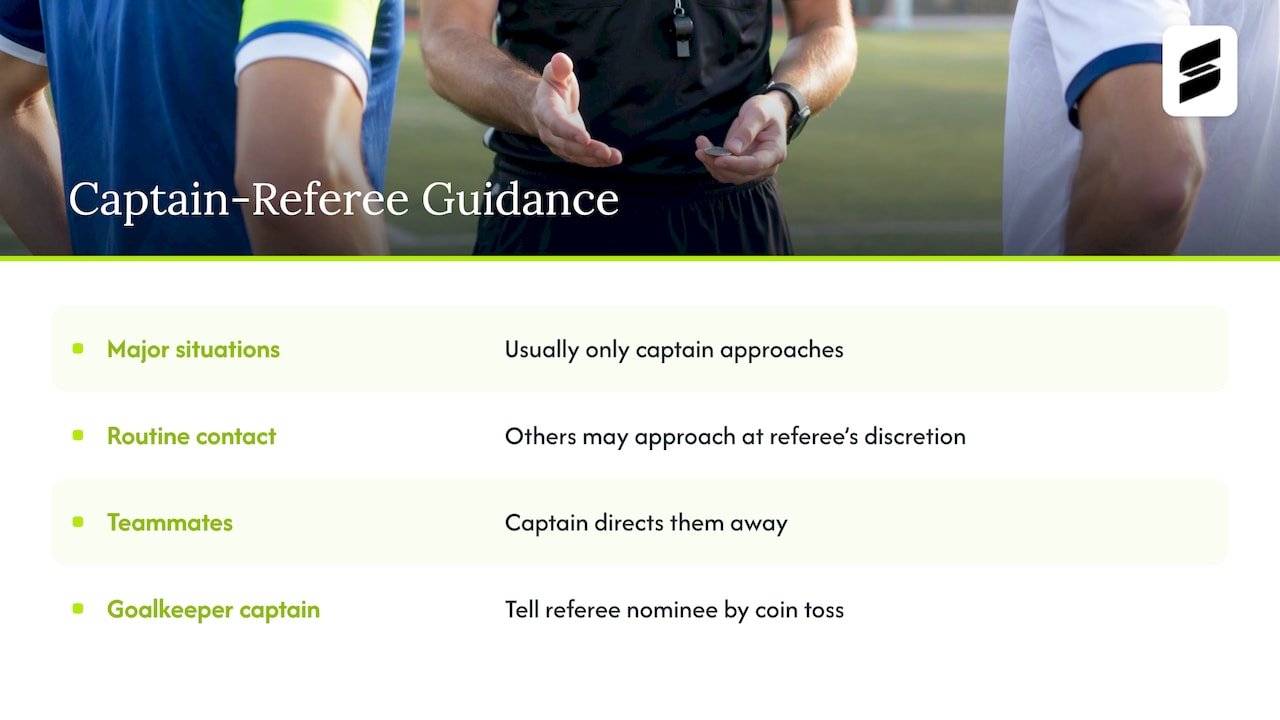
Under the guidance, usually only the captain may approach the referee in major situations. Normal interactions remain allowed, and other players may approach at the referee’s discretion. Captains also take on a job: directing teammates away from the referee to prevent mobbing.
Where the guidelines apply, the referee must be told no later than the coin toss which player is nominated to approach instead of the goalkeeper when the goalkeeper is the captain. This matters for any team whose captain plays in goal. A keeper who is 60 yards from the midfield line is not well placed to speak to the referee after a decision, so the team can name a field player for that job.
Discipline connects directly to this guidance. If you want a clear refresher on how cautions work and why dissent draws them, this overview of yellow card rules in football is a useful companion for players and parents. Make sure your captain understands that walking up to argue a call is the quickest way to earn one.
Local leagues can go further
Some local rules restrict communication with the referee to the captain alone. The Rogers Adult Soccer League’s document says other players and coaches may not approach to ask for clarification. That is stricter than the global guidance, which leaves room for referee discretion. If your league uses a similar rule, brief all players before the first game so no one picks up a caution for a simple question.
What happens when the captain leaves the field
The captain will not always finish the game. A substitution, an injury, or a red card all raise the same question: who wears the band now?
The guidance from IFAB says that if the nominated player is substituted or sent off, another player must be nominated. The standard approach is straightforward:
- Decide before kickoff who the vice captain is, and tell the referee at the coin toss if your league requires it.
- When the captain comes off, the captain hands the band to the vice captain on the field.
- If a captain is sent off, the band passes to a teammate on the field without a long delay.
- Let the referee know who the new captain is at the next stoppage.
Avoid the common mistake of leaving the band on the bench after a substitution. A team with no identifiable captain slows the game and invites confusion about who may talk to the referee.
Goalkeeper as captain
A goalkeeper can be captain, and the band goes on the keeper’s arm over the gloves-and-jersey setup. The only wrinkle is the one covered above: the team may need a nominated teammate to handle conversations with the referee. Settle that before kickoff, not during a corner kick.
Youth and rec leagues: the rules change
Most of the questions coaches ask are not about the Laws. They are about the local handbook.
- Some youth programs do not require the band. The AYSO reference material notes that captain’s bands are not required under its national rules and regulations. If you coach in AYSO, check your region’s guidance.
- Some adult leagues require it at all times. The Rogers league example above shows how a local rule can be stricter than a youth program.
- School and club competitions follow their own rulebooks. Your athletic director or league administrator will know whether a band is expected.
The pattern is simple: the Laws set the baseline, and the organizer who runs your competition can add detail or relax requirements for younger ages. The organizer’s rulebook decides your case.
A pre-season checklist for coaches
Before the first match, run through these points:
- Read the section of your league handbook on captains, equipment, and communication with officials.
- Buy two bands in a color that contrasts with your jersey sleeves.
- Name a captain and a vice captain, and teach both what the role is and is not.
- If your keeper is captain, name a field player to speak with the referee.
- Pack a spare band in the team bag.
- Check your jersey and number setup at the same time. Our guide to soccer jersey number rules covers sizes and coach checks, and the notes on soccer jersey numbering cover placement.
Equipment checks tend to travel together. Referees who look at the band will also look at numbers, colors, and shin guards, so it helps to settle all of it in one pass.
Our perspective on captains and kits
We spend our days talking to coaches about uniforms, and the captain’s band comes up more often than you would think. Usually it is a late question: the kit is designed, the numbers are placed, and then someone asks whether the captain needs a band, what color it should be, and whether it will clash with the sleeve.
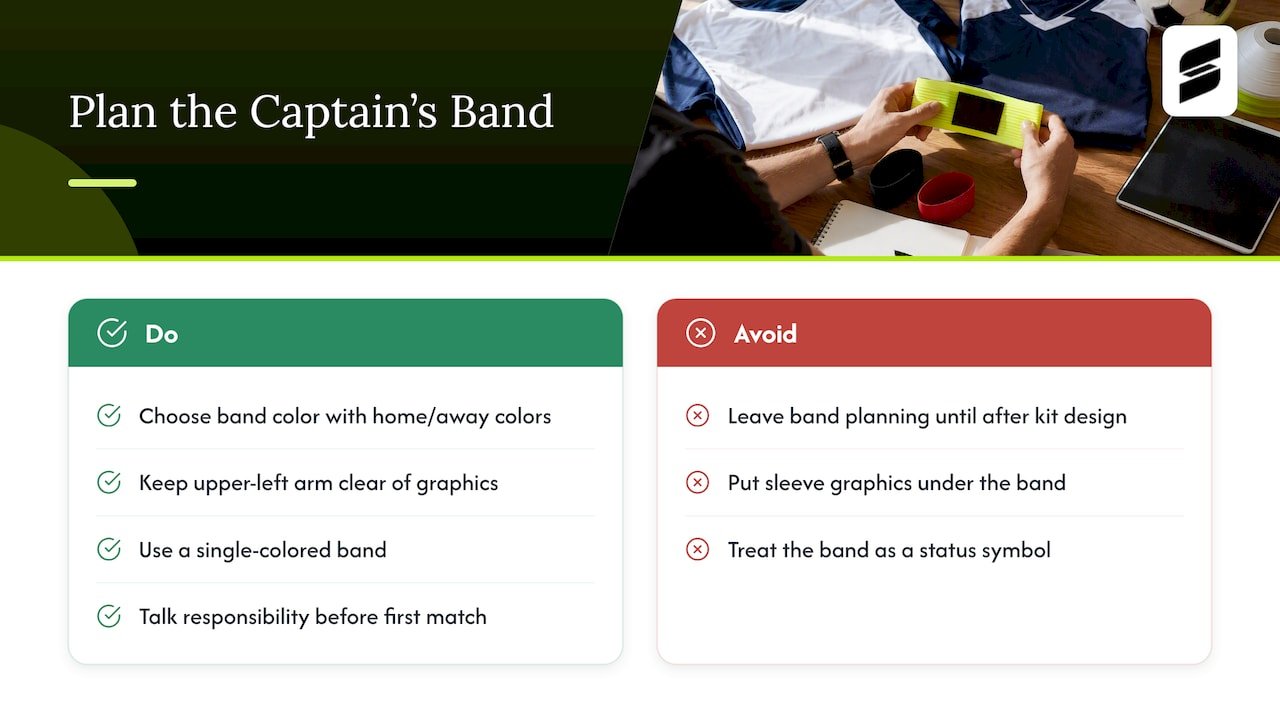
Our advice is to treat the band as part of the kit plan, not an afterthought. Choose a band color when you choose your home and away colors, so it reads clearly on both. Keep sleeve graphics away from the upper-left arm area if you can, so the band sits on a clean surface. And keep it simple. The Laws only ask for a single-colored band, and a plain one is easy to replace when a kid loses it in the parking lot.
The bigger lesson is about the role. A captain who understands that the band means responsibility, not status, makes the referee’s job easier and helps teammates stay out of trouble. That is worth a five-minute talk before the first match.
— Agha
Planning a new soccer kit for your team
If your team is ordering new gear, Capra Sports makes custom sublimated soccer uniforms and kits for youth teams, school programs, and adult rec leagues. Our designers send a free mockup within 24 hours, so you can see how colors, numbers, and sleeves work together before you commit. Team orders start at a 10-set minimum, and we include one sizing sample at no extra charge so you can check fit. Pricing is listed on our pricing page as [PRICE TBD].
FAQ
Does a soccer captain have to wear an armband?
Under the Laws of the Game, yes: each team must have a captain on the field who wears an identifying armband. Some youth organizations relax that, so check your league handbook. When in doubt, wear one, because it costs almost nothing and avoids an argument.
What arm does the captain wear the band on?
The convention is the left arm, above the elbow. Black mourning bands are usually worn on the right, which keeps the two easy to tell apart. Follow your league’s instructions if they name a specific arm.
Can a goalkeeper be the team captain?
Yes. If your competition uses the “Only the captain” guidelines, the referee must be told no later than the coin toss which player will approach the referee in the goalkeeper’s place. Pick a field player who stays calm and is usually near the center of play.
What happens if the captain is substituted or sent off?
Another player must be nominated and wear the band. Name a vice captain before the game, hand over the band at the stoppage, and let the referee know who it is.
Can other players talk to the referee?
Usually only the captain approaches in major situations, and other players may speak to the referee at the referee’s discretion. Some local leagues restrict communication to the captain alone, so tell your team what your league says.
Sources
- IFAB Law 4: The Players’ Equipment
- IFAB: Only the captain
- Changes to the Laws of the Game 2025/26, U.S. Soccer
- The Guardian: Why did captains start wearing armbands?
- Bundesliga: The black armband in soccer
- Rogers Adult Soccer League Rules, Fall 2026
- AYSO Reference Book
- Yellow Cards in Football: Rules, Offenses and Bans