
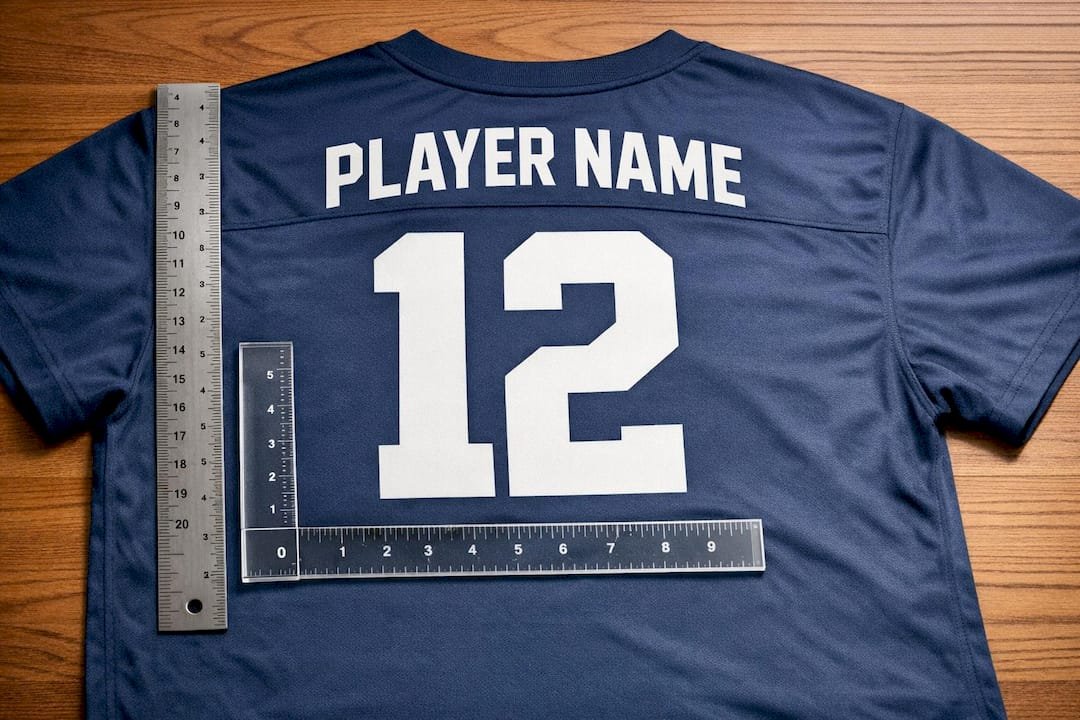
Jersey Number Size Guide for Coaches and Coordinators
Use 6–8 inch back numbers and 3–4 inch front numbers for youth jerseys. For adults, go 8–10 inches on the back and 4–6 inches on the front. That’s the industry default across most team sports, and it lines up with the dimensional standards in competition rulebooks like UEFA’s equipment regulations.
If you’re ordering for a mixed-age roster and need one size that works across the board, default to 8 inch back numbers and 4 inch front numbers. It’s slightly generous for the youngest kids and right in the pocket for adults, which beats reordering a batch that came back too small to read from the bleachers.
- Youth: back 6–8 in., front 3–4 in.
- Adult: back 8–10 in., front 4–6 in.
- Shorts/sleeve numbers: typically 3–4 in. across age groups
Key Takeaways
Correct jersey number sizing depends on matching sport-specific conventions, league rules, and printing method to the player’s age group and jersey size.
| Point | Details |
|---|---|
| Default youth sizing | Use 6–8 in. back numbers and 3–4 in. front numbers for youth jerseys across most sports. |
| Default adult sizing | Use 8–10 in. back numbers and 4–6 in. front numbers for adult jerseys. |
| Verify league rules first | Check UEFA, NCAA, or your specific league’s rulebook before finalizing numbers, since minimums vary. |
| Printing method affects legibility | Sublimation holds true to size, while tackle twill and screen print can change perceived stroke width. |
| Confirm with a mockup | Capra Sports provides free digital mockups and samples so you catch sizing issues before full production. |
Table of Contents
- Standard Jersey Number Size Charts by Sport
- How Do You Place and Measure Jersey Numbers Correctly?
- What Are the League Rules for Jersey Numbers by Sport?
- How Does Printing Method Change Number Legibility?
- Scaling Jersey Numbers Across Player Sizes
- A Copy-Ready Checklist for Your Print Shop
- How Capra Sports Helps You Avoid Sizing Mistakes
- Fitting Sponsor Logos Around Jersey Numbers
- Keeping Jersey Numbers Legible Season After Season
- Frequently Asked Questions
- Sources
Standard Jersey Number Size Charts by Sport
Every sport handles number placement a little differently, and treating soccer sizing rules like basketball sizing rules is how coordinators end up with a reprint bill. The table below consolidates the ranges that decorators and league rulebooks actually use, cross-checked against the uniform and number rules published by governing bodies such as the NFHS, which sets the standard most school and club programs follow.
| Sport | Element | Youth Range | Adult Range |
|---|---|---|---|
| Soccer | Back number | 6–8 in. | 8–10 in. (up to 25–35 cm for elite play) |
| Soccer | Front number | 3–4 in. | 4 in. |
| Soccer | Shorts number | 3–4 in. | 4 in. (10–15 cm per FIFA/UEFA guidance) |
| Football | Back number | 6–8 in. | 8–10 in. |
| Football | Front number | 3–4 in. | 4–6 in. |
| Football | Shoulder/sleeve number | 3–4 in. | 3–4 in. |
| Baseball | Back number | 6 in. | 8 in. |
| Baseball | Front number | Rarely used | Rarely used |
| Softball | Back number | 6 in. | 6–8 in. |
| Softball | Front number | 3 in. | 3–4 in. |
| Basketball | Front number | 4–6 in. | 6–8 in. |
| Basketball | Back number | 6–8 in. | 8–10 in. |
| Hockey | Back number | 8 in. | 10–12 in. |
| Hockey | Sleeve number | 3–4 in. | 4 in. |
| Lacrosse | Back number | 6 in. | 6–8 in. |
| Lacrosse | Front number | 3 in. | 3–4 in. |
| Volleyball | Front number | 3–4 in. | 3–4 in. |
| Volleyball | Back number | 6 in. | 6–8 in. |
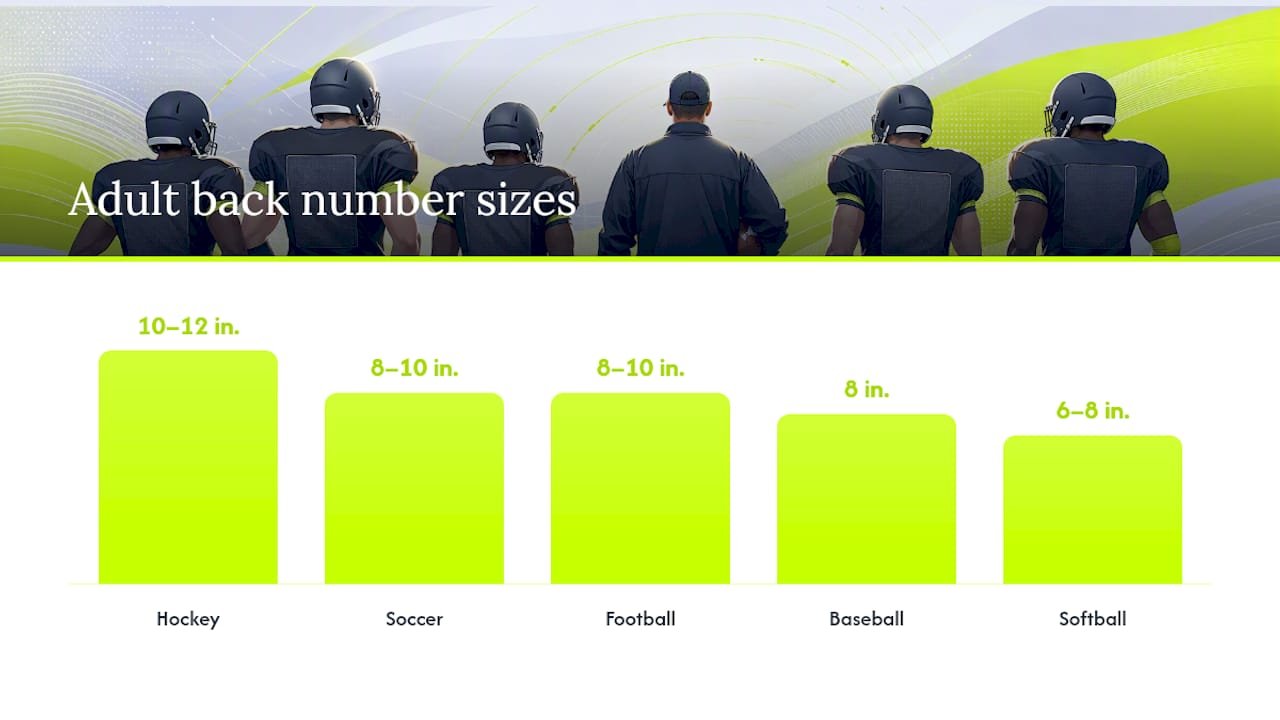
A few sport-specific notes matter more than the raw numbers. Football jerseys almost always carry shoulder or sleeve numbers in addition to front and back, since officials need to identify players at a distance during fast plays. Baseball jerseys, by contrast, usually skip front numbers entirely and rely on back numbers and name placement, following a tradition that goes back generations. Basketball leans toward larger front numbers than most other sports because players face the crowd and cameras more directly, and the NBA’s approach to visual identification has shaped what most club and rec leagues consider standard.
Hockey numbers tend to run bigger than any other sport on this list, partly because jerseys are worn looser and partly because rink sightlines are longer than a typical field or court. If you coordinate for multiple sports in the same season, don’t assume one size chart travels across all of them.
Pro Tip: When you’re placing one order for a roster that spans ages 8 to 14, pick a single default size (say, 6 inch back numbers) rather than customizing per player. Note any exceptions, like a goalkeeper needing a larger number, directly on your roster CSV in a dedicated “size override” column so your decorator catches it before production, not after.
How Do You Place and Measure Jersey Numbers Correctly?
Getting the size right only matters if the placement is right too. A perfectly sized number sitting crooked or too close to the collar seam looks unfinished no matter how legible the font is.
Here’s a measurement checklist you can hand directly to a decorator or run through yourself before submitting an order:
- Measure the collar-to-number gap. Leave roughly 2 inches of clearance below the back collar seam before the top of the number begins.
- Center the number horizontally. Use the jersey’s centerline, not the visible seam, since side panels can shift where “center” looks like it should be.
- Check seam clearance. Keep numbers at least 0.75 to 1 inch away from side seams and sleeve seams, which is standard decorator practice.
- Confirm front number position. Front numbers usually sit centered on the chest or slightly left, depending on sport convention and logo placement.
- Verify sleeve or shoulder numbers. These typically run 3–4 inches tall and sit 1–2 inches below the shoulder seam.
- Check name-to-number spacing. Leave at least 0.5 inch of clearance between a player’s name and the number above or below it.
A quick sense check on scale: on a youth small jersey, a 6 inch number with 2 inches of collar clearance looks proportional. Scale that same 2 inch clearance up slightly, to around 2.5 inches, on an adult XL, or the number reads as too high on a bigger garment.
- Small youth jersey: 6 in. number, 2 in. collar gap
- Adult medium jersey: 8 in. number, 2.5 in. collar gap
- Adult XXL jersey: 8–10 in. number, 3 in. collar gap to maintain proportion
What Are the League Rules for Jersey Numbers by Sport?
Before you finalize any order, check whether your league restricts number sizes or which digits are allowed. This is where a lot of coordinators get tripped up, ordering a design that looks great but doesn’t pass inspection at check-in.
- International soccer competitions typically bar jersey numbers above 99, and UEFA rules require back numbers to be centered with specific height and stroke-width ranges, 25–35 cm for men’s shirts, 20–35 cm for women’s, and 10–15 cm for shorts numbers.
- Goalkeepers in soccer often have separate numbering conventions (commonly 1, 12, or a dedicated keeper range) depending on league rules.
- Basketball and football leagues frequently restrict which digits are legal, some high school associations disallow numbers using 6, 7, 8, or 9 in combination because of hand-signal officiating conventions.
- High school and college programs often set their own minimum number heights that exceed recreational defaults; a front number under 4 inches can fail inspection even if it matches general youth guidance.
Always verify current rules with your specific league before finalizing an order. High school associations, college conferences, and tournament organizers each maintain their own rulebooks, and NCAA’s official rulebook is the authoritative reference for college-level play. What passes for a rec league scrimmage won’t necessarily pass for a sanctioned tournament.
For football, number ranges are tied to position, so check football numbers by position before you assign anything. For the numeral style itself, run through our jersey number font checks.
How Does Printing Method Change Number Legibility?
The size you order and the size that shows up on the field aren’t always identical, because different printing methods handle stroke width and edge sharpness differently.
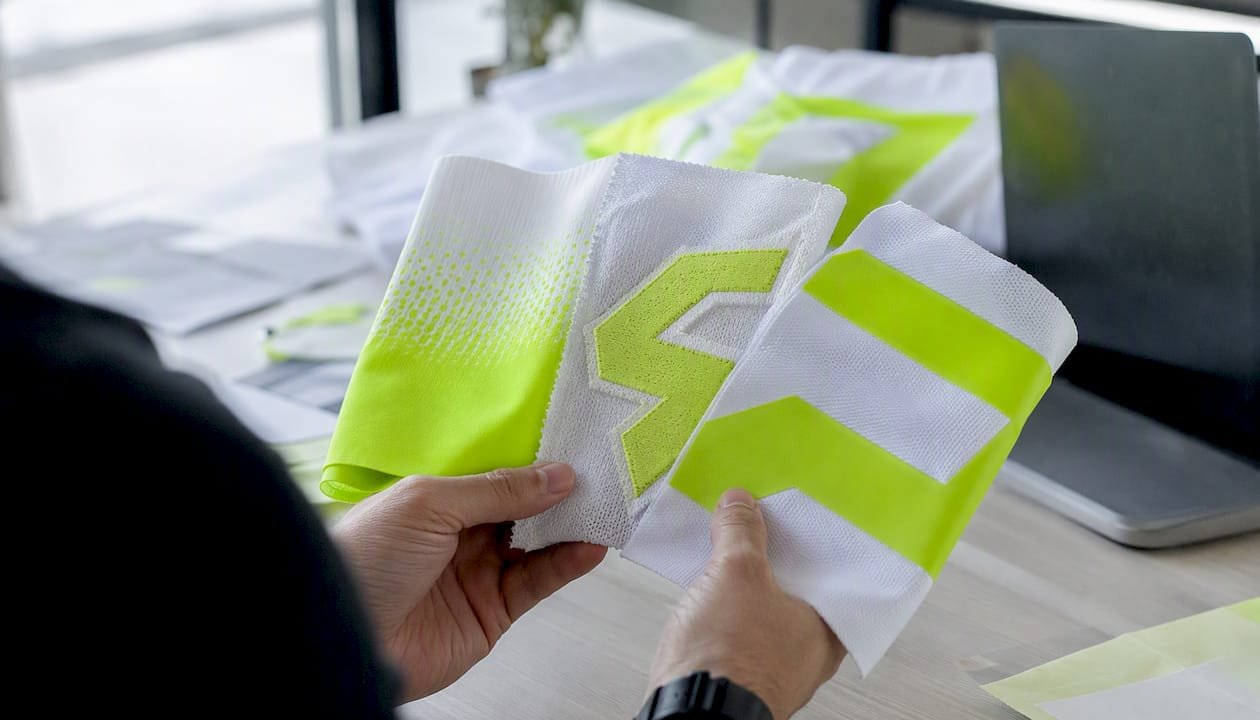
Sublimation prints ink directly into the fabric fibers, so there’s no raised texture and the number stays exactly the dimensions you specified, with clean edges even on complex fonts. Tackle twill uses stitched applique letters, which naturally read a bit bolder because the fabric edge and stitching add visual weight, so a 6 inch twill number can look closer to 6.5 inches at a glance. Heat transfer vinyl is flexible and works well on stretch fabrics, but it can distort slightly if applied over curved seams or heavily contoured jerseys. Screen printing lays down a flat layer of ink that’s crisp initially but prone to hairline cracking at the stroke edges over time, especially on thinner or heavily worn jerseys.
If your jersey uses a stretchy performance knit, size up slightly, maybe half an inch on the number height, since stretch fabric can make thin strokes look thinner once the garment is worn and pulled.
Pro Tip: Ask your decorator for a physical fabric swatch or digital mockup before approving a full run, and confirm the default stroke width in writing. A “medium” stroke from one vendor can look noticeably thinner than another’s, and that’s not something you catch from a flat digital proof alone.
Scaling Jersey Numbers Across Player Sizes
A number that looks perfectly proportioned on an adult large jersey can look oversized and cramped on a youth small. Grading numbers down for smaller garments, not just shrinking the whole design uniformly, keeps the proportions right.
For a youth small compared to an adult medium, reduce front numbers by roughly 20 percent and back numbers by a similar margin. On the largest sizes, XXL and beyond, you can hold numbers steady or even nudge them up slightly since there’s more chest and back real estate to fill without looking cramped. Narrower jerseys sometimes need shoulder or sleeve numbers shifted inward by half an inch to avoid crowding the seam.
Pro Tip: Before committing to a full production run for outlier sizes, whether that’s a 6-year-old’s youth XS or a lineman’s 5XL, request a single sample garment. Seeing the number at true scale on the actual body type catches proportion issues that a size chart on paper never will.
- Reduce front and back numbers ~20% for youth XS/S versus adult M baseline
- Hold or slightly increase number size for XXL and larger to avoid a “lost in space” look
- Shift shoulder/sleeve numbers inward on narrow-cut jerseys to preserve seam clearance
A Copy-Ready Checklist for Your Print Shop
Paste this directly into an email or order form when you’re ready to submit:
- Sport: [soccer / football / basketball / baseball / etc.]
- Roster file: CSV attached with name, number, and size columns
- Default back number height: 8 in. (adjust per sport chart above)
- Default front number height: 4 in.
- Font and stroke width: [specify or request decorator’s standard block font]
- Placement margins: 2 in. collar clearance, 0.75–1 in. seam clearance
- Color contrast: confirm number color reads clearly against jersey base color
- Special placements: shoulder numbers, shorts numbers, sleeve numbers (list separately)
- Roster exceptions: goalkeeper, oversized players, or non-standard numbers noted
- Approval step: mockup or physical sample required before full production
How Capra Sports Helps You Avoid Sizing Mistakes
Most sizing errors happen because nobody caught the mismatch until the boxes arrived. Capra Sports builds a free digital mockup, turned around within 24 hours, into every order, so you see number placement and proportions before anything gets printed, and physical samples are available for teams that want to check an outlier size in hand.
When you submit your roster, flag any exceptions (a goalkeeper, an oversized lineman, a very young player) directly in your notes so the stroke width and contrast get confirmed before mass production starts.
Pro Tip: If you have even one player at an extreme size, request a single physical sample for that jersey before approving the full run. It’s a small delay that saves you from a much bigger reorder.
Fitting Sponsor Logos Around Jersey Numbers
Sponsor logos and additional patches complicate number placement more than most coordinators expect going in. The front number and chest logo are usually competing for the same real estate, so something has to shift.
The most common solution is centering the number on the chest and moving the sponsor logo to a shoulder, sleeve, or lower hem position where it won’t crowd the number’s clearance zone. If your league or sponsor agreement requires the logo to sit front and center, you may need to reduce the front number slightly (dropping from 4 inches to 3.5 inches, for instance) or shift it slightly off-center rather than shrinking it drastically.
Keep at least 1 inch of clearance between any logo and the number’s edge, more if the logo has its own busy background or bright colors that could bleed visually into the number’s contrast. For jerseys carrying multiple sponsor marks, a common approach is stacking smaller sponsor logos along one side seam or sleeve, keeping the front and back numbers untouched and fully sized per your sport’s standard.
Test the full layout in a mockup before production, not just the number and not just the logo in isolation. Overlap problems are often invisible until you see everything placed together on the actual garment shape, especially on curved areas like the shoulder or side panel.
Keeping Jersey Numbers Legible Season After Season
A number sized perfectly on day one can look distorted by midseason if the jersey isn’t cared for correctly, and that’s often a laundry problem more than a printing one.
Wash jerseys inside out in cold water to reduce direct friction on the printed or applied surface, and skip the dryer’s high heat setting, which is one of the fastest ways to warp heat transfer vinyl or crack screen print ink over repeated cycles. Sublimated numbers hold up best over time since the ink is embedded in the fabric rather than sitting on top of it, but even sublimation can fade slightly with harsh detergents or bleach exposure.
Avoid ironing directly over a printed or applied number; if you must press a jersey, use a pressing cloth and keep the heat setting low. Skip fabric softener too, since it can leave a residue that dulls the fabric surface around raised or textured numbers like tackle twill.
Store jerseys folded rather than tightly rolled or crammed into a bag for months at a time, since sustained creasing across a printed number can eventually cause micro-cracking at the fold line. Catching frayed edges or peeling corners early, and getting a touch-up rather than waiting for full replacement, keeps a roster looking consistent all season instead of patchy by the playoffs.
A Uniform Coordinator’s Honest Take
The biggest mistake I see coordinators make isn’t picking the wrong number size. It’s skipping the mockup step to save a few days, then discovering the placement is off once 20 jerseys arrive. Pro Tip: A high-contrast number in a plain block font will always read better from the stands than a stylish font in a color that blends with the jersey. Legibility beats personality every time.
Get Your Sizing Right the First Time
You’ve got the size charts and the placement rules. The part that trips up most coordinators isn’t the math, it’s confirming everything looks right before a full production run goes out the door. Capra Sports builds a free digital mockup into every custom order, so you see exact number placement, sizing, and color contrast before anything gets cut or printed. Team orders start at 10 sets, and you can request a single sizing sample first at no extra charge.
Whether you’re outfitting a youth soccer club or a varsity football program, you can start with a free mockup request and see your roster’s numbers laid out exactly as they’ll print. If football’s your sport, Capra’s football uniform builder already accounts for shoulder and sleeve numbering conventions covered above. Either way, the next step is the same: request your mockup, review the sizing in context, and approve before production starts.
Next step: see what a full basketball team kit costs per player, or request a free 24-hour mockup of your design.
Frequently Asked Questions
What is the standard jersey number size for youth teams? Youth back numbers typically run 6–8 inches tall, with front numbers around 3–4 inches, based on the sizing conventions used across the decorating industry and reflected in most youth league rulebooks.
What jersey number size should adult teams use? Adult jerseys generally use 8–10 inch back numbers and 4–6 inch front numbers, though competition-level soccer under UEFA rules can run larger, up to 25–35 cm for men’s shirts.
How far should a jersey number be from the collar? Leave roughly 2 inches of clearance between the back collar seam and the top of the number, adjusting slightly larger on bigger adult sizes to maintain visual proportion.
Does printing method affect jersey number size? Yes. Sublimation keeps numbers true to their specified dimensions, while tackle twill and heat transfer can add visual weight or slight distortion depending on fabric stretch and application method.
Can I use one number size for a mixed-age roster? An 8 inch back number and 4 inch front number works as a reasonably safe default across mixed youth and adult rosters, though noting individual exceptions on your roster file prevents mismatches.
Are there legal number restrictions in competitive leagues? Yes. International soccer typically bans numbers above 99, and many high school and college leagues restrict specific digits or set minimum heights, so checking your league’s current rulebook before ordering matters.
Sources
- NFHS — National Federation of State High School Associations
- Article 10 Numbers – Equipment (UEFA document)
- Little League Official Playing Rules
- NCAA official site