
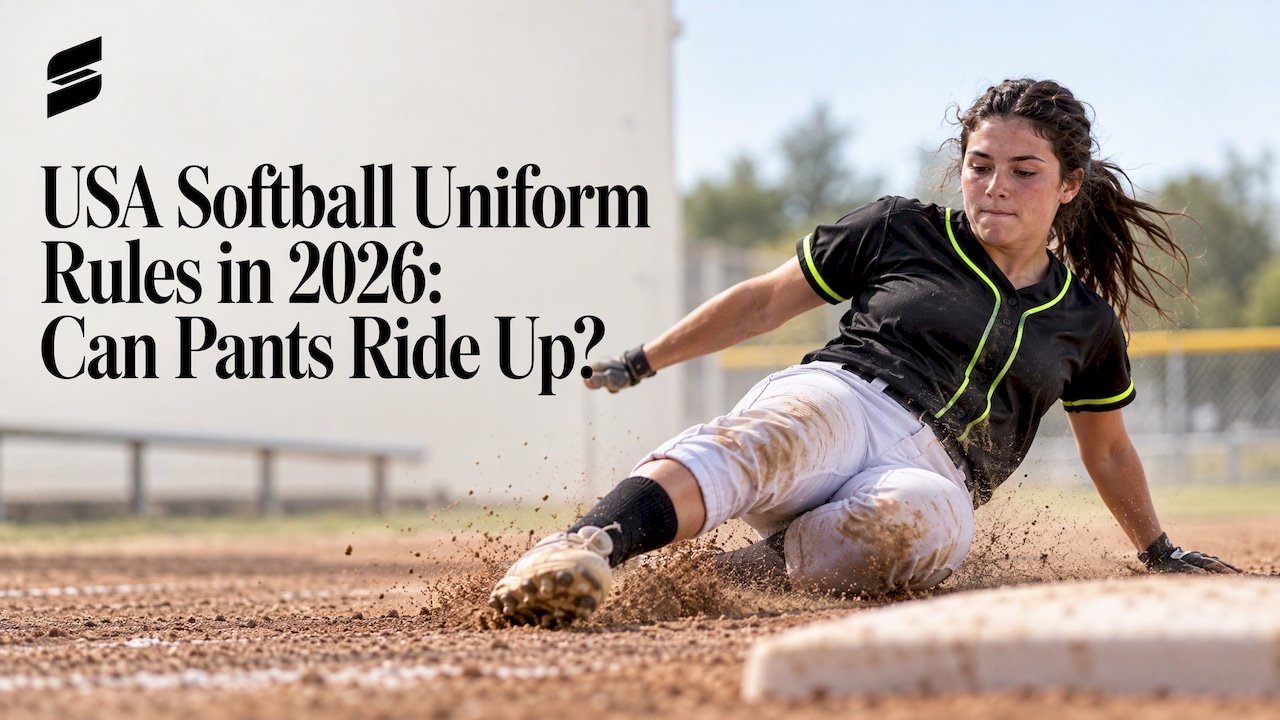
USA Softball Uniform Rules in 2026: Can Pants Ride Up?
Yes, USA Softball has official uniform rules, and they cover more than matching jerseys. Teams must wear identical style and color for jerseys, pants or shorts, and socks, while accessories like sleeves and headwear follow separate color limits. Umpires enforce these standards for safety and fairness, and state associations can grant narrow local exceptions. If a player’s pants ride up mid-game, the real concern is visible undergarment color and number legibility, not appearance.
TL;DR:
- A pant leg riding up is not a violation; exposed undergarments must be a solid approved color, and umpires can intervene over safety hazards.
- Men’s D and E/Rec and several women’s and coed recreational divisions require similar shirt colors and visible numbers, not matching pants or socks.
- Metal cleats may be allowed at higher competitive levels, but divisions can restrict them; confirm tournament rules before players arrive.
- Manufacturer logos are limited to 2-1/4 square inches under NFHS guidance, and sponsor logos may face stricter local limits, so confirm placement before printing.
- State associations may approve individual religious or medical accommodations, but approval does not override safety rules, and teams should document it before game day.
Table of Contents
- Where USA Softball’s Uniform Rules Actually Live
- Pants, Shorts, and the “Riding Up” Question
- Undergarments, Sleeves, Headwear, Shoes, and Jewelry: The Specifics
- When the Rules Bend: Exceptions Worth Knowing
- How Umpires Enforce Uniform Rules on the Field
- Pre-Game Checklist to Avoid Uniform Disputes
- Ordering Softball Uniforms That Fit Right the First Time
- How USA Softball Reviews Custom Uniform Designs
- Sponsor Logos and Advertising on Softball Uniforms
- How Uniform Rules Have Changed Heading Into 2026
- Uniform Rules Across Age Groups and Divisions
- Rules Exist for Safety, Not to Police Fit
- Get Compliant Softball Uniforms Built for Your Team
- FAQ
- Sources
Where USA Softball’s Uniform Rules Actually Live
Three documents govern what a legal softball uniform looks like. The USA Softball rulebook sets the baseline playing rules each season, the annual rule changes document spells out what shifted from the prior year, and the Procedural Code governs how local and state associations may adjust enforcement for tournaments. Together they tell you what’s required, what changed, and who has authority to grant exceptions.
The core requirement is straightforward: eligible players on a team wear uniforms identical in style and color, meaning the jersey, pants or shorts, and socks must match across the roster. According to the 2026 USA Softball rule changes, accessories can vary player to player as long as they’re worn properly, and a uniform piece that gets replaced mid-game due to blood saturation doesn’t draw a penalty.
A few specific details trip teams up more than the broad matching rule:
- Numbers must appear on the uniform in a size that is clearly visible to umpires and scorers from an appropriate distance.
- Manufacturer logos are capped at 2-1/4 square inches, according to NFHS uniform guidance.
- Sleeves and headwear get their own color rules separate from the jersey-pants-socks matching requirement.
- A uniform part swapped out due to blood or injury during play doesn’t count as a violation.
These details matter because umpires check them before and during games, and a team that shows up with mismatched pant shades or oversized logos can face a correction request before the first pitch. Knowing the rule in advance saves a sideline scramble.
Pants, Shorts, and the “Riding Up” Question
Here’s the direct answer: pants can be long, short, or a mix of both styles on the same team, as long as the color and overall style match across the roster. There’s no rule that penalizes a pair of pants for riding up during a slide or a sprint to first. The issue only becomes a violation when the exposure creates a problem, specifically when it reveals undergarment color that doesn’t meet the solid single-color requirement, or when it creates an actual safety hazard like exposed skin catching on a cleat.
In practice, umpires are watching for two things when pants shift: whether the visible undergarment matches the approved color (commonly black, white, gray, or a school color) and whether the situation poses any physical risk. A brief wardrobe adjustment between innings is normal and isn’t treated as a rule violation on its own.
Teams dealing with recurring ride-up problems during a season have a few practical fixes:
- Switch to longer compression shorts underneath so any exposed undergarment still matches team color.
- Check that pant waistbands are sized correctly rather than relying on a drawstring alone.
- Use a secured belt if the pant style allows one.
- Consider a shorter pant length for players who find full-length pants shift more during sliding.
Pro Tip: If one or two players consistently struggle with pants riding up, order a different length in the same color and style rather than forcing a one-size-fits-all fix across the roster.
Undergarments, Sleeves, Headwear, Shoes, and Jewelry: The Specifics
These five categories account for most mid-game rulings, so knowing the exact standard for each saves time at the plate meeting.
- Exposed undergarments count as part of the official uniform once visible, and they must be a solid, single color, typically black, white, gray, or a school color, per the 2026 rule changes.
- Anything worn on the arm or leg is classified as a sleeve, with the sole exception of a medical or protective brace, and sleeves must stay within the approved color range.
- Headwear colors follow the same team-consistency principle, and a 2024 rule update added pink to the list of allowed sweatband and headwear colors, according to the 2024 rule changes with comments. Plastic-brimmed visors are not permitted.
- Shoes and cleats are generally allowed with metal spikes at higher competitive levels, though specific divisions may restrict metal cleats; check the division rule before a tournament.
- Jewelry that an umpire judges dangerous must come off before the player returns to the field, regardless of sentimental or religious value attached to the item, unless a state association has granted a documented accommodation.
These five checks take under a minute at the plate meeting and prevent the most common delays once the game starts.
When the Rules Bend: Exceptions Worth Knowing
Not every division plays under the strict matching standard. Recreational slow-pitch classes, including Men’s D and E/Rec, Women’s Open/C/D/E Rec, and Coed C/D/E Rec, only require shirts similar in color with a visible number, according to the 2026 rule changes. That’s a meaningfully lower bar than the identical-style requirement for competitive divisions.
State associations also hold discretion to approve individual accommodations for religious or medical reasons, such as a head covering or a specific undergarment a player needs for a documented condition. These exceptions apply to the individual player, not the whole roster, and they don’t override safety-related enforcement.
Before any tournament, it’s worth a quick check of the host association’s published rules:
- Confirm whether the event follows standard USA Softball rules or a modified local version.
- Ask tournament directors about any recreational-class relaxations that apply to your division.
- Verify any approved individual accommodation in writing ahead of game day.
How Umpires Enforce Uniform Rules on the Field
Umpires carry real authority here. They can require a player to remove an illegal item, such as dangerous jewelry or an out-of-compliance accessory, and they can prohibit a player from taking the field until the issue is fixed.
Typical in-game requests include:
- Removing jewelry flagged as a safety risk.
- Changing out shoes with illegal cleats for the division.
- Correcting a visible undergarment that doesn’t match the approved color.
Refusal to comply isn’t treated lightly. Repeated refusal can lead to ejection, and the 2024 rule changes affirm umpire authority to issue suspensions in more serious cases. If a coach disagrees with a ruling, the right move is to raise it calmly through the proper channel rather than arguing on the field; the Procedural Code or the tournament director is the appropriate place to appeal, not a dispute with the umpire mid-game.
Pre-Game Checklist to Avoid Uniform Disputes
A five-minute check before warmups prevents most issues before they start:
- Confirm every pair of pants or shorts matches in color and style across the roster.
- Check that numbers are sized and placed where they’re clearly visible from the field and the stands.
- Verify undergarment colors match the approved team color before anyone takes the field.
- Pack a spare pair of compliant undershorts in the team bag for quick swaps.
- Inspect cleats for compliance with the division’s metal-spike rules.
If your tournament follows local or modified rules, bring a printed copy of the relevant section so a disagreement at the plate meeting can be resolved on the spot rather than debated from memory.
Pro Tip: Schedule a short team fitting or sample try-on before placing a full uniform order using One Sign Up Link Organizers Use to Run Pickup Softball. Catching a sizing issue on one sample pair is far easier than reordering twenty sets mid-season.
Ordering Softball Uniforms That Fit Right the First Time
We build custom softball uniforms with pant length and cut as a sizing decision, not an afterthought, because the right cut from the start prevents most ride-up complaints before a season even begins. Working directly with our design team, coaches can request a specific pant length, a secure waistband style, and number placement that stays visible even when a jersey shifts during play.
A few steps that make the biggest difference:
- Order a sizing sample before committing to full-team quantities so length and fit get confirmed on an actual player.
- Request mockups that show number placement relative to the pant waistband, especially for shorter-cut styles.
- Standardize on one pant color and style for the roster while allowing players to choose between length options within that style.
Our custom softball pants are built with fit and durability as the starting point, which is where most ride-up problems actually get solved, long before a game ever starts.
How USA Softball Reviews Custom Uniform Designs
Teams ordering custom uniforms don’t need to submit colors or logos to USA Softball for pre-approval before every game. The organization’s role is setting the rule framework, not reviewing each team’s specific design. Compliance is checked at the field, where an umpire confirms the uniform meets style, color, and logo-size standards rather than referencing a prior design submission.
That means the real approval process happens earlier, between a team and its uniform supplier. Coaches should confirm color consistency, number sizing, and logo dimensions before production, since the 2-1/4 square inch logo cap from NFHS guidance applies regardless of how a design looks on a mockup. A design that looks sharp on screen can still run into a sizing issue if a sponsor logo or team crest exceeds that limit once printed.
Working through a coach’s guide to choosing custom uniforms before finalizing a design helps catch these details early, since adjustments are far simpler during the mockup stage than after a full order ships.
Sponsor Logos and Advertising on Softball Uniforms
Sponsor logos are common on youth and recreational softball uniforms, and the uniform rules don’t prohibit them outright. The constraint is size, not presence: the same 2-1/4 square inch manufacturer logo limit from NFHS guidance sets the practical ceiling most teams work within for any logo placed on the uniform, sponsor or otherwise.
Teams that rely on local business sponsorships to fund uniforms should plan logo placement with that size limit in mind from the design stage, rather than scaling down an oversized logo after production. A sponsor name on the back of a jersey, a small patch near the collar, or a logo on the pant leg all work within the rule as long as the dimensions stay compliant.
Divisions and tournament hosts can sometimes apply stricter local limits than the baseline NFHS guidance, so it’s worth confirming sponsor logo rules with a state association or tournament director before finalizing uniform artwork, particularly for a showcase event with its own published standards.
How Uniform Rules Have Changed Heading Into 2026
Uniform rules aren’t static, and teams that assume last year’s standard still applies can run into surprises. The 2024 rule changes with comments added pink as an approved headwear and sweatband color, a small but real shift from prior seasons when the approved color list was narrower.
The 2026 rule changes document reaffirms the core identical-style-and-color requirement while clarifying how blood-saturation replacements and accessory variation are handled, details that weren’t always spelled out as clearly in earlier editions. These updates tend to arrive incrementally rather than as wholesale rewrites, which is exactly why checking the current year’s rule changes document matters more than relying on a rulebook from two or three seasons back.
Since USA Softball publishes updated rulebooks and rule-change summaries annually, the most reliable habit for a coach or parent is a quick check each preseason rather than assuming the prior year’s uniform standard still holds.
Uniform Rules Across Age Groups and Divisions
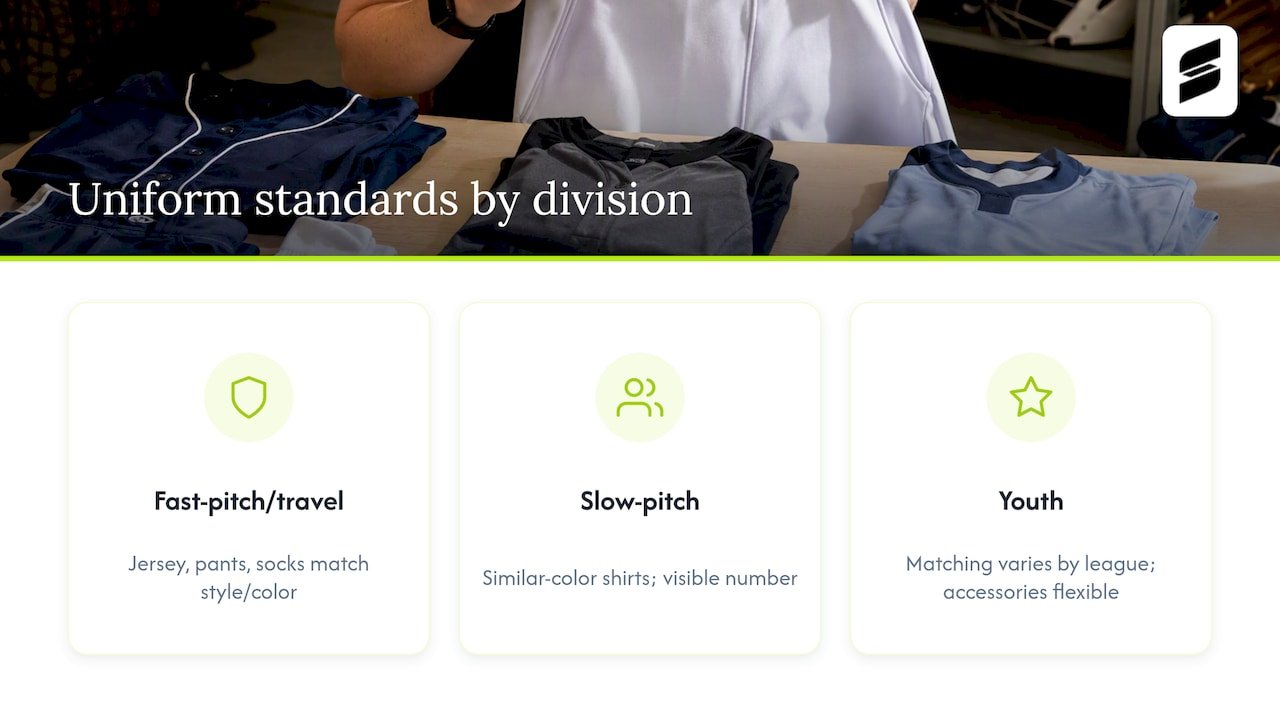
Uniform requirements shift meaningfully depending on the division and competitive level. Fast-pitch and competitive travel divisions generally hold to the strict identical-style-and-color standard across jersey, pants, and socks, with closer attention to logo size and number visibility given the higher level of officiating scrutiny.
Recreational slow-pitch classes, by contrast, operate under a lighter standard. As covered earlier, divisions like Women’s Open/C/D/E Rec and Coed C/D/E Rec only need shirts similar in color with a visible number, a rule built for leagues where full uniform sets aren’t always practical or affordable for every player.
Youth divisions often sit somewhere in between, with many leagues adopting the competitive matching standard even at younger ages to build consistent team identity, while still allowing more flexibility around accessory colors than college or elite travel ball. Coaches moving a team up a division, or players transitioning from recreational to competitive play, should confirm which standard applies rather than assuming continuity from one season or division to the next.
Rules Exist for Safety, Not to Police Fit
The uniform rules read as strict on paper, but their intent is narrower than it looks: keep teams identifiable, keep players safe, and keep the game fair. A pant riding up during a steal isn’t a violation by itself, and treating it like one misses the point.
The more useful habit is proofing designs and ordering a sample before a full team order ships. That single step catches fit problems early and keeps the focus where it belongs, on the game instead of a wardrobe malfunction.
— Agha
Get Compliant Softball Uniforms Built for Your Team
Once the rules are clear, the next step is ordering a uniform set that holds up to them without a mid-season scramble. Our custom softball uniforms are built with matching color and style across the full roster from the first sample, and our design team works directly with coaches through unlimited revisions until number placement, pant length, and color all check out before production.
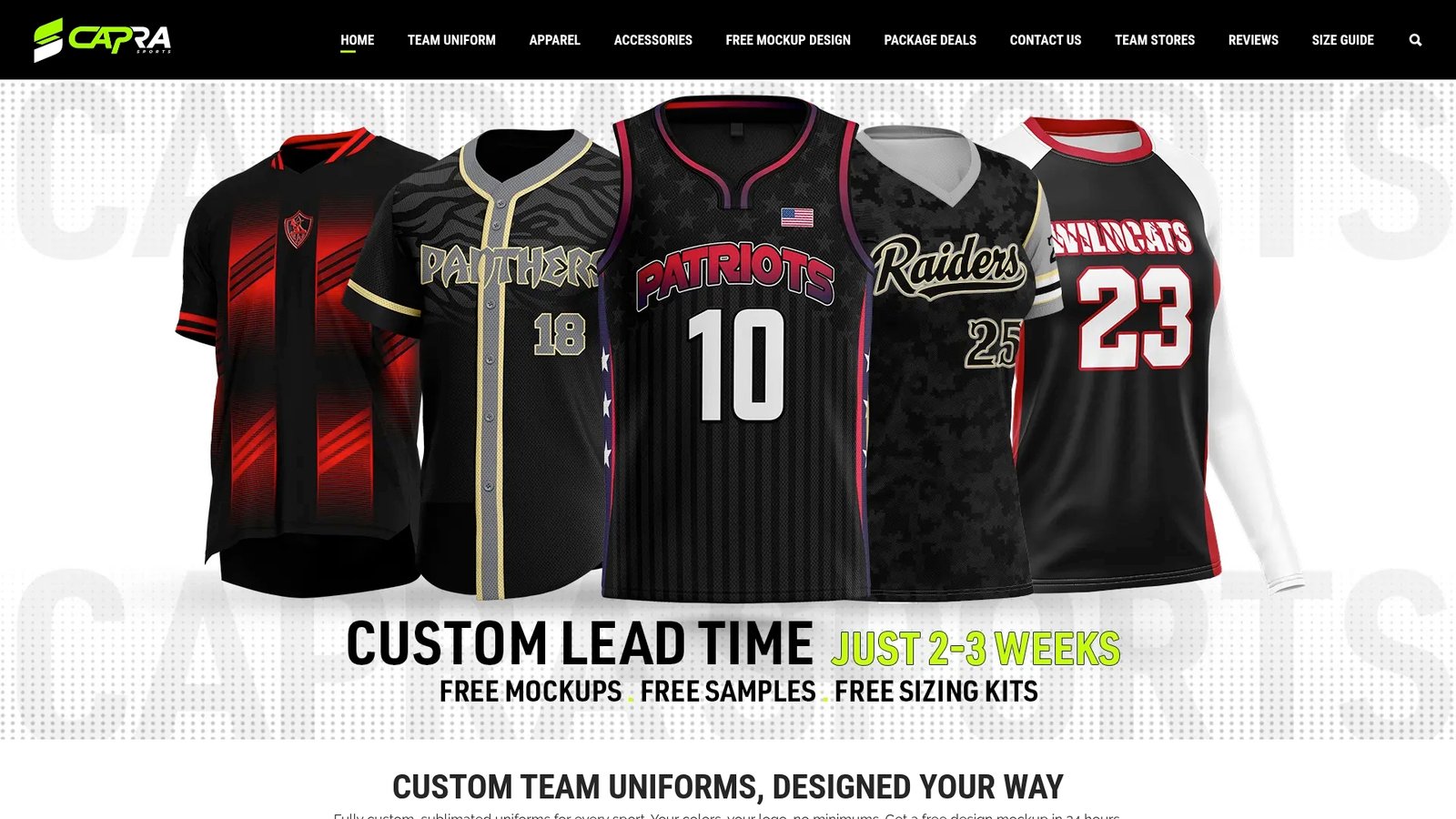
Every order includes a free sizing sample, so a coach can confirm fit on an actual player before committing to the full team set, which is exactly the step that prevents pants-riding-up complaints later in the season. Mockup turnaround is 24 hours, so adjustments to logo size or number placement don’t stall an order.
If your team is also shopping other sports, we carry the same sample-first process across basketball, baseball, and football uniforms. For softball specifically, start with our softball uniform page to request a mockup and sample for your roster.
FAQ
Is there professional softball in the United States?
Yes, professional women’s softball leagues operate in the United States, separate from the amateur and youth divisions that USA Softball’s uniform rules primarily govern. The uniform rules covered in this guide apply to USA Softball-sanctioned amateur, youth, and recreational play rather than professional league competition.
What are the pitching rules in USA Softball?
USA Softball’s pitching rules cover pitcher positioning, delivery style, and legal motion, and they’re detailed separately from uniform regulations in the official rulebook. Teams should check the current USA Softball rulebook for the specific pitching distance and delivery requirements that apply to their division.
Can the DP and Flex both play defense in the same game?
Yes, the designated player (DP) and Flex position are built to allow both roster spots to participate defensively under USA Softball’s lineup rules, though the specific substitution mechanics depend on the division’s rule set. This is a lineup and substitution rule rather than a uniform requirement, so it’s covered separately in the rulebook’s playing rules section.
Do softball players have to wear team uniforms?
Yes, USA Softball requires players on a team to wear uniforms identical in style and color for the jersey, pants or shorts, and socks, according to 2026 rule updates. Recreational slow-pitch classes have a lighter standard, requiring only shirts similar in color with a visible number.
How much do custom softball uniforms cost?
Pricing for custom softball uniforms is available on request through our softball product page, since exact costs depend on the specific design, quantities, and options a team selects. Coaches can request a mockup and sample to see fit and pricing details before committing to a full team order.
Sources
- 2026 USA NFHS and NCAA Rule Changes (USA Softball)
- 2024 USA Softball Rule Changes with Comments (Nov 2, 2023)