
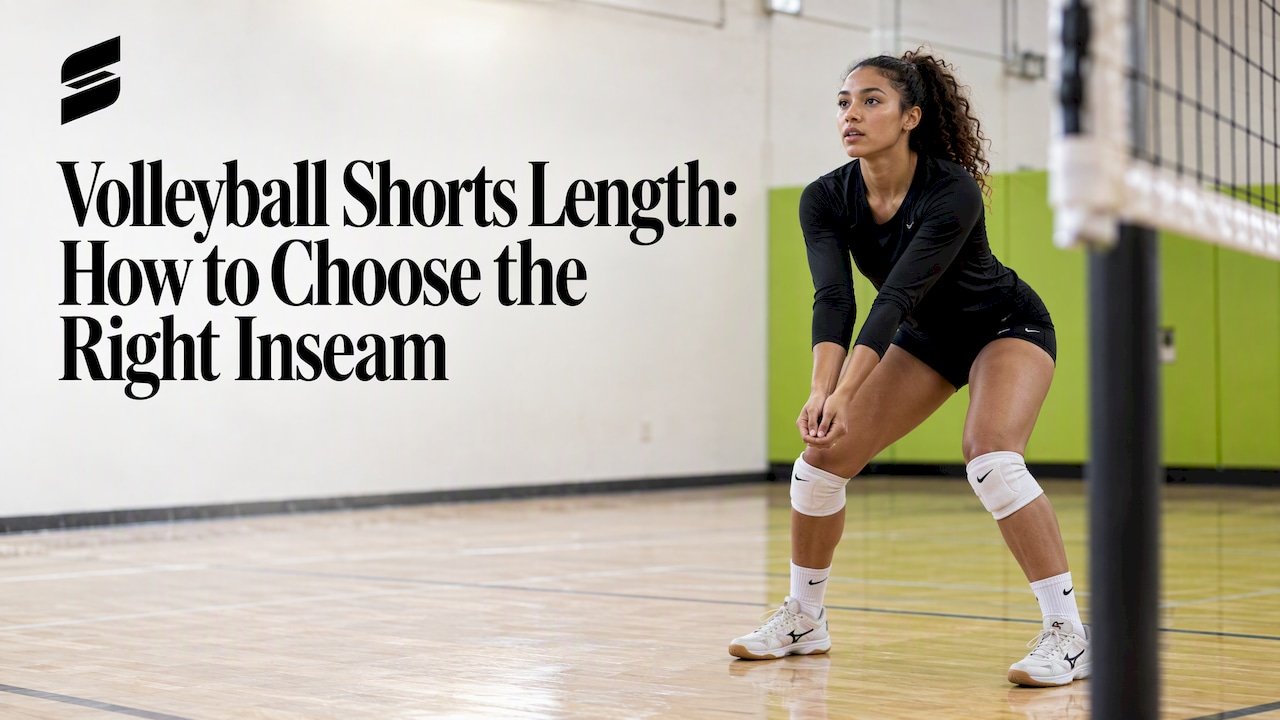
Volleyball Shorts Length: How to Choose the Right Inseam
Volleyball shorts are usually short, and that is on purpose. The right length depends on three things: what your league allows, how the player moves, and what she feels comfortable wearing. For high school play, the national rulebook sets no required inseam. It requires that the team’s bottoms match and that any visible undergarment follow a color rule. So the real decision falls to you and your coach.
This guide explains what inseam means, which lengths players commonly choose, what the rules say, and how a team can settle on one length without arguments. We also cover how to measure, what matters more than the number on the tag, and how to order uniforms when players want different coverage.
TL;DR
- Inseam is measured along the inner leg seam from the crotch to the hem. A smaller number means a shorter short.
- The NFHS 2026-27 volleyball uniform rules do not mandate a specific inseam. They allow shorts, spandex, pants or skirts, as long as the bottoms are like-colored.
- Check your own league, club or tournament rules before ordering. Sanctioning bodies can add their own requirements.
- Fit, waistband and seam construction affect comfort more than a half inch of length.
- Order a sizing sample before you commit a full team order.
Table of Contents
- What inseam means and why it matters
- What the rules actually say
- Typical lengths by player and level
- Length is only one part of fit
- How to measure inseam for an existing pair
- How a team picks one length
- Handling different comfort levels
- Perspective: what we see when teams order
- Ordering custom volleyball uniforms from Capra Sports
- Pre-order checklist for coaches and athletic directors
- FAQ
- Sources
What inseam means and why it matters
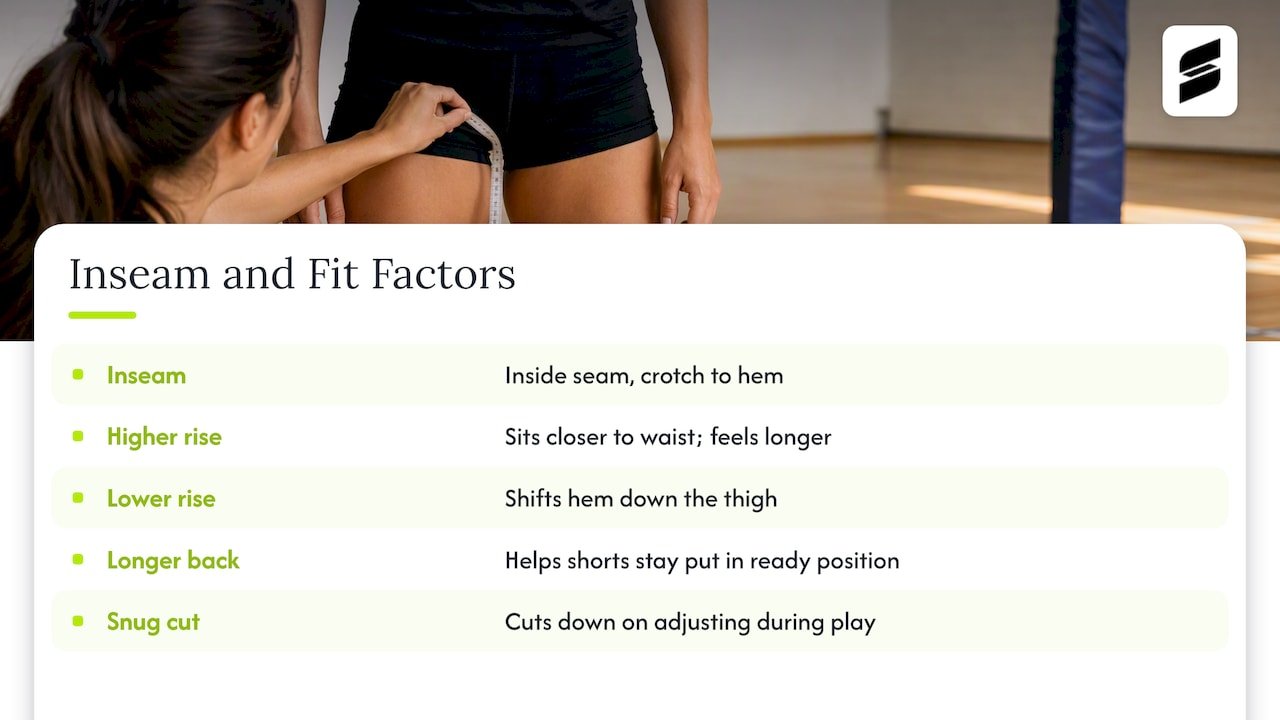
Inseam is the length of the seam on the inside of the leg, from the crotch to the bottom hem. It is the number most product pages use, and it is the one that matters for volleyball because the sport is played low, with a lot of jumping, diving and sliding.
Two shorts with the same listed inseam can look different on the court. A higher rise sits closer to the waist and makes the short feel longer. A lower rise shifts the hem down the thigh. Some cuts are also slightly longer at the back than the front, which helps the short stay put when a player drops into a ready position. So treat the inseam as a starting point, not a promise.
There is also a practical reason the cut is so close and short. Loose fabric tends to ride up, bunch or twist during serving, digging and blocking. A snug, short bottom cuts down on the constant adjusting that pulls a player’s attention away from the rally. That comfort argument is the one most coaches and players cite, and it holds up better than any appearance-based reasoning.
What the rules actually say
For US high school volleyball, the governing document is the NFHS uniform rules. For 2026-27, there is no mandated inseam. Teams may wear shorts, spandex, pants or skirts, provided the bottoms are like-colored across the team.
The same rules also cover what shows beneath the bottoms. Visible undergarments must be unadorned and solid-colored, either matching the uniform bottom or solid black, white or gray. All team members, other than the libero, must wear the same color undergarment. Uniforms must be worn as the manufacturer intended and cannot include hard or unyielding items.
Three takeaways for a coach or athletic director:
- No national high school rule says your shorts must be 2, 3 or 5 inches. Do not let a vendor or another parent tell you otherwise.
- The matching rule applies to color, so a mixed set of lengths in one color is generally not what the rulebook is concerned with. Your state association and local officials are the final word, so confirm with them.
- Club and tournament organizers, college conferences and rec leagues write their own rules. If you play outside the high school season, ask the organizer in writing before you order.
If you coach a school team, your state association adopts the NFHS code with its own changes. A short email to your athletic director or state association before ordering costs nothing and avoids reordering.
Typical lengths by player and level
There is no single standard. Instead there are ranges that players tend to choose, and the sensible approach is to match the range to the player.
Women’s and girls’ spandex
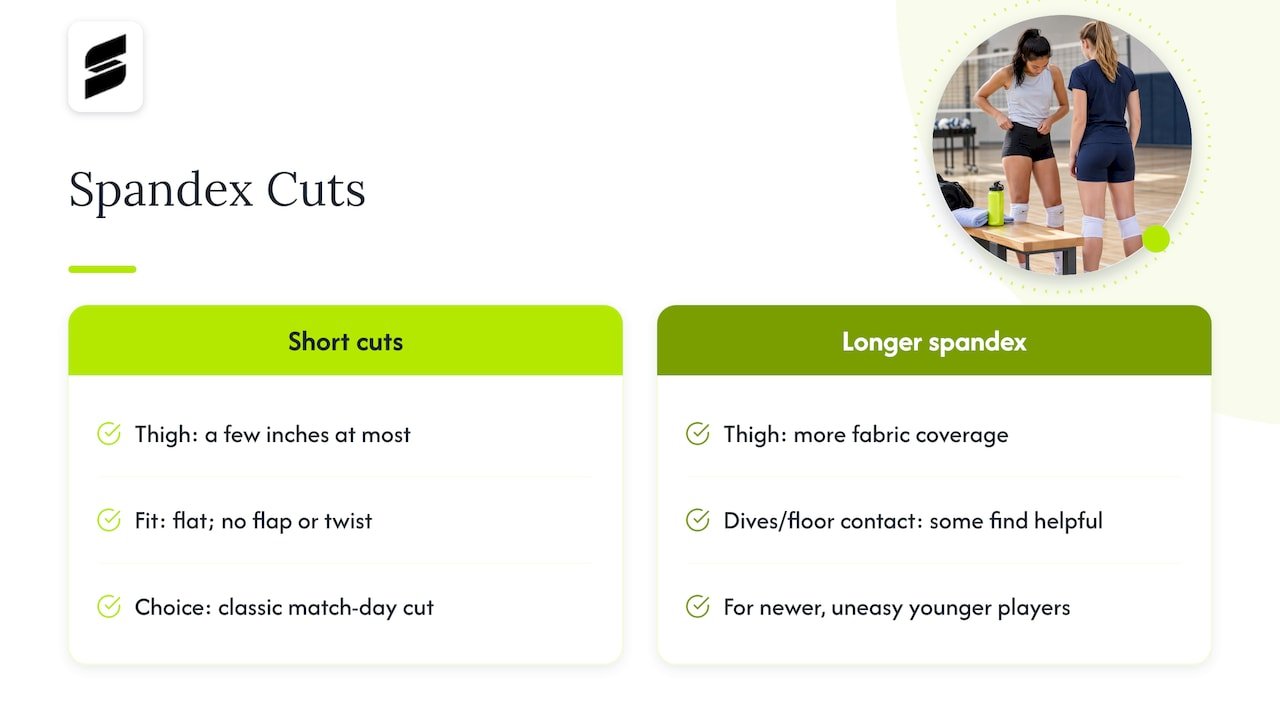
The shortest cuts are the classic match-day choice for many women’s and girls’ players, usually landing a few inches down the thigh at most. Compression spandex stays flat against the leg, so even a very short inseam does not flap or twist.
Some players prefer a little more coverage. Longer spandex gives more fabric on the thigh, which some players find helpful for dives and floor contact. It also helps younger players who are new to the sport and still uneasy about the traditional look.
Youth players
For younger players, comfort and confidence come first. A modest inseam, with a waistband that does not dig, is a reasonable default. Make sure it is also one the player will actually wear for an entire tournament weekend. A player who tugs at her shorts between points is the exact problem the short cut is designed to avoid.
Men’s and boys’ volleyball
Men typically wear a longer, looser short than women’s spandex. It still should not be baggy. Excess fabric can catch on the net, the antenna or the floor, and a heavy, wet short slows a player down in a long match. Lightweight, moisture-wicking synthetic fabric is the common choice. Measure a candidate short against the player’s knee. The hem should sit above it so that it never interferes with the jump or landing.
Beach and recreational play
Beach and casual rec play is looser on both rules and style. Players there often choose based on sun, sand and comfort. If your adult rec league has no written uniform rule, a team vote works fine, as long as the color matches.
Length is only one part of fit
If a short fits badly, changing the inseam by half an inch rarely fixes it. These are the things that decide whether a short stays in place.
- Waistband. A wide, flat waistband spreads pressure and resists digging in. A thin elastic band tends to roll or leave marks after a long day of matches.
- Gusset and seams. A flatlock gusset and flat seams cut friction and chafing across a long tournament. Run a hand along the inside of any sample to feel for raised stitching.
- Rise. A higher rise holds the short in place when a player drops low. A lower rise feels shorter and can slide.
- Back versus front length. Some cuts run slightly longer at the back to help the short stay in place in a low defensive stance.
- Fabric stretch and recovery. Fabric that stretches and returns to shape keeps its fit after dozens of washes.
How to measure inseam for an existing pair
If you already own a pair your player loves, measure it and use it as the target.
- Lay the short flat on a table, smoothing out wrinkles without stretching the fabric.
- Find the crotch seam, where the two legs meet.
- Run a soft tape along the inside leg seam to the bottom hem.
- Write the number down to the nearest quarter inch.
- Repeat for the front and the back if the short looks longer on one side.
If you are measuring the player instead, have her stand straight in athletic shoes, measure from the upper inner thigh to where she wants the hem to land, and compare that against the pair’s measured inseam. Pair that with her waist and hip measurements, since a short that fits the hip but not the waist will slide. Our volleyball uniform size chart lays out the body measurements we use for sizing.
How a team picks one length
Teams often argue about shorts length more than about anything else on the uniform. A short process keeps it civil.
- Confirm the rules. Get your league, state association or tournament policy in writing.
- Set the baseline. Pick one cut and one color for the whole roster so the bottoms match.
- Collect measurements. Ask every player, with a parent’s help for younger ones, to measure a pair she likes.
- Test a sample. Have two or three players of different sizes wear a sample through a full practice, including serving, diving and blocking drills.
- Decide and document. Share the final spec with parents before ordering, so there are no surprises at pickup.
A useful test: the player should be able to drop into a deep defensive position, reach and recover without touching the waistband or the hem. If she does, the length works.
Handling different comfort levels
A roster is rarely uniform in what players want. A few approaches work well.
- One cut, with options on coverage. Because the rulebook cares about matching color for the team, some programs offer a slightly longer cut in the same color for players who ask. Confirm with your state association or league that this is acceptable before ordering.
- Compression layer for coverage. Visible undergarments must be solid and follow the color rule, so a plain black, white or gray layer, or one matching the bottom, is the safe route. The libero is treated separately in the rules.
- Let the athlete decide. Players who feel confident play better. A coach who handles this respectfully gets a more committed team.
Perspective: what we see when teams order
At Capra Sports, we build custom sublimated volleyball uniforms for teams, and shorts length comes up in many conversations. Our experience is that the best outcome comes from treating the bottoms as part of a complete design rather than an afterthought. Colors, panels and trim should be planned with the jersey, so the team looks like one unit from the first serve.
We also push every team toward a fit check before the full order. That is why we offer one sizing sample at no extra charge, and why you can see a free design mockup, returned within 24 hours, before you approve anything. A sample shows you how the cut moves on a real player and how the waistband sits, which no spec sheet can do. Our team orders start at a 10-set minimum.
One piece of practical advice from us: decide the length and the matching rules first, then do the design. Reversing that order is how teams end up with a beautiful mockup that a league official then questions.
— Agha
Ordering custom volleyball uniforms from Capra Sports
If your team is ready to move from shorts-length debate to an actual order, start with our custom volleyball uniforms for teams. Our professional designers work with you on the layout, you get a free mockup in 24 hours, and revisions continue until the design is right. You can also browse a volleyball uniform set or a short sleeve volleyball uniform to see how a full set comes together. For costs by sport, see our pricing page. Volleyball uniform pricing is listed as [PRICE TBD] here, so check that page for the current per-piece figures.
Teams that need a warm-up layer can add a volleyball warmup jacket, and players who want extra forearm protection can look at padded arm sleeves.
Pre-order checklist for coaches and athletic directors
- Written confirmation of your league or association’s uniform rules.
- Final bottom color, and the undergarment color the team will use.
- Target inseam, measured from a pair the players already like.
- Waist and hip measurements for every player, checked against the size chart.
- A sizing sample tried on at least two body types.
- Approved mockup, including numbers and names, from the designer.
- A parent communication with the final spec and the order deadline.
FAQ
What is the standard length for volleyball shorts?
There is no single standard. Women’s and girls’ spandex generally runs short, men’s shorts run longer and looser, and the best length is the one that stays put when the player is in a low stance. High school rules do not set one. Choose by comfort and by your league’s written rules.
Does NFHS require a specific inseam?
No. The 2026-27 NFHS volleyball uniform rules say there is no mandated inseam and allow shorts, spandex, pants or skirts, provided the team’s bottoms are like-colored. Your state association can add its own requirements, so confirm with it before you order.
Can players wear something under their shorts?
Yes, with limits. Under NFHS rules, any visible undergarment must be unadorned and solid-colored, matching the uniform bottom or solid black, white or gray. All team members except the libero must wear the same color undergarment.
How do I know which size and length to order?
Measure waist and hips, check the numbers against a size chart, and try a sample before ordering the whole team. We include one sizing sample at no extra charge with team orders, so you can test the fit first.