

The Best Fabric for Jerseys: What Actually Performs
For most sports jerseys, polyester-based performance knits, think polyester mesh, interlock, and polyester-spandex blends, are the industry standard, and for good reason. They pull sweat away from skin fast, hold up through hundreds of wash cycles, and take dye-sublimation printing better than any other fiber family on the market.
Three things drive that recommendation:
- Moisture management: polyester fibers absorb almost no water themselves, so sweat moves to the fabric surface and evaporates instead of soaking in.
- Durability: polyester resists stretching out of shape, pilling, and UV breakdown far longer than natural fibers under game-day abuse.
- Print compatibility: polyester’s molecular structure bonds permanently with sublimation dye, which is why it’s the default choice across team sports.
That said, “polyester” isn’t a single answer. You still have to pick the fiber blend, the knit construction, and confirm the fabric matches your decoration method. Basketball wants more crosswise stretch than soccer does. A baseball jersey needs different abrasion resistance than a running singlet. The right call depends on the sport, and that’s what the rest of this guide walks through.
Key Takeaways
Polyester-based performance knits win on moisture management, durability, and sublimation compatibility, but the right construction and stretch direction still depend on the sport.
| Point | Details |
|---|---|
| Choose polyester first | Polyester mesh, interlock, or polyester-spandex blends dominate performance jerseys for wicking and print quality. |
| Match construction to sport | Interlock suits basketball’s four-way movement; lightweight mesh suits soccer’s breathability needs. |
| Confirm sublimation compatibility | Polyester-rich fabric is required for full-color, fade-resistant sublimation printing. |
| Test before ordering | Run fold stretch tests and a small wash-cycle sample before approving a full team order. |
| Ask for engineered finishes | Built-in wicking and anti-odor treatments outlast topical coatings that wash out over time. |
Table of Contents
- What Fiber Types Work Best for Sports Jerseys?
- What Do Jersey Knit Constructions Mean?
- Which Fabric Suits Which Sport?
- Which Printing Methods Work With Which Fabrics?
- How Should You Wash and Maintain Jersey Fabric?
- How Capra Sports Applies This to Real Team Orders
- What New Fabric Technologies Matter for Jerseys?
- What Actually Matters When You Choose Jersey Fabric
- Sources
- FAQ
What Fiber Types Work Best for Sports Jerseys?
Fiber content determines almost everything else, wicking speed, stretch, print quality, and how the jersey feels after 20 washes. Here’s how the main options actually compare.
Polyester: the default for a reason
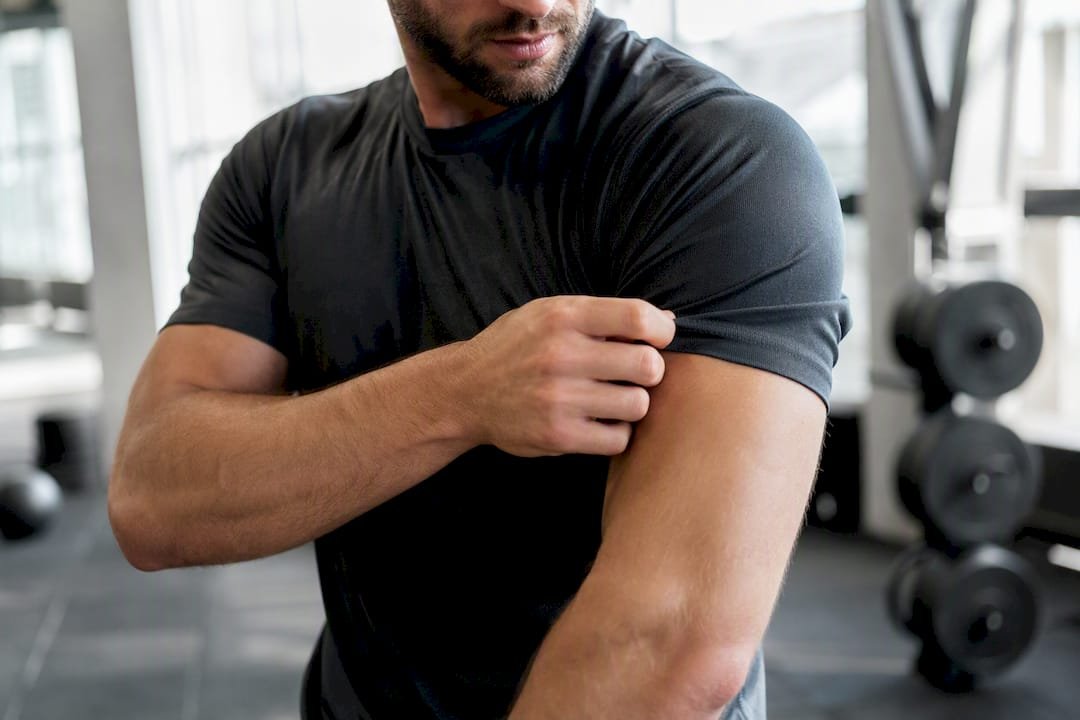
Polyester dominates performance apparel because it checks every box teams care about. It’s hydrophobic, meaning individual fibers barely absorb water, so moisture gets pushed to the outer surface where it evaporates instead of weighing the fabric down. That same low water pickup is what makes polyester dye deep and permanent during sublimation printing, an outcome cotton or nylon can’t match. Polyester also resists UV degradation and mechanical wear, so a polyester jersey holds its shape and color through a full season of practices, games, and washes.
Manufacturer-side sourcing guides consistently point to polyester mesh, interlock, and polyester-spandex blends as the standard picks for team sports, and that consensus isn’t just tradition. It reflects decades of trial and error with fibers that failed under repeated laundering or faded under stadium lights.
Recycled polyester: closing the performance gap
Recycled polyester (often labeled rPET, made from post-consumer plastic bottles or textile waste) has come a long way from its early reputation as a weaker substitute. Modern rPET can deliver near-parity with virgin polyester on both wicking and durability, provided the mill controls fiber tenacity and dye uptake carefully during processing. The trade-off worth knowing: rPET sometimes takes sublimation dye slightly differently than virgin polyester, so color matching across a large team order needs a bit more quality control. If sustainability matters to your program, ask your supplier directly whether their recycled poly has been validated for colorfastness at scale, not just cost.
Nylon: smooth, tough, but less common
Nylon shows up less often in jerseys but earns its place in specific spots. It has a smoother hand feel than polyester and better abrasion resistance in some constructions, which is why you’ll sometimes see it in high-wear zones or performance base layers. It’s less common as the primary jersey fabric, mostly because nylon doesn’t sublimate as cleanly as polyester and tends to cost more per yard.
Why cotton falls short for performance jerseys
Cotton feels great off the shelf, but it’s the wrong choice for anything played in. Cotton fibers absorb water rather than repelling it, which means a cotton jersey gets heavy and stays wet through an entire game. It also dries slowly between wears, which becomes a real problem for teams practicing daily. Cotton has its place in casual fan apparel, but for game jerseys, it’s a liability.
Elastane: small percentage, big difference
That small addition gives the fabric stretch and recovery, letting it move with an athlete’s body and snap back to shape instead of sagging after a season. Elastane at this percentage doesn’t meaningfully interfere with sublimation printing, which is why it’s become standard in fitted jerseys for basketball, volleyball, and other high-mobility sports.
What Do Jersey Knit Constructions Mean?
Fiber content is half the equation. The other half is how that fiber gets knitted into fabric, and that decision shapes ventilation, opacity, stretch, and how crisp your printed graphics look.
Single jersey is the simplest knit: one set of needles, one layer of loops. It’s lightweight, has natural stretch, and tends to curl at cut edges, which is why it’s usually paired with binding or seaming at the collar and sleeves. According to the Wikipedia entry on jersey fabric), the construction dates back to hand-knit wool garments and now spans everything from cotton T-shirts to synthetic athletic wear.
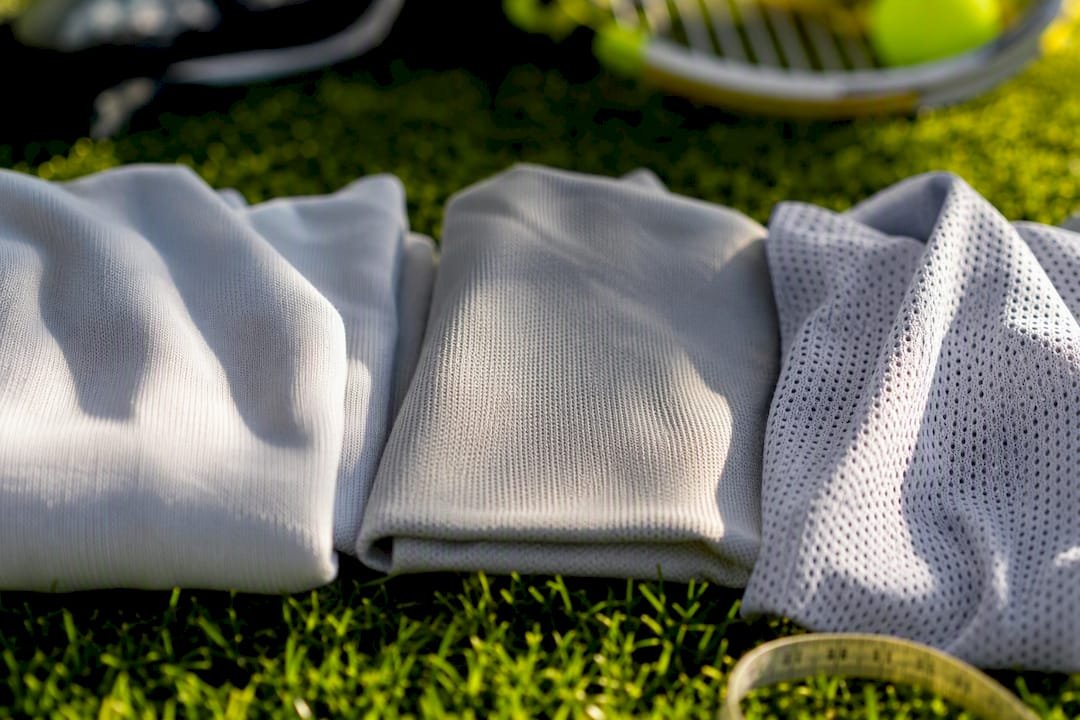
Double knit, or interlock, uses two sets of needles to interlock two layers of loops into one thicker, more stable fabric. Interlock doesn’t curl at the edges, holds its shape better under stress, and provides a smoother, more opaque surface, which is exactly why it’s a favorite for sublimated team jerseys where sharp graphics matter.
Mesh and micro-mesh are open, ventilated constructions built for airflow. Mesh trades some opacity for breathability, which is why you’ll often see it as underarm panels or side inserts rather than the entire jersey body. Micro-mesh tightens that weave slightly, balancing ventilation against enough opacity to keep the jersey from being see-through under stadium lights.
Pique is a textured knit with a slightly raised surface, historically associated with polo shirts but occasionally used in jersey side panels for its structured feel and durability.
A few practical points worth knowing before you order fabric:
- GSM (grams per square meter) is the weight metric suppliers use on spec sheets; lighter jerseys with lower GSM tend to suit running and soccer, while heavier weights favor football and baseball.
- Ask for GSM alongside a physical swatch. Two fabrics at the same GSM can feel completely different depending on fiber and knit.
- Stretch is often anisotropic, meaning it stretches more in one direction than the other. That distinction matters more than most buyers realize.
Pro Tip: Pull a fabric swatch both lengthwise and widthwise before approving it. If it stretches noticeably more in one direction, note which way, because that orientation needs to align with how the athlete’s body moves in that sport.
Which Fabric Suits Which Sport?
Fabric choice isn’t one-size-fits-all across sports. The movement patterns, contact level, and climate of each sport point toward different fiber and construction choices, and getting this wrong shows up fast, either as a jersey that rips at the seams or one that overheats a player before halftime.
- Basketball demands wide-range motion in every direction, so widthwise (crosswise) stretch matters as much as length. Interlock knits or polyester-spandex blends with four-way stretch let players extend for a rebound without the fabric fighting them.
- Soccer and football (the international kind) call for light weight and maximum breathability over 90 minutes of continuous running. Single jersey or lightweight mesh with strong longitudinal stability keeps the jersey from sagging during sprints while staying cool.
- American football takes heavy contact, so durability outranks lightness. Heavier GSM interlock with reinforced stitching handles grabbing, pulling, and turf abrasion far better than a lightweight knit built for running sports.
- Baseball and softball involve sliding into bases, which means abrasion resistance and opacity matter more than breathability. Some programs add woven panels in high-wear zones like the front placket for extra structure.
- Running and endurance sports prioritize heat dissipation above everything else. Ultra-light micro-mesh with aggressive moisture migration keeps runners from overheating on long efforts where every ounce of extra weight counts.
Whatever sport you’re outfitting, a few validation steps catch problems before a full team order ships:
- Fold stretch test: fold the swatch and pull gently in both directions to confirm the stretch orientation matches the sport’s movement demands.
- Sleeve stretch check: if the jersey has sleeves, test that section separately since sleeve fabric sometimes differs from the body panel.
- Small-sample wash test: run one sample jersey through five to ten wash cycles before committing to a full order, watching for color shift, pilling, or seam strain.
Suppliers with technical sourcing experience consistently recommend testing directional stretch rather than assuming isotropy, since a fabric that performs well in one sport can underperform badly in another simply because of how it’s oriented on the roll.
Which Printing Methods Work With Which Fabrics?
Your fabric choice and your decoration method are locked together, get one wrong and the other fails no matter how good it looks on paper.
Dye-sublimation printing requires polyester-rich fabric, ideally 100% polyester or very close to it. The process turns solid dye into gas under heat, which bonds directly into the polyester fiber itself rather than sitting on top of it. That’s why sublimated graphics don’t crack, peel, or fade the way surface-applied prints eventually do, and why it can cover the entire jersey in full color without adding weight or stiffness.
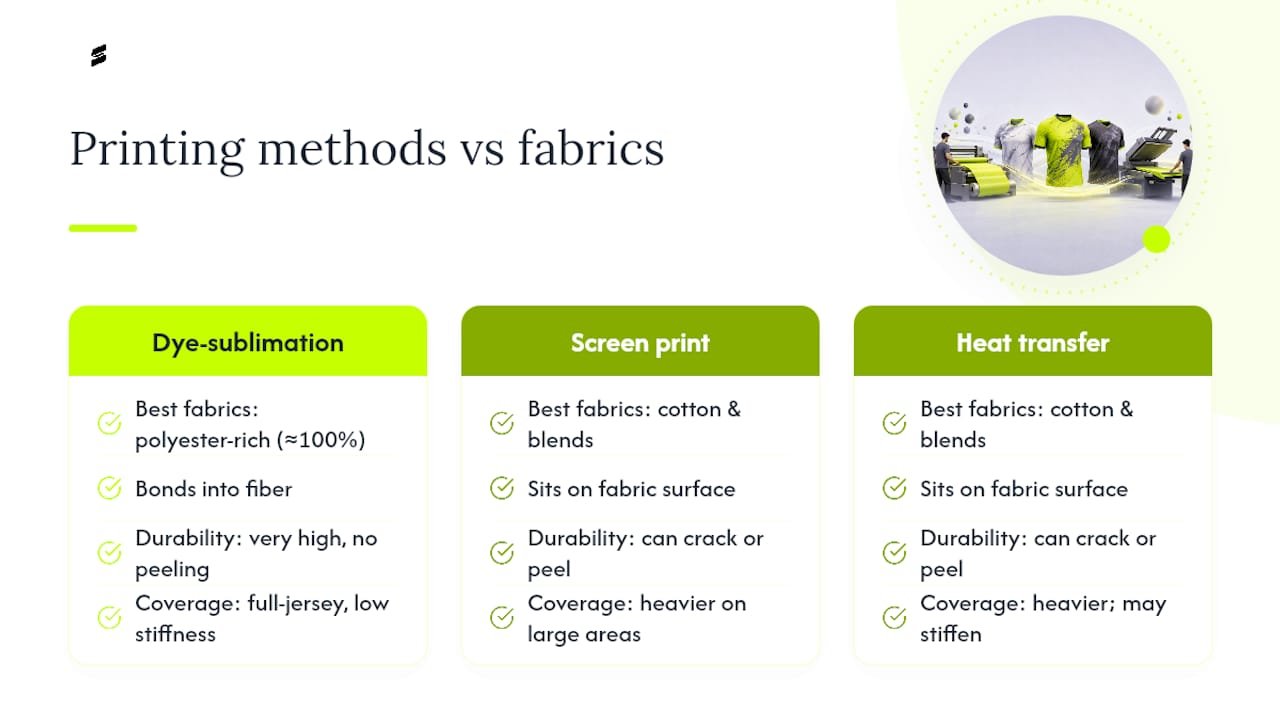
Screen printing and heat transfer work on a wider range of blends, including cotton and cotton-poly mixes, but they come with real limits. Both methods sit on top of the fabric rather than bonding into it, so they can crack over time and feel heavier against the skin, especially on large graphic areas. They’re a reasonable choice for simple logos on lower-budget orders, but comparing print methods in detail before committing saves headaches later, particularly for teams weighing cost against longevity.
Knit texture also affects print sharpness. Tighter constructions like interlock hold fine detail and crisp edges better than open mesh, where ink or dye can migrate slightly into the gaps between loops. Before finalizing any order, request a printed sample and run it through several wash and dry cycles to confirm colorfastness. Comparing decoration methods against your fabric choice up front avoids a costly reprint down the line.
Pro Tip: Never approve a full team order based on a digital mockup alone. Ask for one physical printed sample, wash it, and check the colors again before signing off.
How Should You Wash and Maintain Jersey Fabric?
Polyester and sublimated jerseys hold up well, but only with the right care. Wash them in cold water on a gentle cycle, skip fabric softener (it coats fibers and blocks moisture-wicking), and air dry instead of using high heat, which can degrade both the fabric and the print over time.
Not all wicking finishes are created equal. Topical hydrophilic coatings applied after knitting tend to wash out after repeated industrial laundering, while engineered fibers with built-in wicking channels retain that performance for the life of the garment. That distinction is worth asking your supplier about directly.
Useful tests to request from any fabric supplier:
- AATCC moisture management tests, which measure how fast and how far moisture spreads across the fabric.
- Elmendorf tear or ASTM tear strength tests, which reveal how the fabric holds up against ripping under stress, a stronger durability signal than GSM alone.
- Pilling resistance tests, which predict how the surface will look after a season of friction from pads, bags, and other jerseys.
A well-made polyester jersey with proper care typically lasts multiple seasons before colors or stretch noticeably decline, though heavy-contact sports shorten that window.
How Capra Sports Applies This to Real Team Orders
Knowing the theory is one thing. Getting a jersey that actually performs on a schedule that works for your season is another problem entirely, and it’s the one Caprasport was built to solve.
Every uniform Caprasport produces uses sublimated, polyester-based performance fabric matched to the sport it’s built for: interlock and stretch blends for basketball, lighter mesh constructions for soccer, heavier durable knits for football. There’s no minimum order quantity, which means a 10-player rec league team gets the same fabric quality as a 40-player varsity program.
Manufacturer sourcing guidance stresses that short lead times and sample programs matter as much as the fabric spec sheet itself for teams ordering on a season deadline.
That’s exactly why Caprasport builds free samples and rapid mockups into every order, so coaches and equipment managers can physically check stretch direction, weight, and print quality before committing budget to a full roster.
Pro Tip: Request a free sample before your season deadline, not during it. Fabric approval takes days; reprints take weeks.
Here’s the practical path from research to a jersey in hand:
- Request a free sample in the fabric and construction that fits your sport.
- Run the fold and sleeve stretch test yourself before approving anything.
- Confirm the fabric is sublimation-compatible if you want full-color, multi-panel designs.
- Approve a design mockup with a professional designer before production starts.
- Place a small pre-season run first if you’re testing a new design or fabric weight for the first time.
Pro Tip: If your team plays multiple sports across seasons, ask about fabric weight differences between a basketball uniform and a soccer jersey. The same brand name doesn’t mean the same fabric.
Direct collaboration with a designer means you’re not guessing at fit or fabric weight from a catalog photo. You’re working from a physical sample, checked against your sport’s actual demands.
What New Fabric Technologies Matter for Jerseys?
Fabric innovation in team sports has moved well past basic moisture-wicking. Anti-odor finishes, often built from silver ion or other antimicrobial treatments woven into the yarn itself, slow bacterial growth that causes lingering smell after heavy use. Like moisture-wicking treatments, finishes engineered into the fiber structure tend to outlast those sprayed on as a surface coating.
UV protection has become more common in outdoor sports fabrics, particularly for baseball, softball, and running jerseys worn for hours under direct sun. These fabrics are knitted more tightly or treated to block ultraviolet rays, reducing skin exposure without adding noticeable weight.
Four-way stretch technology has also improved significantly, with newer elastane blends recovering their shape more consistently through hundreds of wash cycles than older spandex formulations did. Some mills are also experimenting with cooling treatments that draw heat away from the skin faster than standard polyester alone, useful for high-intensity sports in warm climates.
None of these innovations replace the fundamentals covered above, fiber content, knit construction, and sport-specific fit still matter most. But they’re worth asking about if your program plays in extreme heat, needs jerseys to survive daily use without odor buildup, or competes outdoors for extended periods. A good supplier should be able to tell you plainly which of these treatments are built into the yarn versus applied afterward, since that difference determines how long the benefit actually lasts.
What Actually Matters When You Choose Jersey Fabric
Most fabric guides bury the real decision under a pile of technical specs that don’t change the outcome. The truth is simpler: get the fiber and construction right for your sport, confirm sublimation compatibility up front, and everything else, GSM, anti-odor finishes, UV treatments, is a refinement, not a foundation.
Where conventional advice falls short is treating GSM as the main durability signal. It isn’t. A heavier fabric that fails a tear strength test will rip before a lighter one engineered with the right yarn structure. Teams get fixated on weight because it’s an easy number to compare, when directional stretch and tear resistance predict real-world failure far better.
If there’s one thing to prioritize first, it’s testing a physical sample against your sport’s actual movement pattern before you commit to a full order. Mockups and spec sheets can’t tell you how a jersey moves. A sample in your hands, stretched, washed, and worn once, tells you everything the paperwork can’t.
Sources
- 4 Best Fabric for Sports Jerseys | Trusted by Apparel Brands — MFGMerch
- How to Source Fabric for Athletic Team Jerseys? — Fumao Fabric
FAQ
What type of fabric is used for jersey?
Jersey fabric is a knit construction historically made from wool and now commonly made from cotton or synthetic fibers, most often polyester, according to the canonical definition on Wikipedia. Sports jerseys specifically use polyester-based knits like mesh and interlock.
What is the best fabric for sports jerseys?
Polyester mesh, interlock, and polyester-spandex blends are the industry standard for sports jerseys because they wick moisture, resist wear, and take sublimation dye permanently. The exact choice still depends on the sport’s movement and contact demands.
What fabric is used for NFL jerseys?
Professional football jerseys use heavier-weight polyester knits, often interlock or double-knit constructions, engineered for durability under contact and reinforced at high-stress seams. The same performance principles apply at the youth and amateur level, just at a lighter weight suited to less contact.
What fabric is used for NBA jerseys?
Basketball jerseys typically use lightweight polyester-spandex blends or interlock knits that provide four-way stretch for the wide range of motion the sport demands. That same crosswise stretch requirement applies to any basketball uniform, from recreational leagues to the professional level.
Is recycled polyester as good as regular polyester for jerseys?
Recycled polyester can perform nearly identically to virgin polyester for moisture-wicking and durability when the mill controls dye uptake and fiber strength carefully. It’s worth confirming colorfastness testing with your supplier before ordering a full team run.
Ready to see how these fabric choices translate into an actual uniform for your team? Request a free custom mockup from Caprasport and get a physical sample in hand before you commit to a full order.