
3 Moves Coaches Use to Nail Football Jersey Fit, Samples and Rules
For custom team football jerseys, correct fit comes down to three moves: collect position-specific measurements (pit-to-pit chest, HPS length, sleeve length), test a free sizing sample over pads before bulk production, and lock fabric stretch, recovery, and tolerance specs into the tech pack. Skip any one of those steps and you’re guessing. Capra Sports offers a free sizing sample and a 10-set team minimum that make this approach practical for teams of any size.
TL;DR:
- Proper jersey fit requires measuring over pads and testing samples to ensure comfort, safety, and compliance during actual game conditions.
- Position-specific cuts, such as looser for linemen and narrower for skill players, are essential for optimal performance and reduced injury risk.
- Fabric stretch recovery and panel construction significantly influence how well a jersey maintains its fit through multiple washes.
- Jerseys must meet NFHS and NCAA rules, including full shoulder coverage, proper length, and unaltered fabric, to avoid penalties and safety issues.
- A sample-first workflow, including verifying measurements with actual players wearing pads, ensures correct fit before bulk production, especially for mixed rosters.
Table of Contents
- What Does Football Jersey Fit Actually Mean for Custom Teams?
- Step-by-Step Measuring Checklist for Team Fittings
- Which Jersey Cut Fits Each Position Best?
- How Fabric and Construction Choices Change the Fit
- What NFHS and NCAA Rules Say About Jersey Design
- From Measurements to Bulk Order: The Fitting Workflow
- How Should Fit Preferences Differ by Age and Gender?
- Does Jersey Fit Actually Affect Player Safety?
- How Should Teams Care for Jerseys to Preserve Fit?
- Custom vs. Off-the-Rack: Which Fits Better for a Team?
- What Coaches Get Wrong About Jersey Fit
- Get the Fit Right Before You Order in Bulk
- Sources
- FAQ
What Does Football Jersey Fit Actually Mean for Custom Teams?
When coaches search for football jersey fit, they’re rarely asking about retail fan gear off a store shelf. They mean something specific: how a sublimated, team-ordered playing jersey sits on an athlete wearing shoulder pads, moving through routes, blocks, and tackles for four quarters. That distinction matters because the sizing logic is completely different from buying a licensed jersey for game day viewing.
A jersey built for play has to account for pad bulk, range of motion at the shoulder, and the difference between a lineman’s build and a defensive back’s. The industry term for this discipline is technical apparel fit, sometimes called performance fit in manufacturer tech packs. It covers everything from panel construction to stretch recovery percentages, and it’s the standard vocabulary you’ll see in spec sheets once you start ordering from a sublimation manufacturer.
Getting it right isn’t about picking a size off a generic chart. It’s about pairing accurate body measurements with a cut suited to the player’s position, then verifying that pairing against a physical sample before committing to fifty jerseys. Teams that skip the sample step are the ones who end up with linemen who can’t raise their arms and receivers wearing jerseys with three extra inches of fabric flapping at the waist.
Step-by-Step Measuring Checklist for Team Fittings
Reliable sizing starts with a tape measure, not a guess based on a player’s shirt size from last year. Run this checklist during a team fitting session, ideally weeks before your production deadline.
- Chest, pit-to-pit. Measure straight across the chest from armpit to armpit, garment style, not around the body. This is the single most important number for jersey fit.
- Body length. Measure from the high point of the shoulder (HPS) down to where you want the hem to fall. NCAA rules require the jersey to stay tucked into the pants throughout play, so err generous rather than short.
- Shoulder width. Measure seam to seam across the back. This determines how the sleeve sits and whether the jersey rides up during arm movement.
- Sleeve length. Measure from the shoulder seam to where the sleeve should end, factoring in NFHS sleeve rules covered below.
- Neck opening. Measure around the base of the neck; leave enough room for a quick pull-over motion, especially for linemen.
- Arm circumference. Measure the bicep at its widest point, both bare and, where possible, with a shoulder pad in place.
- Waist. Measure at the point where the jersey hem will sit, accounting for girdle and pad bulk.
The critical judgment call is measuring over pads versus without them. A practical fitting session records both, but the over-pad number becomes your ordering baseline for game jerseys since that’s the condition the player will actually wear on Saturdays. Keep both figures in your spreadsheet in case you ever need a practice-only cut.
For tolerances, aim for ±1.0 inch on chest and shoulder measurements and ±0.5 inch on length and sleeve. Ask your manufacturer whether fabric is pre-shrunk; if not, request a shrinkage allowance so a jersey that fits in August still fits in November after a dozen wash cycles. Capra Sports’ football size chart is a useful cross-reference once your raw measurements are in hand.
Pro Tip: Bring two tape measures to a team fitting and split the roster in half. A 60-player varsity and JV combined session can eat an entire practice if one person measures everyone alone.
Which Jersey Cut Fits Each Position Best?
Not every player on your roster should wear the same silhouette, even if they’re wearing the identical design. Position dictates cut, and getting this wrong is one of the most common ordering mistakes teams make.
- Linemen need a looser, longer cut. Extra room through the chest and sleeve accommodates shoulder pads and repetitive arm extension without the fabric binding at the armpit during a pass block.
- Skill players (wide receivers, defensive backs, running backs) do better in an athletic or regular fit with narrower side panels. Less excess fabric means fewer grab points for a tackler, which is a real safety consideration, not just an aesthetic one.
- Quarterbacks need a balance: enough room through the shoulder for a full throwing motion, but sleeves that aren’t so loose they interfere with grip or ball security on a handoff.
- Specialists and youth players should get a growth allowance, particularly at the skill positions where roster turnover is high year over year. A youth football jersey sizing chart should build in a size of headroom that a varsity chart wouldn’t need.
As a rough conversion, a 44 inch pit-to-pit chest measurement typically maps to an adult large in most sublimated patterns, but that varies by manufacturer panel construction, so always confirm against the actual size chart rather than assuming standard retail sizing carries over.
Pro Tip: If your roster runs unusually broad across builds, from 140 pound slot receivers to 280 pound tackles, order in two distinct pattern profiles rather than forcing everyone into one grading scale. Most sublimation shops can run both patterns in the same design.
How Fabric and Construction Choices Change the Fit
Two jerseys can list the same chest measurement and still fit completely differently once you factor in fabric and panel construction. This is where a lot of buyers underspecify and then wonder why the finished product doesn’t match the sample photo.
Most performance football jerseys today use lightweight, moisture-wicking polyester blends, sometimes with an elastane component for stretch. Manufacturers increasingly add micro-ventilation or perforated zones at the underarm and back panel to improve heat dispersion during play, a design detail borrowed directly from professional uniform updates.
- Stretch and recovery. A fabric blend with 90%+ recovery after standardized wash cycles resists bagging at the elbows and waist. Ask for this figure explicitly; “stretchy” is not a spec.
- Panel count. Jerseys typically run 2 to 6 panels. More panels create a three-dimensional shape that moves with the athlete, though higher panel counts add production complexity and cost.
- Seam reinforcement. Bonded seams or coverstitch construction prevent the sleeve ripping that plagues cheaper jerseys during contact.
- Sublimation compatibility. Sublimation printing pairs naturally with multi-panel stretch fabrics because the dye becomes part of the fiber rather than sitting on top of it, so the design stays sharp even as the panel stretches during a tackle.
Professional teams treat fit and seam durability as equally important design goals, not one traded off against the other. When you write your spec sheet, include language like: “4 panel construction, 12% spandex blend, minimum 90% stretch recovery after 20 wash cycles, coverstitch shoulder and side seams.” That level of detail is what separates a jersey that fits on delivery from one that fits for three seasons.
What NFHS and NCAA Rules Say About Jersey Design
Fit isn’t just a comfort question. Both NFHS and NCAA rulebooks set hard requirements that affect how a jersey can be cut and altered, and violating them gets a player pulled from the field.
- Jerseys must fully cover the shoulder pads at all times during play.
- Jerseys must remain unaltered from the manufacturer’s original production; tear-away or structurally modified jerseys are illegal equipment.
- Jerseys must stay tucked into the pants, meeting minimum length requirements.
- Numbers must meet mandated minimum sizes and placement on both the front and back of the jersey.
- New NFHS arm sleeve specifications take effect for the 2027 season, so teams ordering ahead should confirm sleeve construction against the current timeline before locking a design.
Officials have the authority to require a jersey change before a player takes the field, and nonconforming numerals or altered jerseys can draw a penalty against the team. It’s a fixable problem if caught in warmups, and an expensive one if it isn’t.
State associations don’t always adopt NFHS changes on identical timelines, so confirm your own state’s adoption schedule and build a conservative allowance into your tech pack rather than assuming the national rule applies verbatim.
From Measurements to Bulk Order: The Fitting Workflow
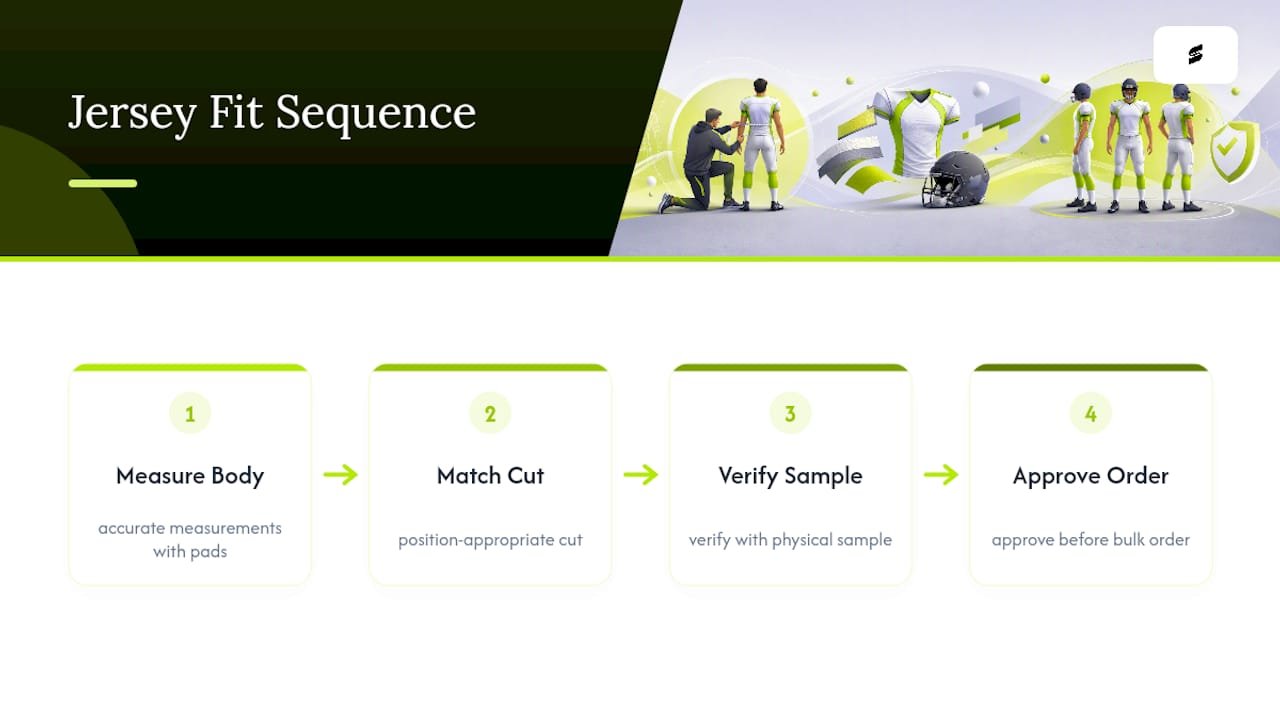
Turning raw measurements into a finished uniform order works best as a linear process, not a single email with a spreadsheet attached.
- Collect measurements using the checklist above, over pads for the game-day baseline.
- Select a pattern profile by position group, separating linemen from skill players if your roster spans a wide range of builds.
- Request and fit samples on actual players wearing pads, not just holding the jersey up to check the number.
- Review design mockups for number placement, sleeve coverage, and any compliance details flagged in your rulebook review.
- Specify tolerances and wash testing in writing, then confirm the manufacturer will hold to them.
- Approve the bulk run only after every sample has been signed off by the position groups that tested them.
A physical reference sample communicates target fit far more reliably than a measurement table alone, which is why a free sizing sample matters so much for teams ordering their first custom run. Schedule fittings at least six to eight weeks before your first game if your roster size runs wide, since sample turnaround and a possible second fitting round both eat into that window.
Pro Tip: If your size distribution is unusually wide, split your order into two shipments: one for the bulk of the roster in standard sizes, and a smaller follow-up batch for outlier builds once you’ve confirmed those specific samples fit.
How Should Fit Preferences Differ by Age and Gender?
Youth players need meaningfully more growth allowance than high school or college athletes, since a jersey ordered in August for a 12-year-old often needs to survive a growth spurt by November. Many programs build in a half size of headroom specifically for youth orders rather than sizing to the exact current measurement.
Women’s flag football and women’s tackle programs have grown quickly, and fit preferences there tend to run toward a more tailored cut through the torso without sacrificing shoulder mobility. The mistake teams make is defaulting every women’s order to a men’s pattern scaled down uniformly, which usually leaves excess fabric at the shoulder while still running tight through the hip. A better approach is requesting a pattern grading specifically built for a women’s fit rather than a scaled men’s block.
High school programs also see far more roster turnover than college programs, so many athletic directors order slightly looser than exact measurements to extend a jersey’s usable life across two or three seasons of underclassmen. College and adult recreational leagues, by contrast, can size tighter to exact current measurements since roster stability is higher and the emphasis shifts toward game-day performance over multi-year durability.
None of these are universal rules. They’re starting points that should get adjusted once you see how your specific samples perform on your specific players.
Does Jersey Fit Actually Affect Player Safety?
Yes, and this is the point most equipment managers underweight when they’re focused purely on appearance. A jersey that’s too loose creates extra fabric for an opposing tackler to grab, which changes tackling angles in ways that can increase injury risk, particularly for skill players in open-field situations.
A jersey that’s too tight creates a different problem: restricted range of motion. A quarterback whose sleeve binds at the shoulder during a throwing motion isn’t just performing worse; he’s more likely to compensate with an unnatural motion that stresses the shoulder joint over a season of reps. Linemen in jerseys sized too narrow through the chest report the same compensation pattern in blocking stance, which over time contributes to fatigue-related injury risk during the fourth quarter of physical games.
Coverage matters too. NCAA and NFHS rules requiring full shoulder pad coverage exist specifically because exposed pad edges create a sharper contact surface during collisions. A jersey that rides up during play, because it was ordered too short or without enough growth allowance, can expose that edge mid-game without anyone noticing until it’s already happened.
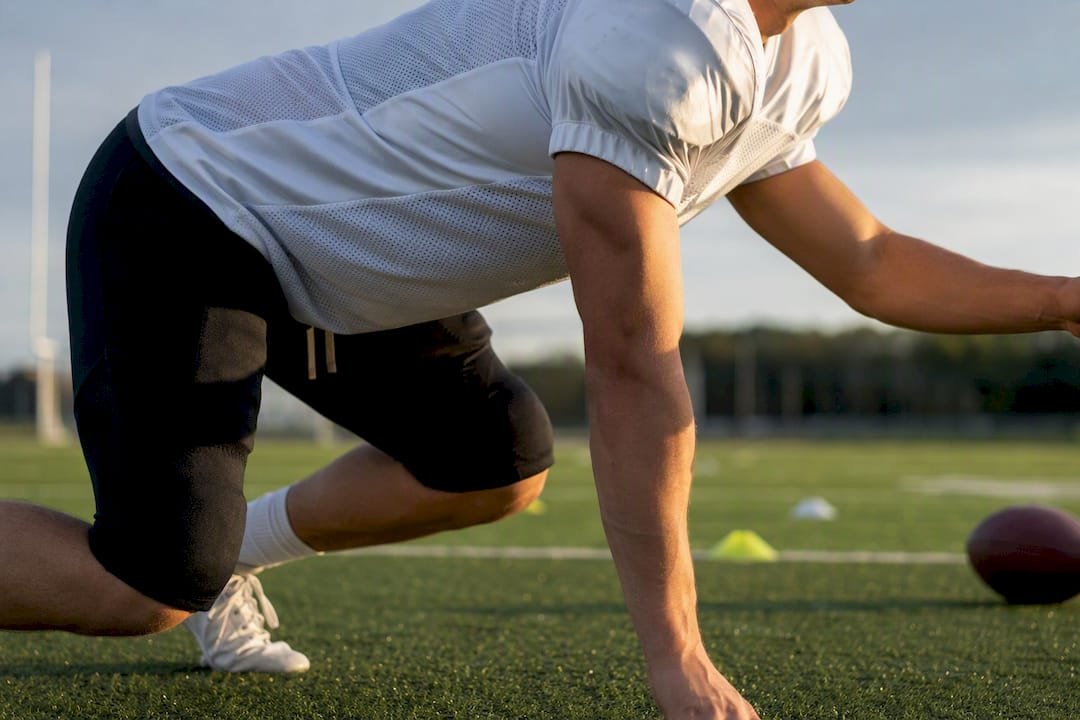
The fix isn’t complicated: fit over pads, not without them, and test the sample through actual football movements, not just a standing try-on. A jersey that looks correct standing still can bind completely differently once a player drops into a three-point stance or extends for a tackle.
How Should Teams Care for Jerseys to Preserve Fit?
Fit doesn’t stay fixed the moment a jersey leaves the factory. How a team washes and dries its uniforms over a season determines whether that fit holds through week twelve or degrades by week four.
Cold water washing is the standard recommendation for sublimated performance fabric, since heat is the primary driver of shrinkage in polyester and elastane blends. Machine drying on high heat is the single fastest way to shrink a jersey out of its intended fit over a season of weekly washes. Air drying or low-heat tumble drying preserves both the stretch recovery and the printed design far better than a standard high-heat cycle.
Equipment managers should also avoid fabric softener on sublimated jerseys, since it can degrade the moisture-wicking finish over repeated washes, changing how the fabric handles sweat and, indirectly, how it fits against the skin during play. Turning jerseys inside out before washing reduces abrasion on the printed surface and on any seam reinforcement at the shoulders and sides.
Building a simple team laundry protocol, cold wash, inside out, low-heat dry, no fabric softener, does more to preserve fit across a season than any single purchasing decision. It’s a five-minute conversation with equipment staff that prevents a season’s worth of complaints about jerseys “shrinking weird.”
Custom vs. Off-the-Rack: Which Fits Better for a Team?
Off-the-rack jerseys are built to a generic size run, usually small through 4XL, with no accommodation for position-specific builds or team-specific measurements. The appeal is speed and lower upfront research: you order a size, it arrives, done. The tradeoff is that a generic large fits no player on your roster particularly well; it’s a compromise fit averaged across a population that doesn’t match your actual team.
Custom team jerseys, ordered through a sublimation process with position-based sizing and sample fitting, solve that averaging problem directly. The tradeoff runs the other direction: custom orders require more upfront coordination, a fitting session, sample review, and a longer production timeline than pulling stock sizes off a shelf.
For most programs, the calculation favors custom once you factor in the safety and performance costs of a poor generic fit, loose fabric creating tackle risk, restricted movement at the shoulder, sleeves that don’t meet compliance length. Off-the-rack still makes sense for a one-off scrimmage jersey or a practice squad that doesn’t need game-day precision. For the jerseys your starters wear every Friday or Saturday, the case for custom, position-matched sizing is straightforward once you’ve seen both options side by side on the same player.
What Coaches Get Wrong About Jersey Fit
The most common mistake is measuring players without pads and ordering to that number, which produces a jersey that fits perfectly in the equipment room and binds across the shoulders the first time a player suits up for practice. The second most common mistake is guessing at shrinkage instead of asking the manufacturer directly whether fabric is pre-shrunk or requesting a wash-tested sample.
The third: trusting a size label like “athletic fit” without confirming what that means in inches for that specific manufacturer’s pattern block. Every shop grades differently, and a size large from one factory can run two inches narrower than a size large from another.
The fixes are all cheap and take almost no extra time. Fit every sample over pads before approving a bulk order. Ask directly whether fabric is pre-shrunk, and if not, request one wash-tested sample. Ignore the size label and read the actual tolerance numbers in the tech pack. Capra Sports builds its ordering process around exactly this sequence, with a free sizing sample, a 10-set team minimum, and direct designer collaboration through unlimited revisions before production starts.
— Agha
Get the Fit Right Before You Order in Bulk
Every measurement, tolerance, and fabric spec covered above only matters if you can verify it before committing to fifty or a hundred jerseys. Capra Sports builds around exactly that verification step: a free 24-hour mockup, a free sizing sample, a 10-set team minimum, and direct collaboration with a designer through unlimited revisions until the fit and design both check out.
That sample-first workflow matters most for programs sizing a mixed roster, linemen and slot receivers on the same order, where one pattern profile never fits everyone. Instead of committing to a full run based on a size chart alone, you can request a free mockup and test it against your own players over pads before a single bulk jersey gets printed. If you’re specifically outfitting a football program, the football uniform line shows the pattern options and fabric specs available for that sample request. Start with a mockup, confirm the fit on your roster, then place the order with confidence instead of a guess.
Next step: see what a full football team kit costs per player, or request a free 24-hour mockup of your design.
Sources
- Functionality of form: Falcons unveil a faster, smarter uniform built for movement
- 2025 NFHS football rules equipment situations (Delaware education site copy)
- RULES BOOK (NCAA football rule excerpts)
FAQ
What is the best way to check football jersey fit before ordering in bulk?
Request a physical sample and fit it on players wearing pads, not just measuring against a chart, since over-pad fit is the true game-day baseline.
How much growth allowance should youth football jerseys have?
Many programs build in about a half size of extra room for youth orders to account for growth over a season, more than what’s needed for high school or adult teams.
Do NCAA and NFHS rules affect how a football jersey can be altered?
Yes. Jerseys must stay unaltered from the manufacturer’s original production and fully cover shoulder pads, and structural modifications can make a jersey illegal equipment.
What tolerances should I request for custom football jersey measurements?
A common standard is roughly ±1.0 inch on chest and shoulder measurements and ±0.5 inch on length and sleeve, confirmed against a fitted sample.
Does Capra Sports offer a free sample for football jersey orders?
Yes. Capra Sports provides a free 24-hour mockup and one free sizing sample, with team orders starting at 10 sets, so teams can verify fit before committing to a full production run.
How does washing affect football jersey fit over a season?
High-heat machine drying is the leading cause of shrinkage in sublimated jerseys; cold washing and low-heat or air drying preserve the original fit far longer.